

Ceiling Insulation in Santa Clarita, CA
Energy-Saving Ceiling Insulation for Santa Clarita, CA Homes — Licensed & Insured
Need ceiling insulation in Santa Clarita, CA? Next Level Insulation offers expert installation, removal & replacement. Call (661) 582-0187 for a free estimate today.
- Licensed & Insured
- Locally Owned & Operated
- Free Inspection & Estimate
Request Your
Free EstimateCeiling insulation is the thermal and acoustic barrier installed between your living space and the area above it — whether that’s an attic, a second floor, or the open sky. In Santa Clarita, CA, where summer temperatures in the Santa Clarita Valley regularly climb past 100°F and winter nights can dip into the low 30s, a properly insulated ceiling is one of the most impactful investments a homeowner can make.
Next Level Insulation of Santa Clarita specializes in ceiling insulation solutions tailored to the unique demands of this high-desert valley environment. Our team understands how the region’s extreme diurnal temperature swings, periodic Santa Ana wind events, and mix of tract homes, custom estates, and commercial buildings all influence how insulation must be selected, installed, and maintained. From Newhall bungalows to Canyon Country subdivisions, we bring precision installation and deep local knowledge to every project.
Call us today at (661) 582-0187 for a free estimate on ceiling insulation in Santa Clarita, CA.
Understanding Ceiling Insulation
Ceiling insulation refers to any insulating material placed at the ceiling plane of a structure to slow the transfer of heat between interior living spaces and unconditioned areas above. Historically, builders relied on materials like horsehair, sawdust, and cork — but modern insulation science has produced far more effective solutions, including blown-in fiberglass, cellulose, spray foam, and mineral wool products designed to meet or exceed California Title 24 energy code requirements.
The ceiling is one of the most thermally critical surfaces in any building because heat rises. In summer, radiant heat from a sun-baked roof can push attic temperatures in Santa Clarita to 150°F or higher, creating a furnace directly above your living space. Without adequate ceiling insulation, that heat radiates downward, forcing air conditioning systems to work overtime. In winter, warm interior air escapes upward through an under-insulated ceiling, driving up heating costs.
In Santa Clarita specifically, the building stock spans a wide range of eras and construction types. The older neighborhoods of Newhall and Canyon Country include homes built in the 1950s through 1970s that often have little more than R-11 batt insulation — far below the current California Energy Code minimum of R-38 for ceiling assemblies in Climate Zone 9, which encompasses most of the Santa Clarita Valley. Newer master-planned communities like Stevenson Ranch may have original insulation at code, but settling, moisture intrusion from rare-but-real El Niño rain events, and pest activity can degrade performance over time.
Commercial and light industrial properties along the Lyons Avenue and Bouquet Canyon Road corridors face different challenges, including large flat roof assemblies where thermal bridging through steel framing can dramatically reduce effective R-values. Understanding these distinctions is essential to recommending the right ceiling insulation system for any building type in the Santa Clarita area.
Proper ceiling insulation also contributes to acoustic comfort, fire resistance (depending on material choice), and indoor air quality by reducing the infiltration of dust and outdoor pollutants — a meaningful benefit given Santa Clarita’s periodic air quality alerts during wildfire season and high-wind events. Learn more about our attic insulation services
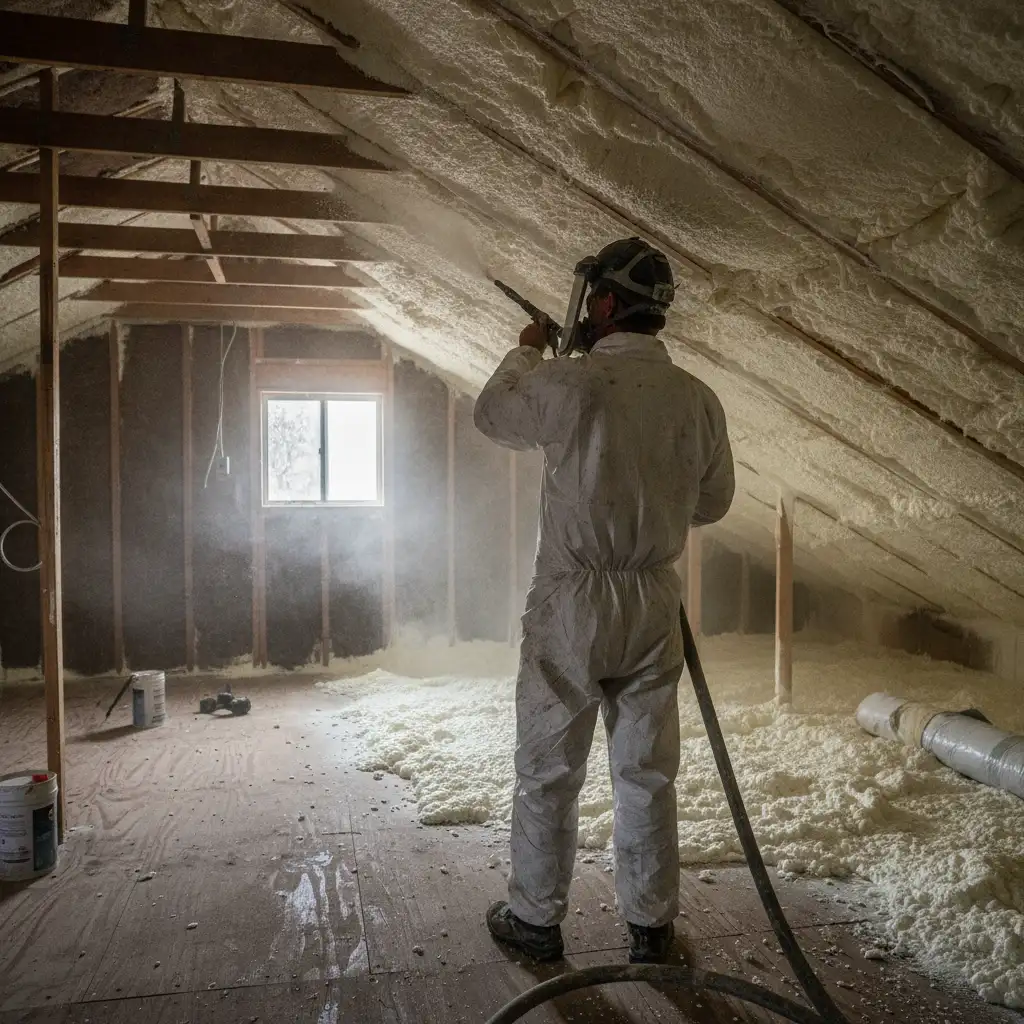
Our team in action — insulation professionals serving Santa Clarita
Why Ceiling Insulation Is Needed in Santa Clarita, CA
Extreme Heat Gain
Santa Clarita is classified under ASHRAE Climate Zone 3B and California Energy Commission Climate Zone 9. Summer high temperatures routinely reach 100–108°F, and the National Weather Service has recorded heat events in the Santa Clarita Valley exceeding 112°F during extreme heat episodes. Attic air temperatures under a dark composition shingle roof — the most common roofing material in local tract developments — can reach 150–160°F on peak summer days. Without ceiling insulation at or above the Title 24 minimum of R-38, that radiant heat load transfers directly into living spaces, increasing cooling loads by 20–30% according to Department of Energy modeling for similar climates.
Santa Ana Wind Events and Thermal Stress
The Santa Ana winds that periodically blast through the Santa Clarita Valley — sometimes exceeding 70 mph through the Newhall Pass and Soledad Canyon corridors — create rapid and dramatic temperature swings. October and November are historically the most intense months, with the October 2019 Tick Fire burning more than 4,200 acres in and around Canyon Country, exposing thousands of homes to extreme radiant heat. These wind events also dramatically accelerate heat loss from poorly insulated ceilings during cooler months when Santa Ana conditions coincide with cold air masses, creating overnight lows in the upper 20s in elevated neighborhoods like Porter Ranch’s Sinaloa Ridge area.
Older Housing Stock with Outdated R-Values
Significant portions of Newhall, Old Orchard in Canyon Country, and parts of the Saugus district contain homes built before 1978, when California’s energy codes were far less stringent. Many of these homes were originally insulated to R-11 or R-19, values that are less than half the current R-38 minimum. Annual energy cost penalties for under-insulated homes in this valley can exceed $600–$900 per year based on Southern California Edison rate schedules and local utility usage patterns.
Moisture and Pest Infiltration
El Niño years — such as 2022–23, when Santa Clarita recorded over 20 inches of rainfall — create moisture intrusion events that can soak and compress existing batt insulation, destroying its thermal performance. Roof rats, which are prevalent in the foothill communities bordering the Angeles National Forest, routinely nest in attic insulation and render it ineffective. Both conditions demand ceiling insulation inspection and replacement on a regular cycle.
Wildfire Ash and Air Quality
Following major fires like the 2016 Sand Fire — which burned over 41,000 acres across the Santa Clarita Valley — fine ash and particulate matter infiltrate attic spaces and degrade insulation materials while worsening indoor air quality. Ceiling insulation acts as a partial barrier, but compromised or missing insulation accelerates this infiltration. Explore our insulation removal and replacement services
Signs You Need Ceiling Insulation in Santa Clarita
Energy Performance Indicators
- Monthly Southern California Edison or SoCalGas bills that have increased more than 15% year-over-year without a change in usage habits
- HVAC system running continuously during summer heat events above 100°F without reaching the set thermostat temperature
- Significant room-to-room temperature variation — greater than 5°F — between upstairs and downstairs spaces
Physical Symptoms Inside the Home
- Ceilings that feel noticeably warm to the touch during afternoon hours in summer
- Drafts or cold spots along ceiling perimeters in winter, especially in older Newhall or Canyon Country ranch-style homes
- Visible water staining on ceilings following El Niño-level rain events, which may indicate compressed or damaged insulation above
Attic and Structural Warning Signs
- Visible gaps, voids, or areas where batt insulation has shifted or fallen from ceiling joists
- Presence of rodent droppings, nesting material, or chewed insulation in attic inspections
- Insulation depth below 10 inches (indicating less than R-30 blown-in) when measured with a ruler at the attic hatch
- Insulation that is gray-black in color or matted flat — both indicators of moisture damage or extreme age
Urgency Indicators
If your home lost insulation due to a roof leak, pest infestation, or proximity to recent wildfire ash events like those in Canyon Country, addressing ceiling insulation should be treated as urgent — not deferred maintenance.
Ceiling Insulation Methods and Approaches
Blown-In Fiberglass Insulation
Blown-in fiberglass is our most commonly recommended solution for existing Santa Clarita homes with accessible attic spaces. It achieves R-38 to R-60 easily, conforms around obstructions like HVAC ducts and wiring, and resists moisture absorption better than cellulose — an advantage in Stevenson Ranch and Castaic homes prone to condensation from temperature swings. Installation typically takes 2–4 hours. More about our blow-in insulation services
Blown-In Cellulose Insulation
Cellulose is an excellent choice for homeowners prioritizing recycled content and superior air resistance. It is particularly effective in older Newhall and Canyon Country homes where draft control is a priority. Cellulose achieves R-3.5 per inch and is treated with borate compounds that provide pest and fire resistance — both relevant concerns in Santa Clarita’s wildfire interface zones.
Spray Foam Insulation
Closed-cell spray foam is ideal for cathedral ceilings, flat roof assemblies, and any application where both air sealing and insulation must occur in a single layer. At R-6 to R-7 per inch, it achieves required R-values in tight spaces. Open-cell spray foam is used in interior ceiling applications where sound attenuation between floors is also a goal. Explore our spray foam insulation services
Fiberglass Batt Insulation
Batts are appropriate for new construction framing or open ceiling assemblies during renovation. They are cost-effective and readily available but require precise installation to avoid gaps and compression — both of which reduce effective R-value and are common failure modes in hastily built tract developments throughout the Santa Clarita Valley.
Mineral Wool (Rockwool) Insulation
Mineral wool offers superior fire resistance and sound attenuation, making it well-suited for homes in Santa Clarita’s wildland-urban interface and for multi-unit residential buildings where fire separation between units is required by California Building Code.
Ready for Ceiling Insulation? Get Your Free Estimate Today.
Next Level Insulation of Santa Clarita serves Santa Clarita and the surrounding area — we’ll be on-site within 24 hours.
📞 Call (661) 582-0187Ceiling Insulation Cost in Santa Clarita, CA
Understanding ceiling insulation costs helps homeowners in Santa Clarita plan and budget effectively. The following ranges reflect current material and labor pricing in the greater Santa Clarita Valley market.
Typical Price Ranges
- Blown-In Fiberglass (to R-38): $1.20–$1.80 per square foot installed. A 1,500 sq ft attic floor typically costs $1,800–$2,700.
- Blown-In Cellulose (to R-38): $1.10–$1.60 per square foot installed. The same 1,500 sq ft space runs $1,650–$2,400.
- Spray Foam (Closed-Cell, Roof Deck): $3.00–$5.50 per square foot. A 1,500 sq ft application ranges from $4,500–$8,250.
- Fiberglass Batt (New Construction): $0.80–$1.40 per square foot installed.
- Insulation Removal: $1.00–$2.00 per square foot, depending on contamination level and material type.
Key Cost Factors in Santa Clarita
- Attic Accessibility: Many Santa Clarita homes have limited attic hatch sizes or low-pitch rooflines that increase labor time and cost.
- Existing Insulation Removal: Pest-damaged or fire-ash-contaminated insulation in Canyon Country or Newhall adds $800–$2,500 to project costs before new insulation is installed.
- R-Value Target: Upgrading to R-60 adds approximately 20–30% to material costs over an R-38 project.
- Utility Rebates: Southern California Edison and SoCalGas offer rebates of $0.10–$0.25 per square foot for insulation upgrades meeting Title 24 standards, which can offset $150–$375 on a typical project.
Call (661) 582-0187 for a precise, no-obligation quote tailored to your home’s specific conditions.
Ceiling Insulation Service Areas Near Santa Clarita
Newhall
One of Santa Clarita’s oldest communities, Newhall features a mix of 1940s–1960s bungalows and post-war ranch homes along Lyons Avenue and Market Street corridors. Many of these properties have original insulation that is 50+ years old, severely depleted, and often contaminated with rodent activity. R-value upgrades from R-11 to R-38 are common projects in this neighborhood.
Canyon Country
Canyon Country’s older tracts — particularly those built before 1980 along Soledad Canyon Road — are a priority for ceiling insulation upgrades. Proximity to the 2019 Tick Fire footprint means some properties here still have ash-compromised attic insulation requiring professional removal before new material can be installed.
Stevenson Ranch
This planned community features mostly 1990s–2000s construction with original insulation at or near R-30. Many Stevenson Ranch homeowners seek upgrades to R-49 or R-60 to maximize efficiency against high SCE summer billing rates and reduce strain on aging HVAC systems.
Castaic and Valencia
Newer master-planned developments in Castaic and Valencia often have adequate original insulation but benefit from air sealing services paired with blown-in top-offs to reach current code minimums. We also serve attic insulation needs across Saugus, Northridge, Granada Hills, and Porter Ranch.
Ceiling Insulation Maintenance Tips for Santa Clarita Homeowners
- Inspect Annually After Wildfire Season: Each fall after Santa Ana wind and wildfire season, inspect your attic for ash infiltration, which can contaminate insulation and compromise indoor air quality.
- Check Insulation Depth Every 3–5 Years: Use a ruler at your attic hatch to verify blown-in insulation hasn’t settled below 10 inches (R-30). Settling is common in Santa Clarita’s seismically active environment.
- Seal New Penetrations Promptly: Any new recessed light, fan, or HVAC penetration through the ceiling should be air-sealed immediately to prevent thermal bridging and insect entry.
- Monitor for Roof Rat Activity: Set bait stations and inspect for droppings each spring. Rodent-compromised insulation should be removed and replaced, not simply supplemented.
- Maintain Attic Ventilation: Clear soffit vents of debris — especially after autumn leaf drop or post-construction — to ensure ventilation airflow that prevents moisture buildup in winter.
- Check After Major Rain Events: Following El Niño-intensity rainfall, inspect ceilings for staining and attic insulation for moisture. Wet insulation loses up to 40% of its R-value and should be assessed professionally.
- Apply for Utility Rebates When Upgrading: When you do replace or add insulation, submit rebate paperwork to SCE or SoCalGas within 90 days of project completion to capture available incentives.
Why Choose Next Level Insulation of Santa Clarita
Next Level Insulation of Santa Clarita is a locally focused insulation contractor with deep knowledge of the Santa Clarita Valley’s unique climate challenges, housing stock, and energy code requirements. We don’t apply cookie-cutter solutions — we design every ceiling insulation project around the specific conditions of your home, your neighborhood, and the local climate you live in.
Our team is trained on California Title 24 compliance, familiar with Southern California Edison and SoCalGas rebate programs, and experienced with the full range of insulation types used in residential and commercial applications across the valley — from Newhall’s aging bungalows to Stevenson Ranch’s modern tract homes.
We handle every phase of the project in-house: inspection, removal, air sealing, installation, and verification. You won’t get subcontracted crews or out-of-area technicians unfamiliar with local building conditions.
We serve homeowners and businesses across Santa Clarita, Canyon Country, Newhall, Stevenson Ranch, Castaic, Valencia, Saugus, Granada Hills, Porter Ranch, Simi Valley, San Fernando, Sylmar, Mission Hills, Northridge, Chatsworth, North Hills, Canoga Park, and surrounding communities.
Explore our crawl space insulation services | Learn about spray foam insulation
Frequently Asked Questions About Ceiling Insulation in Santa Clarita, CA
How much does ceiling insulation cost in Santa Clarita?
Costs vary based on insulation type, existing conditions, and R-value target. Blown-in fiberglass to R-38 typically runs $1,800–$2,700 for a 1,500 sq ft attic in Santa Clarita. Spray foam applications cost more — $4,500–$8,250 for the same area. Insulation removal, which is frequently required for older Canyon Country and Newhall homes with pest or moisture damage, adds $800–$2,500. Call (661) 582-0187 for a free, site-specific estimate.
What R-value do I need for ceiling insulation in Santa Clarita?
California Energy Code (Title 24) requires a minimum of R-38 for ceiling insulation in Climate Zone 9, which covers most of the Santa Clarita Valley. For maximum energy efficiency — especially given local summer temperatures that regularly exceed 100°F — we recommend R-49 to R-60 for most residential applications.
How long does ceiling insulation installation take?
Most blown-in insulation projects in Santa Clarita can be completed in a single day. If old insulation removal is required, plan for a two-day project. Spray foam applications typically require 1–2 days depending on scope and cure time requirements.
Can ceiling insulation really lower my energy bills in Santa Clarita?
Yes, significantly. Homes in the Santa Clarita Valley with under-insulated ceilings (R-11 to R-19) can see 20–35% reductions in cooling energy costs after upgrading to R-38 or R-49. Given SCE’s summer tiered rates — where usage above baseline can exceed $0.35 per kWh — the payback period on a ceiling insulation upgrade is typically 3–6 years.
Does the Tick Fire or Sand Fire ash affect existing insulation?
Yes. Homes within or downwind of the 2019 Tick Fire’s Canyon Country perimeter or the 2016 Sand Fire’s Agua Dulce and Saugus areas may have attic insulation that absorbed fine ash particles. This contamination reduces insulation performance and can degrade indoor air quality. We recommend a professional attic inspection for any affected property. Learn about our insulation removal services
Are rebates available for ceiling insulation upgrades in Santa Clarita?
Yes. Southern California Edison and SoCalGas both offer rebates for insulation upgrades that meet or exceed Title 24 standards. Rebates typically range from $0.10–$0.25 per square foot of insulation installed. We help customers identify and document eligible work for rebate submission.
Do I need to remove old insulation before adding new ceiling insulation?
Not always. If existing insulation is dry, intact, and free of pest contamination, blown-in insulation can be added on top to bring the total to the target R-value. However, if insulation is wet, pest-infested, ash-contaminated, or severely degraded — conditions common in older Santa Clarita homes — removal is required before new material is installed for proper adhesion and performance.
Do you serve areas outside of Santa Clarita proper?
Yes. We serve the broader Santa Clarita Valley and surrounding communities including Newhall, Canyon Country, Stevenson Ranch, Castaic, Valencia, Saugus, Northridge, Granada Hills, Porter Ranch, Canoga Park, Chatsworth, Mission Hills, Sylmar, North Hills, San Fernando, and Simi Valley. View our full service area
Get a Free Ceiling Insulation Estimate in Santa Clarita Today
Don’t let an under-insulated ceiling drive up your energy bills through another brutal Santa Clarita summer or drain your heat during cold valley nights. Next Level Insulation of Santa Clarita is ready to assess your home, recommend the right solution, and install it with precision craftsmanship and deep local knowledge.
Whether you’re in Newhall, Canyon Country, Stevenson Ranch, Castaic, or anywhere across the Santa Clarita Valley, we bring the expertise and equipment to bring your ceiling insulation up to — and beyond — California Title 24 standards.
Call us now at (661) 582-0187 to schedule your free, no-obligation ceiling insulation inspection and estimate. We respond promptly and offer flexible scheduling to fit your calendar.
Schedule your free estimate online