
Blown-In Insulation in El Monte, CA
Energy-Saving Blown-In Insulation for El Monte, CA Homes — Licensed & Insured
Need blown-in insulation in El Monte, CA? Next Level Insulation offers expert attic & wall insulation. Call (626) 469-7656 for a free quote today.
- Licensed & Insured
- Locally Owned & Operated
- Free Inspection & Estimate
Request Your
Free EstimateBlown-in insulation is a modern, highly efficient insulation method that involves using specialized blowing equipment to distribute loose-fill insulation material—typically cellulose, fiberglass, or mineral wool—into walls, attics, and other hard-to-reach spaces. Unlike traditional batt insulation, blown-in material conforms to irregular surfaces, fills gaps around joists and rafters, and delivers consistent thermal coverage throughout your home or commercial building.
In El Monte, CA, where summer temperatures regularly push past 95°F and older housing stock dominates the residential landscape, proper insulation is not a luxury—it is a necessity. The San Gabriel Valley’s dry heat, combined with El Monte’s significant share of mid-century homes built before modern energy codes, creates a perfect storm of energy loss that drives utility bills upward year after year.
At Next Level Insulation of El Monte, we specialize in blown-in insulation solutions tailored specifically to the climatic and structural realities of El Monte and the surrounding San Gabriel Valley. Call us today at (626) 469-7656 to schedule your free assessment.
Understanding Blown-In Insulation
Blown-in insulation, also commonly called loose-fill insulation, has been used in American residential construction since the mid-20th century. The technology evolved significantly in the 1970s following the oil crisis, when homeowners and builders across the country began prioritizing energy efficiency as fuel costs skyrocketed. By the 1980s and 1990s, blown-in methods had become the preferred retrofit solution for existing homes, largely because the material can be installed without tearing out walls or ceilings.
The process works by loading loose insulation material into a blowing machine, which then forces the material through a long, flexible hose. A trained technician directs the hose into attic spaces, wall cavities through small drilled holes, or crawl spaces, creating a dense, seamless blanket of thermal resistance. The result is an R-value—the measurement of thermal resistance—that can be precisely calibrated by controlling the depth and density of the material deposited.
Three primary materials are used in blown-in applications:
- Cellulose: Made from recycled paper products treated with fire retardant, cellulose is an eco-friendly option with excellent R-values (approximately R-3.2 to R-3.8 per inch) and strong sound-dampening properties. It is particularly popular in older El Monte homes where air sealing is a priority.
- Fiberglass: Lightweight and resistant to moisture absorption, blown fiberglass (R-2.2 to R-2.7 per inch) is ideal for well-ventilated attics and areas with potential humidity concerns, such as homes near the Rio Hondo or San Gabriel River corridors.
- Mineral Wool (Rockwool): Offering superior fire resistance and acoustic performance (R-3.0 to R-3.3 per inch), mineral wool is increasingly specified in El Monte’s commercial buildings and mixed-use properties along Valley Boulevard and Garvey Avenue.
In El Monte, blown-in insulation is particularly prevalent in single-family homes built between 1945 and 1975—a period when the city experienced dramatic residential expansion following World War II. These homes, many of which feature 2×4 wall framing and uninsulated attics, represent an enormous opportunity for energy efficiency improvements through blown-in retrofit applications.
Whether you own a post-war bungalow in the Norwood neighborhood or a newer commercial property near the El Monte Airport corridor, blown-in insulation offers a cost-effective, minimally disruptive path to superior thermal performance. Learn more about our attic insulation services
Why Blown-In Insulation Is Needed in El Monte, CA
The San Gabriel Valley Heat Trap
El Monte sits in the eastern end of the Los Angeles Basin, nestled between the San Gabriel Mountains to the north and the Puente Hills to the south. This bowl-like geography creates a localized heat trap effect that regularly amplifies temperatures compared to coastal communities. During the historic heat wave of September 2022, El Monte recorded temperatures exceeding 107°F—nearly 20°F hotter than Santa Monica on the same day. Homes without adequate attic insulation can see indoor temperatures climb 15°F to 25°F above the outdoor air temperature under these conditions, placing enormous strain on HVAC systems.
The California Building Code now requires a minimum of R-38 in attics for Climate Zone 10, which encompasses El Monte. However, surveys of pre-1980 homes in El Monte neighborhoods like Garvey, Norwood, and South El Monte consistently reveal existing insulation levels of only R-11 to R-19—less than half the current standard. Blown-in insulation is the fastest and most economical way to bring these homes up to code-compliant R-values.
Hard Water and Humidity Fluctuations
El Monte’s water supply, sourced largely from San Gabriel Valley groundwater basins, is notably hard—typically measuring between 200 and 400 parts per million (ppm) of dissolved minerals. Over time, this mineral-rich environment contributes to condensation-related moisture issues in attic and crawl space areas, particularly in the wet winter months when El Monte averages 15 to 18 inches of annual rainfall. Moisture infiltration degrades traditional batt insulation rapidly, reducing its effective R-value by up to 40%. Blown-in cellulose and mineral wool products are treated to resist moisture damage, making them a more durable long-term choice for El Monte’s specific conditions.
Aging Housing Stock
A significant portion of El Monte’s residential inventory was constructed during the post-war boom of the late 1940s through the 1960s, when energy codes were virtually nonexistent. Streets like Ramona Boulevard, Durfee Avenue, and Tyler Avenue are lined with homes that were built with little or no wall insulation and minimal attic coverage. Many of these homes also feature original single-pane windows, meaning the attic and walls represent the largest remaining opportunity for thermal improvement. Blown-in insulation can be added to existing wall cavities through small 2-inch holes drilled from the exterior or interior, preserving the original character of these historic homes while delivering modern energy performance.
Proximity to the 10 and 605 Freeway Corridors
Homes situated near the I-10 (San Bernardino Freeway) and SR-605 interchange in El Monte face elevated noise pollution in addition to thermal challenges. Blown-in cellulose and mineral wool both offer Sound Transmission Class (STC) ratings that can reduce exterior noise intrusion by 10 to 15 decibels—a meaningful improvement for families living within a quarter mile of these high-traffic corridors.
Explore our insulation removal services for homes with degraded existing insulation
Signs You Need Blown-In Insulation in El Monte
Energy Performance Indicators
- Monthly electricity bills exceeding $180 to $220 during July and August cooling season
- HVAC system running continuously for more than 45 minutes per cycle during summer days
- Noticeable temperature differences (5°F or more) between upstairs and downstairs rooms
- Thermostat struggles to maintain set temperature despite recent HVAC maintenance
Physical Warning Signs
- Attic insulation depth measuring less than 10 to 11 inches (indicating R-values below current R-38 minimums)
- Visible gaps, bare patches, or compressed batting in existing insulation
- Discolored or stained insulation suggesting water infiltration or pest activity
- Drafts felt near electrical outlets, baseboards, or recessed lighting fixtures
Comfort and Health Concerns
- Rooms that feel stuffy or excessively hot during El Monte’s summer heat events
- Increased dust accumulation on surfaces, suggesting air infiltration through unsealed cavities
- Allergy symptoms worsening indoors, possibly due to degraded fiberglass particles from aging insulation
Urgency Indicators
If your home was built before 1978 and has never had an insulation assessment, or if you notice ice damming after rare El Monte frost events, treat these as urgent situations requiring immediate professional evaluation. Learn about our insulation replacement options
Our Blown-In Insulation Process in El Monte
At Next Level Insulation of El Monte, we follow a structured, transparent installation process designed to deliver consistent results while minimizing disruption to your home or business.
Free On-Site Assessment (Day 1 — 60 to 90 Minutes)
Our technician visits your El Monte property to perform a comprehensive evaluation. We measure existing insulation depth and R-values using calibrated probes, inspect for signs of moisture, pest activity, or damaged insulation, and document our findings with photos. We also assess your attic ventilation—a critical factor in El Monte given the city’s high summer temperatures and their effect on attic air pressure dynamics.
Customized Insulation Plan and Quote (Day 1 to Day 2)
Based on the assessment, we develop a customized insulation plan specifying the appropriate material (cellulose, fiberglass, or mineral wool), target R-value, and installation method. We provide a clear, itemized written quote. For El Monte homes in Climate Zone 10, we typically target R-38 minimum in attics and R-13 to R-15 in exterior walls.
Preparation and Air Sealing (Installation Day — 1 to 2 Hours)
Before any blown-in material is applied, our team air-seals all penetrations—recessed lights, plumbing chases, electrical boxes, and attic hatches—using fire-rated foam and caulk. This step is especially important in El Monte’s older homes, where gaps in the building envelope are common and can negate insulation benefits entirely.
Material Installation (Installation Day — 2 to 4 Hours)
Our licensed technicians operate professional-grade blowing machines to distribute the chosen loose-fill material evenly throughout the target area. Depth gauges (rulers) are installed across the attic floor to ensure we achieve the specified depth—typically 13 to 15 inches of cellulose for R-38 in El Monte’s climate. For wall cavities, we drill 2-inch access holes, insert the fill tube, and pack material to the required density before patching.
Quality Verification (Same Day — 30 Minutes)
Upon completion, a senior technician verifies coverage depth at multiple points, checks for voids or missed areas, and documents final R-values achieved with thermal imaging where applicable.
Clean-Up and Walkthrough (Same Day — 30 to 60 Minutes)
We restore all work areas, patch any drilled holes, and walk you through the completed installation. We provide written documentation of materials installed and R-values achieved for your records—useful for SCE or SoCalGas rebate applications.
Follow-Up (30 Days Post-Installation)
We follow up by phone to confirm your satisfaction and answer any questions about performance or maintenance. Ask about combining blown-in with spray foam for maximum air sealing
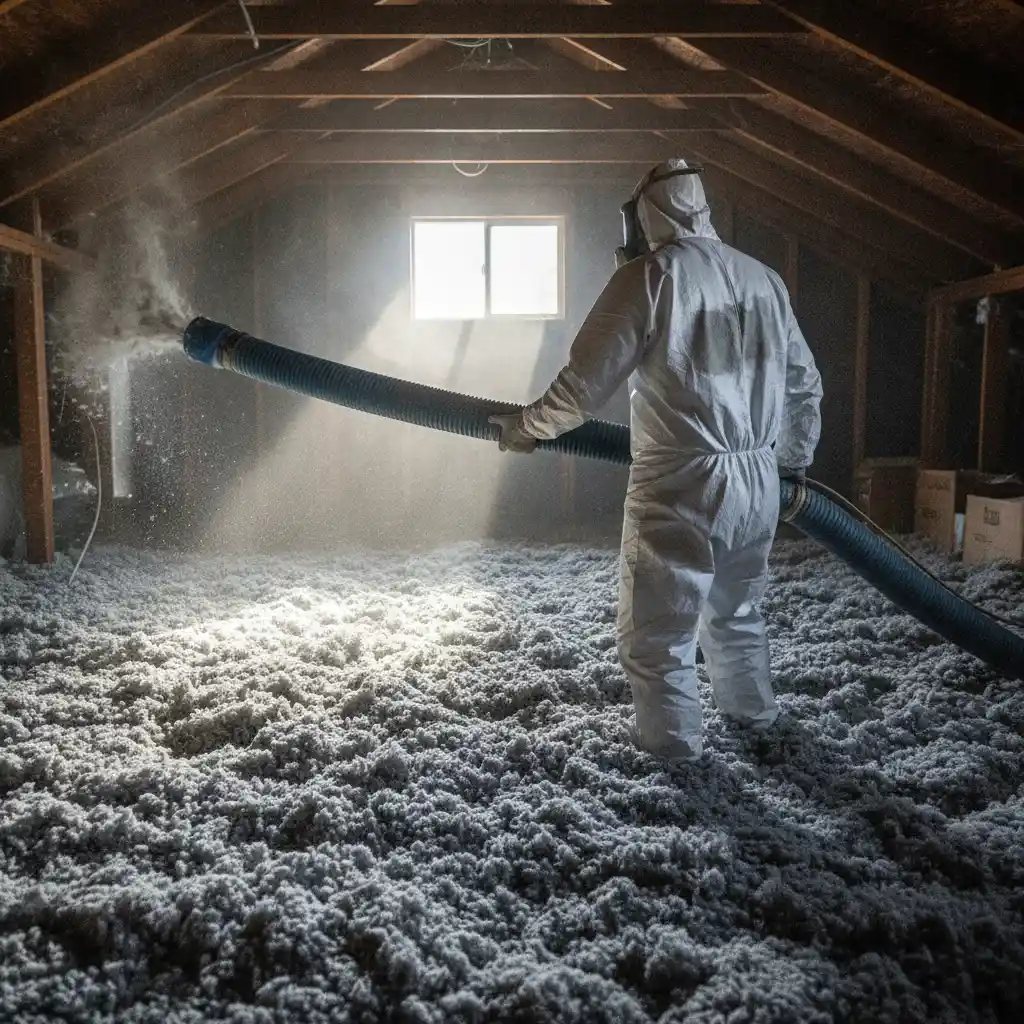
Our team in action — insulation professionals serving El Monte
Blown-In Insulation Methods and Approaches
Open-Blow Attic Application
The most common method in El Monte, open-blow involves installing loose-fill material directly onto the attic floor between and over joists. This approach is ideal for accessible attics with at least 30 inches of headroom. We use this method extensively in Norwood and Garvey neighborhood homes, where attic access is relatively straightforward. Target depth: 13 to 15 inches of cellulose or 15 to 17 inches of fiberglass to achieve R-38.
Dense-Pack Wall Cavity Application
For El Monte’s uninsulated 2×4 and 2×6 exterior walls—common in homes built between 1945 and 1975—dense-pack installation involves drilling small access holes and pumping cellulose or fiberglass at high density (3.5 to 4.0 lbs per cubic foot) to prevent settling. This method is minimally invasive and can be performed from either the exterior or interior.
Enclosed Cavity (Drill-and-Fill)
Used for cathedral ceilings, closed-cell roof assemblies, and floor cavities above unconditioned spaces such as garages, this method requires precision to avoid over-pressurizing the cavity. It is frequently applied in El Monte’s split-level and raised-foundation homes near Peck Road and Ramona Boulevard.
Hybrid Blown-In and Spray Foam
For maximum energy performance, particularly in homes near the I-10 corridor with significant air infiltration issues, we combine a spray foam air barrier (typically 1 to 2 inches of closed-cell) with blown-in insulation to achieve both air-sealing and thermal mass benefits. Explore crawl space insulation options for raised-foundation El Monte homes
Retrofit Blown-In for Commercial Properties
El Monte’s light industrial and commercial corridors along Valley Boulevard and Garvey Avenue include many low-slope or flat-roofed structures that benefit from blown-in mineral wool in plenum spaces and between structural bays.
Ready for Blown-In Insulation? Get Your Free Estimate Today.
Next Level Insulation of El Monte serves El Monte and the surrounding area — we’ll be on-site within 24 hours.
📞 Call (626) 469-7656Blown-In Insulation Cost in El Monte, CA
Understanding the cost of blown-in insulation in El Monte helps you make an informed decision and budget appropriately. Pricing varies based on the scope of work, material selected, and specific conditions of your property.
Typical Price Ranges
- Attic blown-in insulation (open-blow): $1.50 to $3.50 per square foot, or approximately $1,200 to $3,500 for a typical 1,200 to 1,500 sq ft El Monte home attic
- Wall dense-pack blown-in: $2.00 to $5.00 per square foot of wall area, or $1,800 to $4,500 for a full exterior wall treatment on an average-sized home
- Crawl space blown-in (floor application): $1.75 to $3.00 per square foot
- Combined air seal and blown-in package: $2,500 to $6,000 for most El Monte single-family homes
Factors That Affect Cost in El Monte
- Existing insulation removal: If degraded or contaminated insulation must be removed first, add $800 to $2,500 depending on volume
- Attic accessibility: Low-clearance attics common in El Monte’s 1950s-era ranch homes may require additional labor time
- Material choice: Mineral wool runs 20 to 30% more than cellulose or fiberglass
- Current material and labor costs: Los Angeles County labor rates apply, which are generally 10 to 15% higher than national averages
Rebates and Incentives
El Monte homeowners may qualify for Southern California Edison (SCE) and SoCalGas rebates of $0.10 to $0.15 per square foot for qualifying attic insulation upgrades. California’s TECH Clean California program also offers additional incentives for whole-home electrification projects that include insulation. Call us at (626) 469-7656 to discuss current available rebates.
Neighborhoods We Serve in El Monte
Norwood
One of El Monte’s most established residential neighborhoods, Norwood features a dense concentration of post-war ranch homes built primarily between 1948 and 1962. These properties typically have 1,000 to 1,400 sq ft of living space with uninsulated or minimally insulated 2×4 exterior walls and attics with only 2 to 4 inches of original blown-in material. Dense-pack wall applications and attic top-ups are the most common services we provide here.
Garvey
The Garvey neighborhood, centered along Garvey Avenue, includes a mix of single-family homes and small multi-unit buildings from the 1955 to 1975 era. Many properties here have converted garages or added room structures that lack any insulation continuity, making comprehensive blown-in treatments particularly valuable.
South El Monte
South El Monte’s residential pockets near Tyler Avenue and Durfee Avenue feature slightly newer homes (1965 to 1985) with raised foundations and crawl spaces, creating unique insulation challenges below the floor deck in addition to attic needs.
El Monte Airport Corridor
Commercial and light industrial properties near the El Monte Airport on Peck Road frequently require blown-in mineral wool for both thermal performance and the FAA-adjacent noise abatement concerns relevant to this area. Learn about crawl space encapsulation for South El Monte raised-foundation homes
Blown-In Insulation Maintenance Tips for El Monte Homeowners
- Annual attic depth check: Once per year—ideally in late September after El Monte’s peak summer heat season—use a ruler to verify blown-in depth has not settled below 11 inches. Cellulose can settle 10 to 20% over the first year after installation.
- Inspect after heavy rainfall: After significant rain events (El Monte averages 15 to 18 inches annually), check for water stains or compressed areas in attic insulation that may indicate roof leaks.
- Maintain attic ventilation: Keep soffit vents clear of debris, as blocked ventilation in El Monte’s hot summers can trap moisture and heat that degrades insulation performance.
- Seal new penetrations promptly: Any new electrical, plumbing, or HVAC work that creates attic penetrations should be air-sealed before the next heating or cooling season.
- Control pest entry points: El Monte’s semi-arid climate attracts rodents into attic spaces. Regularly inspect for entry points and signs of nesting, as pest activity can displace and contaminate blown-in material.
- Monitor HVAC performance: A sudden increase in utility bills (10% or more month-over-month) without a rate change often signals insulation degradation.
- Schedule professional re-inspection every 10 years: Call (626) 469-7656 to book periodic assessments of your blown-in insulation’s condition and R-value integrity.
Why Choose Next Level Insulation of El Monte
Next Level Insulation of El Monte is a locally focused insulation company with deep knowledge of the San Gabriel Valley’s unique climate, housing stock, and energy landscape. We are not a national franchise sending unfamiliar technicians to your door—we are El Monte specialists who understand the difference between a 1952 Norwood ranch home and a 1978 South El Monte raised foundation, and how each requires a different insulation approach.
Our technicians are trained specifically on the materials and methods most effective in Climate Zone 10, and we stay current with California Title 24 energy code requirements, SCE and SoCalGas rebate programs, and the latest blown-in technology. We use professional-grade blowing equipment calibrated to achieve precise density and R-values—not rental equipment from a hardware store.
We offer comprehensive insulation services beyond blown-in work, including spray foam insulation, attic insulation, crawl space encapsulation, and insulation removal, allowing us to address your complete building envelope in a single coordinated project.
Our commitment is simple: deliver measurable thermal performance improvements to every El Monte home and business we serve. Contact us at (626) 469-7656 to experience the difference.
Frequently Asked Questions About Blown-In Insulation in El Monte
How much does blown-in insulation cost in El Monte, CA?
Most El Monte homeowners pay between $1,200 and $4,500 for a complete attic blown-in insulation project, depending on attic square footage, current insulation condition, and material chosen. Wall dense-pack treatments run $1,800 to $4,500 additional. These figures reflect Los Angeles County labor rates and current material pricing as of 2024. We provide free, no-obligation written quotes for every El Monte property.
How long does blown-in insulation installation take in an El Monte home?
A typical El Monte attic (1,000 to 1,500 sq ft) can be completed in a single day—usually 4 to 6 hours including preparation, air sealing, and installation. Larger homes or projects that include both attic and wall treatments may require 1 to 2 days. We work efficiently to minimize disruption to your household or business operations.
What R-value do I need for my El Monte home?
El Monte falls within California Climate Zone 10, which requires a minimum of R-38 in attics under the current Title 24 energy code. For walls, R-13 in 2×4 framing and R-19 in 2×6 framing are the minimum standards. We recommend targeting R-49 in attics for homes near El Monte’s heat island zones along the freeway corridors for maximum energy savings and comfort.
Will blown-in insulation make my El Monte home noticeably cooler?
Yes—homeowners in El Monte typically report indoor temperature reductions of 8°F to 15°F on peak summer days following a complete blown-in attic installation. During the type of extreme heat events El Monte experienced in September 2022, properly insulated homes maintain comfortable temperatures significantly longer with less HVAC runtime, translating directly to lower electricity bills.
Is blown-in insulation safe for older El Monte homes?
Modern blown-in cellulose and fiberglass products used by Next Level Insulation of El Monte meet all California fire safety standards and are free of the asbestos materials sometimes found in pre-1980 insulation. If your El Monte home was built before 1978, we recommend having existing insulation tested for asbestos before any removal or disturbance work. We can arrange testing as part of our pre-installation assessment.
Can blown-in insulation help with noise from the I-10 Freeway?
Yes. Blown-in cellulose has an STC (Sound Transmission Class) rating that can reduce freeway and traffic noise by 10 to 15 decibels when installed in attic and wall cavities. For El Monte homes within a quarter mile of the I-10 or SR-605 interchange, we often recommend mineral wool for its even higher acoustic performance (STC ratings up to 45 to 52 in wall assemblies).
Are there rebates available for blown-in insulation in El Monte?
El Monte is served by Southern California Edison (SCE) and SoCalGas, both of which offer rebate programs for qualifying insulation upgrades. SCE’s Energy Upgrade California program and SoCalGas rebates can reduce your project cost by $100 to $500 depending on scope. California’s TECH Clean California initiative may offer additional funding. We assist all our El Monte customers in identifying and applying for available incentives.
How long does blown-in insulation last in El Monte’s climate?
Properly installed blown-in cellulose and fiberglass insulation has an expected service life of 20 to 30 years under normal conditions. El Monte’s periodic pest pressure and winter moisture cycles can shorten this lifespan if not managed with annual maintenance checks. Mineral wool products generally last 30 to 50 years and are more resistant to moisture and pest disturbance in El Monte’s semi-arid environment.
Get Your Free Blown-In Insulation Quote in El Monte Today
Don’t let El Monte’s extreme summer heat and aging housing stock drive your energy bills higher every year. Next Level Insulation of El Monte is ready to assess your home or commercial property, recommend the right blown-in insulation solution for your specific situation, and deliver professional installation that delivers real, measurable comfort and savings.
Whether you live in Norwood, Garvey, South El Monte, or anywhere in the San Gabriel Valley, we are your local blown-in insulation experts. We serve both residential and commercial properties throughout El Monte and the surrounding communities.
Call us now at (626) 469-7656 to schedule your free on-site assessment. Our team is ready to answer your questions about blown-in insulation cost, timeline, materials, and available rebate programs—with no pressure and no obligation.
Contact Next Level Insulation of El Monte online or call (626) 469-7656 today. Your more comfortable, energy-efficient El Monte home starts with one call.