
Attic Insulation in El Monte, CA
Energy-Saving Attic Insulation for El Monte, CA Homes — Licensed & Insured
Need attic insulation in El Monte, CA? Next Level Insulation offers expert installation, removal & replacement. Call (626) 469-7656 for a free assessment today.
- Licensed & Insured
- Locally Owned & Operated
- Free Inspection & Estimate
Request Your
Free EstimateAttic insulation is a thermal and air-sealing system installed in your home’s uppermost unconditioned space to regulate indoor temperatures, reduce energy loss, and improve overall comfort. In El Monte, CA, where summer temperatures routinely climb above 95°F in the San Gabriel Valley and winter nights can drop into the low 40s, a properly insulated attic is not a luxury — it is essential infrastructure for every home and business.
At Next Level Insulation of El Monte, we specialize in comprehensive attic insulation services tailored specifically to the climate demands and building stock of El Monte and the greater San Gabriel Valley. Whether you own a mid-century ranch home near Garvey Avenue or a newer construction off Valley Boulevard, our team brings the local knowledge, technical expertise, and hands-on experience needed to deliver lasting results. Call us today at (626) 469-7656 to schedule your free attic assessment.
Understanding Attic Insulation
Attic insulation is measured in R-value — a rating that quantifies a material’s resistance to heat flow. The higher the R-value, the greater the insulating power. For homes in Climate Zone 9, which encompasses El Monte and the broader Los Angeles basin, the U.S. Department of Energy recommends attic insulation between R-38 and R-60 for existing homes and R-49 to R-60 for new construction. Many older El Monte homes, particularly those built before 1980, were insulated to standards as low as R-11 or R-19, leaving them dramatically under-protected by today’s benchmarks.
Attic insulation has evolved significantly since the post-World War II housing boom that defined much of El Monte’s residential character. Early homes used rock wool batts or thin fiberglass batting that degraded over decades. By the 1970s and 1980s, blown-in fiberglass and cellulose became common. Today, modern solutions include open-cell and closed-cell spray foam, dense-pack cellulose, and advanced radiant barrier systems — all of which offer dramatically superior performance for California’s unique climatic conditions.
El Monte’s housing stock reflects the city’s history as one of the San Gabriel Valley’s earliest incorporated municipalities. The city contains a dense concentration of single-family homes built between 1945 and 1975, many of which feature low-slope roofs, wood-frame construction, and minimal original insulation. These structural characteristics make attic insulation upgrades both urgently needed and highly impactful. Multi-family apartment buildings, commercial strip structures along Peck Road and Valley Boulevard, and newer townhome developments each present their own unique attic insulation challenges and opportunities.
Beyond comfort, attic insulation plays a direct role in fire resilience, moisture management, and indoor air quality. In a city like El Monte — situated in a basin prone to temperature inversions that trap pollutants — a well-sealed attic prevents outdoor particulates, allergens, and polluted air from infiltrating living spaces through the ceiling plane.
Why Attic Insulation Is Needed in El Monte, CA
Extreme Heat Loading in the San Gabriel Valley
El Monte sits in an inland valley bowl that amplifies heat compared to coastal Los Angeles communities. During the record-setting heat wave of September 2022, temperatures in the San Gabriel Valley exceeded 109°F, with El Monte recording temperatures well above the regional average. On a 100°F afternoon, attic temperatures without adequate insulation can reach 150°F to 160°F, turning your living spaces below into radiating ovens. Even a modest R-30 attic upgrade can reduce attic peak temperatures by 20 to 30 degrees and cut cooling loads by 15 to 25 percent.
Urban Heat Island Effect
El Monte’s dense urban fabric — characterized by high concentrations of concrete, asphalt, and low-canopy streets along Garvey Avenue, Tyler Avenue, and Valley Boulevard — contributes significantly to the urban heat island effect. This phenomenon elevates ambient temperatures in El Monte by an estimated 2°F to 5°F above surrounding rural areas, placing additional demand on residential cooling systems and making high-performance attic insulation even more valuable for energy savings and comfort.
Santa Ana Wind Events and Temperature Swings
El Monte experiences the full force of Santa Ana wind events, particularly in late fall and early winter months. These hot, dry winds from the northeast push temperatures above 90°F even in November and December, followed by rapid cool-downs. The resulting thermal cycling stresses building materials and accelerates the degradation of older insulation materials, compressing and settling fiberglass batts and reducing their effective R-value over time.
Aging Housing Stock with Outdated Insulation
A large percentage of El Monte’s residential properties were constructed between 1948 and 1965, during the post-war suburban expansion fueled by the city’s proximity to the Whittier Narrows Recreation Area and early industrial employment. These homes were built under building codes that required little to no attic insulation. Decades of thermal cycling, moisture intrusion, pest activity, and simple aging have further compromised what insulation does exist, leaving many El Monte homeowners with effective R-values well below R-10.
Air Quality and Wildfire Smoke Infiltration
El Monte’s location in the San Gabriel Valley places it in one of Southern California’s most persistent air quality non-attainment zones. The South Coast Air Quality Management District consistently records elevated PM2.5 and ozone levels in the El Monte area. Additionally, wildfire smoke from regional fires — such as the Bobcat Fire of 2020 that burned in the nearby San Gabriel Mountains — infiltrates poorly sealed attics and enters living spaces. A properly air-sealed and insulated attic acts as a critical barrier against smoke and particulate infiltration.
Gas and Electricity Cost Pressures
Southern California Gas and Southern California Edison customers in El Monte have faced rate increases averaging 8 to 12 percent annually since 2021. For a typical 1,400-square-foot El Monte ranch home running central air conditioning, inadequate attic insulation can account for 30 to 40 percent of total monthly cooling costs during peak summer months. Upgrading from R-11 to R-49 can save an estimated $400 to $800 annually on energy bills in the El Monte climate.
Signs You Need Attic Insulation in El Monte
Energy and Comfort Indicators
- Monthly summer electricity bills exceeding $200 to $300 for a standard-sized El Monte home
- Rooms on the top floor or directly below the attic that are consistently 5°F or more hotter than the rest of the house
- HVAC system running continuously during San Gabriel Valley heat waves without achieving set temperatures
- Noticeable drafts near ceiling light fixtures, attic hatches, or recessed can lights
Visual and Physical Signs
- Visible daylight through attic vents or gaps around the roofline
- Existing insulation compressed flat, discolored, or showing signs of pest activity (tunneling, nesting debris)
- Insulation depth measuring less than 10 to 12 inches across the attic floor
- Water stains on attic sheathing or ceiling drywall indicating moisture intrusion and insulation damage
Urgency Indicators
- Home was built before 1980 and insulation has never been replaced or assessed
- Recent rodent or pest infestation — pests destroy and contaminate insulation rapidly
- Wildfire smoke odor or outdoor air smell detected inside the home through the ceiling plane
Our Attic Insulation Process in El Monte
Free On-Site Attic Assessment (1–2 Hours)
Our certified technician visits your El Monte property, physically inspects the attic space, measures existing insulation depth and R-value, documents air gaps, bypasses, and ventilation conditions, and photographs areas of concern. We check for moisture, pest damage, and HVAC duct conditions. This assessment is always free and comes with no obligation.
Customized Project Proposal (24–48 Hours)
Based on your attic’s specific conditions, your home’s square footage, and El Monte’s Climate Zone 9 requirements, we prepare a detailed written proposal. This includes material specifications, projected R-value improvements, estimated energy savings, and a transparent itemized cost breakdown. We also identify any California Energy Commission Title 24 compliance considerations relevant to your project.
Attic Preparation and Air Sealing (2–4 Hours)
Before any insulation is installed, our team seals all air bypasses — including top plates, plumbing penetrations, recessed light fixtures, and attic hatch frames. In El Monte’s older homes, this step is particularly critical, as post-war wood-frame construction often features significant air leakage pathways. We use fire-rated caulk, foam sealant, and rigid blocking as appropriate for each penetration type.
Old Insulation Removal (If Required) (3–6 Hours)
When existing insulation is contaminated, rodent-infested, or moisture-damaged, we perform complete removal using high-powered vacuum equipment vented directly to exterior collection bags. All removed material is bagged, sealed, and disposed of per Los Angeles County waste management regulations.
Insulation Installation (3–8 Hours Depending on Method)
We install your selected insulation material — blown-in cellulose, blown-in fiberglass, spray foam, or a hybrid combination — to achieve your target R-value. For most El Monte homes, we target a minimum of R-49, with R-60 recommended for homes in sun-exposed areas with low-slope roofs common along eastern El Monte neighborhoods.
Final Inspection and Documentation (1 Hour)
We conduct a post-installation depth check at a minimum of one measurement point per 100 square feet, photograph completed work, and provide you with a written completion report documenting achieved R-values, materials used, and warranty information for your records and any future home sale disclosures.
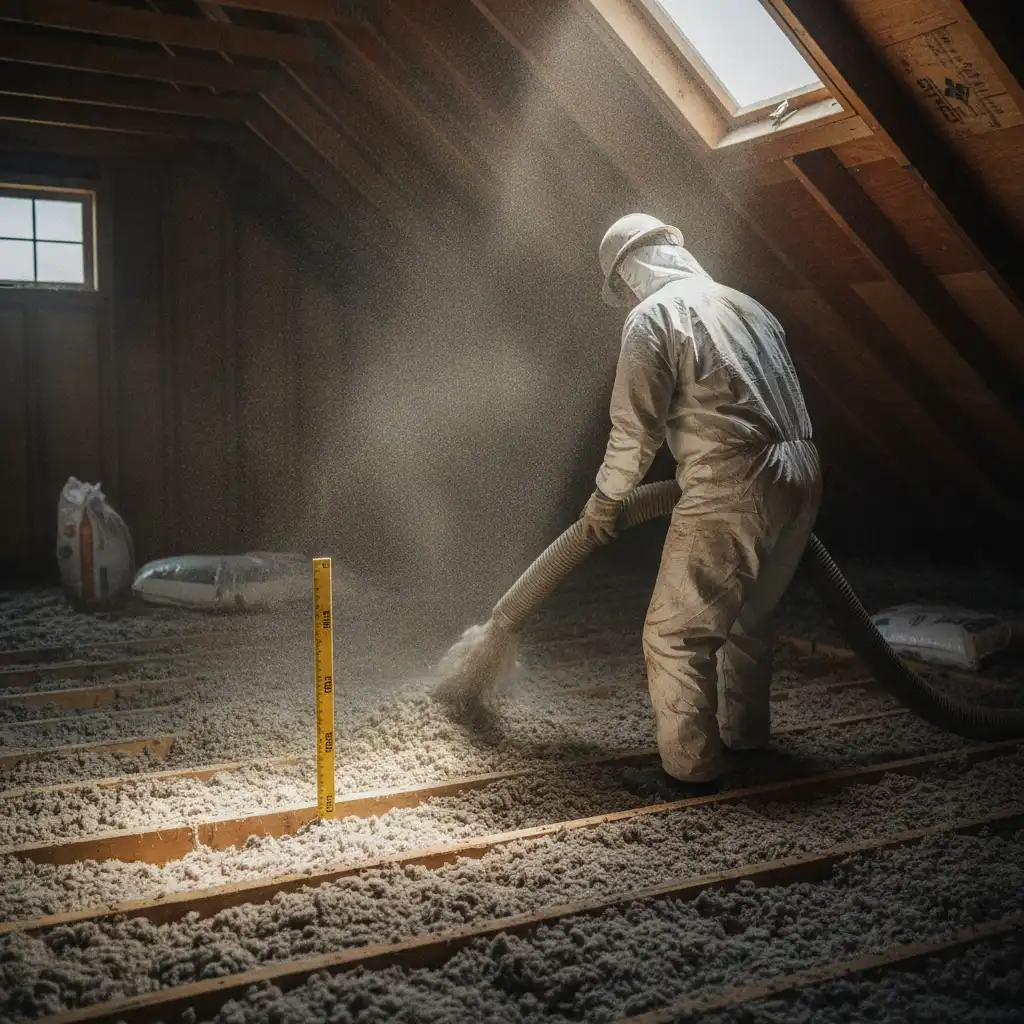
Our team in action — insulation professionals serving El Monte
Attic Insulation Methods and Approaches
Blown-In Fiberglass Insulation
Blown-in fiberglass is the most commonly installed attic insulation in El Monte homes. Lightweight glass fiber particles are machine-blown across the attic floor to uniform depth, achieving R-values from R-30 to R-60 depending on installed depth. This method is ideal for El Monte’s typical ranch-style and single-story homes with standard truss attic configurations. It is non-combustible, resistant to moisture absorption, and does not settle as significantly as cellulose over time.
Learn more about our blow-in insulation services
Blown-In Cellulose Insulation
Cellulose insulation, made from recycled paper fiber treated with fire retardants, offers excellent coverage in irregular attic spaces with obstructions and is a sustainable choice popular with environmentally conscious El Monte homeowners. It has a slightly higher R-value per inch than fiberglass and excels at reducing air infiltration. It is particularly effective in El Monte’s older craftsman and Spanish colonial revival homes with complex framing configurations.
Spray Foam Insulation
Closed-cell and open-cell spray polyurethane foam are used when the attic is a conditioned space, when the roof deck rather than the attic floor is the insulation plane, or when extreme air sealing performance is required. In El Monte homes with HVAC equipment installed in the attic — a common configuration in homes built in the 1970s — spray foam applied to the underside of the roof deck creates a sealed attic that dramatically improves HVAC efficiency.
Learn more about our spray foam insulation services
Radiant Barrier Systems
Given El Monte’s intense solar radiation and high summer attic temperatures, radiant barrier foil systems installed on rafter surfaces can reduce attic radiant heat gain by up to 25 percent. Radiant barriers work best in combination with adequate mass insulation and are particularly effective on south- and west-facing roof surfaces common in El Monte’s street-grid orientation.
Ready for Attic Insulation? Get Your Free Estimate Today.
Next Level Insulation of El Monte serves El Monte and the surrounding area — we’ll be on-site within 24 hours.
📞 Call (626) 469-7656Attic Insulation Cost in El Monte, CA
Understanding the cost of attic insulation in El Monte helps homeowners budget accurately and evaluate proposals with confidence. Pricing varies based on attic size, existing conditions, chosen materials, and the complexity of the installation.
Typical Price Ranges
- Blown-in fiberglass or cellulose (add-on over existing insulation): $1.00 to $2.00 per square foot. A typical 1,200-square-foot El Monte attic costs approximately $1,200 to $2,400 installed to R-49.
- Full attic insulation removal and replacement: $2.50 to $4.50 per square foot, or $3,000 to $5,400 for a standard El Monte home.
- Spray foam insulation (closed-cell): $3.00 to $7.00 per square foot depending on application thickness and roof deck configuration.
- Radiant barrier installation: $0.75 to $1.50 per square foot as a standalone service, or discounted when bundled with insulation installation.
Factors That Affect El Monte Attic Insulation Costs
- Attic access difficulty — low-clearance attics common in 1950s El Monte ranch homes require additional labor
- Extent of required air sealing prior to insulation installation
- Presence of pest contamination requiring biohazard-level removal protocols
- HVAC duct work in the attic requiring insulation coordination
Available Incentives
Southern California Edison’s Energy Savings Assistance Program and the federal Inflation Reduction Act’s 25C tax credit (up to $1,200 per year for insulation improvements) can significantly offset El Monte attic insulation costs. Ask our team about current rebate eligibility during your free assessment.
Explore all our insulation installation services
El Monte Neighborhoods We Serve
North El Monte
The North El Monte area, situated north of the 10 Freeway near Peck Road and Cogswell Road, contains a dense concentration of post-war single-family homes built between 1948 and 1965. These properties frequently feature original fiberglass batt insulation at R-11 or less and are particularly vulnerable to heat gain from the urban heat island effect amplified by proximity to industrial corridors. Full removal and replacement is commonly recommended for homes in this area.
South El Monte Adjacent (Mountain View Corridor)
Homes along the Mountain View School District boundary in southern El Monte tend to be slightly newer, built between 1965 and 1985, with better original insulation but significant settling over four to five decades. Blown-in top-up installations over existing batts are frequently the most cost-effective solution here.
Central El Monte — Garvey Avenue Corridor
The mixed residential and commercial corridor along Garvey Avenue includes a mix of single-family homes, duplexes, and small apartment buildings. Multi-family attic insulation projects in this area often involve shared attic spaces requiring careful air separation and zoning between units.
Historic Downtown El Monte Area
Properties near the historic Lexington-Gallatin Road area include some of El Monte’s oldest residential structures, with attics that may contain original mid-century materials including deteriorated vermiculite or early rock wool — materials requiring professional assessment and careful removal protocols.
Attic Insulation Maintenance Tips for El Monte Homeowners
- Inspect annually before summer: Check insulation depth and condition each spring before El Monte’s heat season begins. Look for compression, moisture staining, or pest activity.
- Check attic ventilation monthly: Ensure soffit vents and ridge vents remain clear of debris, bird nests, and accumulated dust — critical in El Monte’s dusty Santa Ana wind season.
- Seal attic hatch edges: The attic access hatch is one of the most common air leakage points. Ensure weatherstripping remains intact and the hatch panel itself is insulated to match attic R-value.
- Monitor for rodent activity: The San Gabriel Valley’s mild winters make rodent pressure a year-round concern in El Monte. Signs of nesting or tunneling in insulation require prompt professional attention.
- Inspect after Santa Ana events: High winds can dislodge blown-in insulation near attic vents. A quick post-event visual check prevents cumulative performance losses.
- Maintain HVAC duct integrity: Leaky ducts in the attic not only waste energy but introduce moisture that degrades surrounding insulation. Schedule annual duct inspections alongside insulation checks.
- Clear gutters to prevent moisture backup: In El Monte’s periodic heavy winter rains, clogged gutters can drive moisture under roof edges and into attic insulation zones.
Why Choose Next Level Insulation of El Monte
Next Level Insulation of El Monte is a locally based insulation contractor with deep roots in the El Monte and San Gabriel Valley community. Unlike large regional contractors who dispatch crews unfamiliar with local conditions, our team understands the specific building types, climate demands, and pest pressures that define El Monte’s insulation challenges.
We offer a comprehensive range of insulation services — including spray foam insulation, attic insulation, blow-in insulation, insulation removal, insulation replacement, crawl space insulation, and crawl space encapsulation — allowing us to address every aspect of your home’s thermal envelope in a single coordinated project.
Every project begins with a free, no-pressure assessment. We provide transparent, itemized pricing, clear timelines, and dedicated communication from start to finish. Our technicians are trained in California Title 24 energy compliance standards and stay current on Southern California Edison and SoCalGas rebate programs that can reduce your out-of-pocket costs significantly. Call us at (626) 469-7656 to experience the Next Level difference.
Frequently Asked Questions About Attic Insulation in El Monte, CA
How much does attic insulation cost in El Monte, CA?
Attic insulation costs in El Monte typically range from $1.00 to $2.00 per square foot for blown-in insulation top-ups and $2.50 to $4.50 per square foot for full removal and replacement projects. A complete attic insulation upgrade for a typical 1,200-square-foot El Monte home runs between $1,200 and $5,400 depending on existing conditions, chosen materials, and project scope. Spray foam applications cost more, ranging from $3.00 to $7.00 per square foot. Contact us at (626) 469-7656 for a free, accurate on-site estimate.
How long does attic insulation installation take in El Monte?
For most El Monte single-family homes, a blown-in attic insulation installation including air sealing preparation takes one full day — typically 6 to 10 hours. If old insulation removal is required, the project may extend to two days. Spray foam applications in complex attic configurations can take 2 to 3 days. We provide a specific timeline estimate as part of every project proposal.
What R-value do I need for my El Monte attic?
El Monte falls within California’s Climate Zone 9. The U.S. Department of Energy and California Energy Commission recommend R-38 to R-60 for attic insulation in this zone. We target a minimum of R-49 for most El Monte homes and recommend R-60 for homes with significant sun exposure, low-slope roofs, or HVAC equipment located in the attic space.
Do I need to remove my old insulation before installing new insulation?
Not always. If your existing insulation is dry, pest-free, and in generally good condition, blown-in insulation can be added on top to increase total R-value. However, if your El Monte home’s attic shows signs of rodent contamination, moisture damage, mold, or hazardous materials, complete removal is necessary before new installation. Our free assessment will clearly identify which approach is appropriate for your specific situation.
Are there rebates available for attic insulation in El Monte?
Yes. El Monte homeowners may qualify for rebates through Southern California Edison’s Energy Savings Assistance Program and the Residential Energy Efficient Property Credit under the Inflation Reduction Act (25C tax credit), which provides up to $1,200 annually for qualified insulation improvements. Income-qualified El Monte residents may also be eligible for no-cost weatherization programs through Los Angeles County. Ask our team about current programs when you schedule your assessment.
How do I know if my attic insulation in El Monte has been damaged by pests?
Common signs of pest damage include visible tunneling or nesting channels through blown-in insulation, fecal matter or urine staining on insulation surfaces, a persistent musty odor from the ceiling or attic access area, or the sound of activity in the attic at night. El Monte’s mild climate makes rodent pressure a year-round concern. A professional attic inspection will clearly identify the extent of any contamination and recommend appropriate remediation.
Does attic insulation really make a noticeable difference in El Monte summers?
Absolutely. In El Monte’s climate, where summer attic temperatures can exceed 150°F without adequate insulation, upgrading from R-11 to R-49 can reduce the heat load transferred into your living space by more than 50 percent. Most El Monte homeowners report noticeably more consistent indoor temperatures, reduced HVAC cycling, and measurable drops in monthly electricity bills — often $50 to $100 or more per summer month — following a complete attic insulation upgrade.
Can attic insulation help with wildfire smoke infiltration in El Monte?
Yes. A properly air-sealed and insulated attic significantly reduces the pathways through which wildfire smoke, outdoor particulates, and allergens can enter your home through the ceiling plane. This is particularly relevant for El Monte homeowners given the city’s location downwind of the San Gabriel Mountains and the regular occurrence of regional wildfires such as the 2020 Bobcat Fire. While attic insulation is not a complete air filtration solution, it is a meaningful component of a home’s defense against outdoor air quality events.
Get Your Free Attic Insulation Assessment in El Monte Today
Don’t let an under-insulated attic drive up your energy bills through another San Gabriel Valley summer. Next Level Insulation of El Monte is ready to assess your home, explain your options clearly, and deliver a professionally installed attic insulation solution that performs for decades.
Call us now at (626) 469-7656 to schedule your free, no-obligation attic assessment. Our team serves El Monte and the surrounding San Gabriel Valley communities with prompt scheduling and transparent, honest pricing. Take the first step toward a cooler, more efficient, and more comfortable home — contact Next Level Insulation of El Monte today.
Schedule Your Free Attic Assessment Now