

Insulation Materials & Types in Burbank, CA
Energy-Saving Insulation Materials & Types in Burbank for Burbank, CA Homes — Licensed & Insured
Explore all insulation materials for Burbank, CA homes — R-values, costs, pros & cons. Expert guide from Next Level Insulation of Burbank. Call (818) 514-7541.
- Licensed & Insured
- Locally Owned & Operated
- Free Inspection & Estimate
Request Your
Free EstimateChoosing the right insulation material for your Burbank home is one of the most consequential decisions you can make for long-term comfort and energy efficiency. Burbank sits in California Climate Zone 9, characterized by hot, dry summers where attic temperatures routinely exceed 140°F, mild winters, and periodic Santa Ana wind events that can elevate wildfire risk across the region. While Burbank lacks the extreme coastal humidity of beach communities, seasonal temperature swings between day and night can still stress building materials and create condensation risks if insulation is improperly installed.
R-value measures an insulation material’s resistance to heat flow — the higher the number, the greater the thermal resistance. In Burbank’s intense summer heat, selecting a material with the appropriate R-value isn’t just about comfort; it directly determines how hard your HVAC system works and what you pay each month in energy costs.
This guide covers every major insulation material type available to Burbank homeowners — including spray foam, blown-in, fiberglass batts, mineral wool, cellulose, and rigid foam board — helping you understand which performs best for your specific application, budget, and home type.
Understanding Insulation Types for Burbank Homes
Burbank homeowners have access to a wide range of insulation materials, each engineered with different thermal, moisture, and fire-resistance properties. Understanding the broad categories — loose-fill, batt, spray-applied, and rigid board — is the first step toward making an informed decision.
Burbank falls under California’s Title 24 Building Energy Efficiency Standards, which set minimum R-value requirements for new construction and major renovations. For Climate Zone 9, Title 24 typically mandates R-38 or higher in attics and R-13 or better in exterior walls, though exceeding minimums often pays off in long-term savings given the region’s cooling demands.
The age and construction type of your home also matters significantly. Burbank’s housing stock includes a large number of homes built between the 1940s and 1980s — many with 2×4 wall framing that limits cavity depth, older attic systems with inadequate or degraded insulation, and crawl spaces that benefit from moisture-resistant materials. Newer construction from the 1990s onward may already meet modern standards but can still benefit from upgrades.
Additionally, Burbank’s wildfire risk designation in portions of the city means fire-resistant insulation materials like mineral wool deserve serious consideration, particularly in attic and wall assemblies. Understanding all these local factors together is essential before selecting any single material.
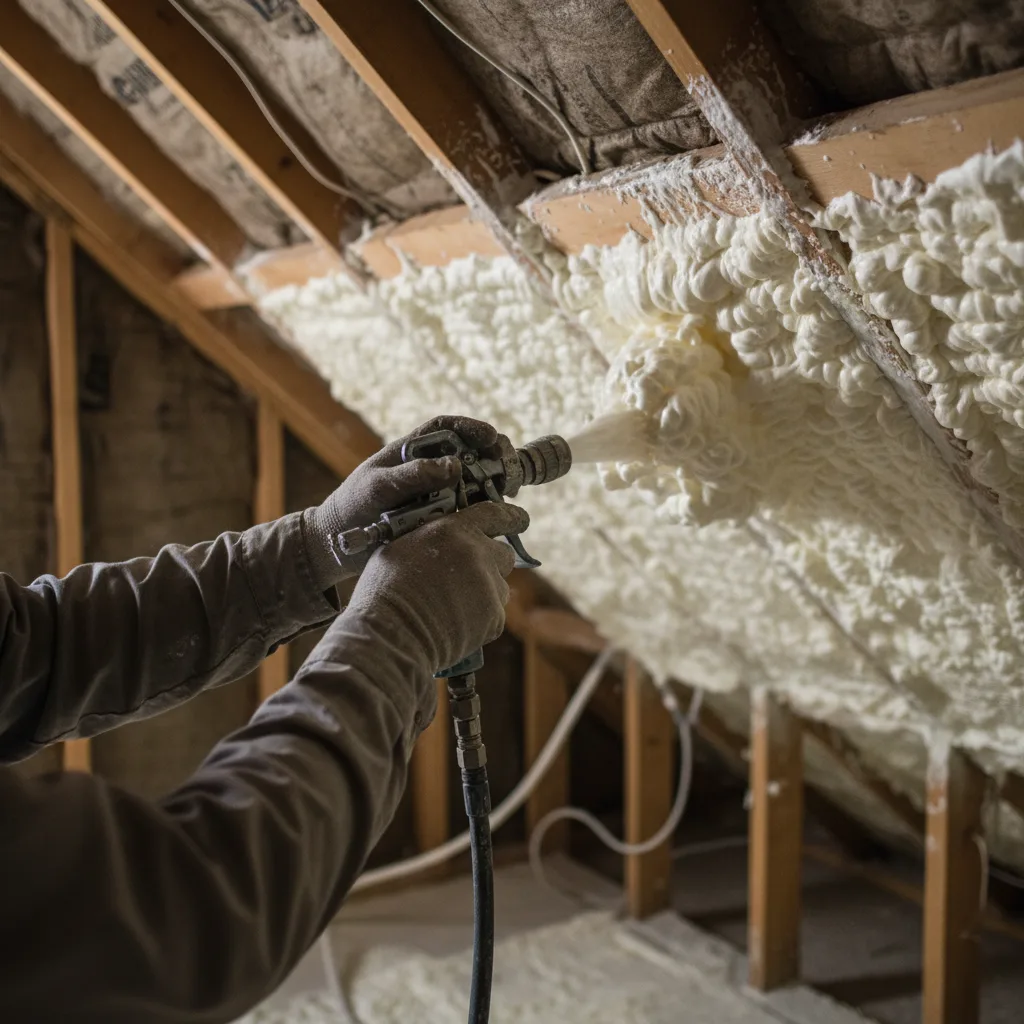
Our team in action — insulation professionals serving Burbank
How Burbank’s Climate Affects Your Insulation Material Choice
Burbank’s climate presents a very specific set of challenges that should drive every insulation material decision. Summer daytime temperatures regularly reach 95–105°F, and attic spaces in uninsulated or under-insulated Burbank homes can hit 140–150°F, forcing air conditioners to work overtime. This makes achieving adequate attic R-values — at minimum R-38, ideally R-49 to R-60 — the single highest-impact upgrade most Burbank homeowners can make.
For attic applications, blown-in cellulose or fiberglass offers the fastest payback in existing homes, while spray foam on the roof deck creates a conditioned attic space that protects HVAC equipment from extreme heat. In new construction or major renovations, combining fiberglass or mineral wool batts with continuous rigid foam board on the exterior can push wall assemblies well beyond Title 24 minimums.
Burbank’s wildfire risk is a growing consideration. Homeowners in or near the hills should prioritize non-combustible mineral wool or closed-cell spray foam over paper-faced fiberglass batts wherever possible. For crawl spaces, closed-cell spray foam or XPS rigid panels are preferred due to ground moisture and pest resistance.
For older Burbank homes built before 1980, dense-pack cellulose or injection foam into existing wall cavities without demolition is often the most practical retrofit option. Homes with HVAC ducts in the attic benefit enormously from air-sealing spray foam applied around penetrations before adding blown-in insulation on top. Matching material to application — not simply choosing the cheapest option — is always the right approach in this climate.
Insulation Materials Available in Burbank, CA
Spray Foam Insulation
Spray polyurethane foam (SPF) is applied as a liquid that expands and hardens, filling gaps and creating an air seal simultaneously. It comes in open-cell (lower density, ~R-3.7 per inch) and closed-cell (higher density, ~R-6 to R-7 per inch) formulas.
Burbank pros: Exceptional air sealing dramatically reduces cooling loads during hot summers; closed-cell resists moisture intrusion; both types add structural rigidity. Cons: Highest upfront cost of any insulation type; professional installation required; open-cell not ideal for crawl spaces with moisture risk. Best applications: Attic roof decks, rim joists, existing wall cavities (injection foam), crawl spaces. Approximate installed cost: Open-cell $1.00–$1.50/sq ft; closed-cell $2.00–$3.50/sq ft.
Blown-In (Loose-Fill) Insulation
Loose-fill insulation — typically fiberglass or cellulose — is machine-blown into place, making it ideal for adding insulation over existing material in attics or filling irregularly shaped cavities.
Burbank pros: Excellent for topping off under-insulated attics quickly and affordably; conforms to existing obstructions; can achieve R-38 to R-60 in attic applications with sufficient depth. Cons: Settles over time, slightly reducing R-value; not suitable for open cathedral ceilings without netting; fiberglass variety offers minimal air sealing. Best applications: Open attic floors, enclosed wall cavities (dense-pack method). Approximate installed cost: $0.50–$1.20/sq ft depending on material and depth.
Fiberglass Batt Insulation
Fiberglass batts are pre-cut panels of spun glass fibers fitted between wall studs, floor joists, and attic rafters. R-values range from R-11 (3.5-inch batt) to R-38 (10-inch batt).
Burbank pros: Most cost-effective material for new construction wall cavities; widely available; non-combustible. Cons: Performance degrades significantly if batts are improperly fitted, compressed, or gaps exist around outlets and pipes — common in older Burbank homes. Offers minimal air sealing on its own. Best applications: New construction wall framing, attic floors between joists, floor assemblies over crawl spaces. Approximate installed cost: $0.30–$0.80/sq ft installed.
Mineral Wool / Rockwool Insulation
Mineral wool (sold under brands like Rockwool) is manufactured from volcanic rock or industrial slag, offering R-3.7 to R-4.2 per inch in batt form and excellent fire resistance with a melting point above 2,000°F.
Burbank pros: Superior fire resistance makes it an outstanding choice in Burbank’s wildfire-adjacent neighborhoods; naturally water-repellent; excellent soundproofing; does not harbor mold or mildew. Cons: Higher cost than standard fiberglass batts; heavier and slightly more labor-intensive to cut and install. Best applications: Exterior walls, attic assemblies in high fire hazard severity zones, party walls for sound control. Approximate installed cost: $0.80–$1.40/sq ft installed.
Cellulose Insulation
Made from 80–85% recycled paper treated with borate fire retardants, cellulose is an eco-friendly loose-fill option with an R-value of approximately R-3.2 to R-3.8 per inch.
Burbank pros: High recycled content appeals to sustainability-minded homeowners; dense-pack method provides excellent air resistance in walls; borate treatment deters pests — relevant in Burbank’s dry climate. Cons: Can absorb moisture if exposed to leaks; heavier than fiberglass loose-fill, which can stress older ceiling drywall; settles 15–20% over time. Best applications: Attic floors, dense-pack retrofit wall insulation, sound dampening between floors. Approximate installed cost: $0.50–$1.10/sq ft installed.
Foam Board (Rigid) Insulation
Rigid foam panels — available as EPS (expanded polystyrene, R-3.6–4/in), XPS (extruded polystyrene, R-5/in), and polyisocyanurate (R-6–6.5/in) — provide a continuous thermal break when applied to exterior walls or under roofing.
Burbank pros: Eliminates thermal bridging through studs, which is particularly valuable in older Burbank homes with minimal wall insulation; highly moisture-resistant (XPS and polyiso); thin profile adds significant R-value. Cons: Must be covered with a thermal barrier (drywall) for fire code compliance; requires precise cutting and sealing at edges. Best applications: Exterior wall continuous insulation, basement/crawl space walls, under radiant barriers in attics. Approximate installed cost: $0.70–$2.00/sq ft depending on type and thickness.
Ready for Insulation Materials & Types? Get Your Free Estimate Today.
Next Level Insulation of Burbank serves Burbank and the surrounding area — we’ll be on-site within 24 hours.
📞 Call (818) 514-7541Why Burbank Homeowners Trust Next Level Insulation of Burbank for Insulation
When Burbank homeowners need guidance on insulation materials, Next Level Insulation of Burbank delivers expertise, transparency, and verified quality at every step. Here is what sets us apart:
Insulation Materials FAQ for Burbank Homeowners
What is the best insulation type for Burbank’s climate?
There is no single “best” material — it depends on the application. For attics in existing Burbank homes, blown-in cellulose or fiberglass at R-38 to R-60 offers excellent cost-effectiveness. For air sealing combined with thermal performance, closed-cell spray foam is the premium option. In wildfire-risk areas, mineral wool is strongly recommended for its non-combustible properties. A professional assessment helps match material to your specific home.
What R-value does Burbank require for attic insulation?
California’s Title 24 Energy Standards for Climate Zone 9 require a minimum of R-38 in attic assemblies for new construction and qualifying renovations. However, energy experts and utility programs often recommend R-49 to R-60 for Burbank homes, as the additional material cost is recovered quickly through reduced air conditioning bills during long, hot summers. Wall insulation minimums are typically R-13 in a 2×4 cavity or R-20 in a 2×6 cavity.
How do insulation material costs compare in Burbank?
Fiberglass batts are the most affordable option at roughly $0.30–$0.80 per square foot installed. Blown-in cellulose and fiberglass run $0.50–$1.20/sq ft. Mineral wool batts cost $0.80–$1.40/sq ft. Rigid foam board ranges from $0.70–$2.00/sq ft depending on type and thickness. Spray foam is the most expensive at $1.00–$1.50/sq ft (open-cell) and $2.00–$3.50/sq ft (closed-cell). Higher upfront costs for premium materials are often offset by greater energy savings and longer service life.
Is attic insulation more important than wall insulation in Burbank?
For most Burbank homeowners, yes — attic insulation delivers the fastest return on investment because radiant heat gain through the roof is the dominant summer energy challenge. However, wall insulation is equally important for overall building envelope performance. Homes with little or no wall insulation lose significant energy year-round. Ideally, both areas should be addressed, but if budget is limited, start with the attic and add wall insulation as resources allow.
How much can I save on energy bills with new insulation in Burbank?
Homeowners in Burbank who upgrade from no insulation or minimal older insulation to properly installed R-38 to R-60 attic insulation commonly report cooling cost reductions of 20–40%. The U.S. Department of Energy estimates that proper insulation and air sealing can reduce total home heating and cooling costs by up to 15% compared to uninsulated homes. Exact savings depend on your current insulation levels, home size, HVAC efficiency, and thermostat habits.
Are there rebates or tax credits available for insulation upgrades in California?
Yes. California homeowners may access several programs. Southern California Edison and SoCalGas offer rebates for qualifying insulation improvements under their energy efficiency programs. Federally, the Inflation Reduction Act’s Energy Efficient Home Improvement Credit (25C) provides a tax credit of up to 30% of insulation material costs (up to $1,200 annually) for eligible upgrades. Income-qualified households may also qualify for free or deeply subsidized insulation through programs like TECH Clean California or LIHEAP. We help our customers identify all applicable programs.
Can I add new insulation over my existing attic insulation in Burbank?
In most cases, yes — existing attic floor insulation can be supplemented with additional blown-in material as long as the existing insulation is dry, undamaged, and free of mold. Adding blown-in cellulose or fiberglass on top of old batts is a common and cost-effective upgrade for Burbank homes with R-11 or R-19 attic insulation. Before adding material, it is important to air-seal around light fixtures, top plates, and HVAC penetrations to prevent conditioned air from escaping into the attic.
Is spray foam insulation worth the extra cost for a Burbank home?
Closed-cell spray foam is often worth the premium for specific applications in Burbank — particularly for sealing and insulating attic roof decks (creating a conditioned attic), crawl space walls and floors, rim joists, and hard-to-reach cavities. Its combined air-sealing and insulating properties can dramatically outperform less expensive materials in problem areas. For large open attic floors where straightforward depth can achieve target R-values, blown-in insulation usually delivers better value dollar-for-dollar.
Get a Free Insulation Assessment in Burbank
Not sure which insulation material is right for your Burbank home? Next Level Insulation of Burbank offers a free, no-obligation insulation assessment to evaluate your current insulation levels, identify energy loss areas, and recommend the most effective material and approach for your budget and home type.
Our licensed and insured team brings deep knowledge of Burbank’s climate, California Title 24 requirements, and available utility rebate programs — so you get the right solution the first time. Whether you need attic, wall, or crawl space insulation, we’ll help you make a confident, informed decision.
Call us today at (818) 514-7541 to schedule your free assessment. Serving Burbank and surrounding communities throughout the San Fernando Valley.