

Insulation Removal in Orange, CA
Energy-Saving Insulation Removal in Orange, CA for Orange, CA Homes — Licensed & Insured
Need insulation removal in Orange, CA? Next Level Insulation of Orange offers safe, thorough attic insulation removal. Free estimates — call 714-266-2070 today.
- Licensed & Insured
- Locally Owned & Operated
- 24/7 Emergency Service
- Financing Available
- Free Inspection & Estimate
Request Your
Free EstimateInsulation removal is the professional extraction and disposal of old, damaged, or contaminated insulation materials from attics, crawl spaces, and walls. Whether your home’s insulation has been compromised by moisture, pest activity, or simply age, proper removal is the essential first step before any new insulation installation can deliver real energy efficiency gains.
In Orange, CA, the combination of warm Mediterranean climate, aging housing stock, and seasonal weather swings creates unique demands on insulation systems. Homes throughout Orange — from historic Craftsman bungalows near Old Towne to mid-century ranch houses in the Panorama Heights area — frequently need insulation removed and replaced to maintain comfort, air quality, and energy performance.
At Next Level Insulation of Orange, we specialize in safe, thorough insulation removal tailored to the specific building types and climate conditions found right here in Orange, CA. Call us today at 714-266-2070 to schedule your free assessment.
Understanding Insulation Removal in Orange, CA
Insulation removal is more than simply pulling old material out of an attic. It is a systematic process of extracting degraded, contaminated, or obsolete insulation, safely bagging and disposing of the waste, and preparing the space so new insulation can perform at its highest rated R-value. The work requires specialized vacuum equipment, personal protective gear, and a thorough understanding of what type of insulation material is present — because different materials require different removal techniques.
Historically, homes built in Orange before 1980 commonly received blown-in cellulose or fiberglass batts as the insulation standard of the era. Many properties built during Orange’s postwar suburban expansion in the 1950s and 1960s — particularly in neighborhoods like Serrano Heights and around Chapman Avenue — were insulated to standards that fall well below California’s current Title 24 energy code requirements of R-38 or higher for attic assemblies in Climate Zone 8, which covers most of Orange County. Decades later, that original insulation may have settled, become moldy from roof leaks, or been colonized by rodents, rendering it not just ineffective but potentially hazardous.
Asbestos-containing insulation is also a historical concern in Orange. Vermiculite insulation, sometimes used in attics before the 1980s, may contain asbestos fibers, and any suspected asbestos material must be tested and handled by a licensed abatement contractor before standard removal can proceed. While not every older Orange home has this issue, it is an important possibility our team evaluates during initial inspection.
Orange’s housing stock is diverse, ranging from single-story ranch homes and Spanish Colonial Revival properties to newer two-story construction in master-planned developments. Each building type presents different insulation removal challenges. Low-slope roofs common on ranch-style homes leave minimal attic clearance, complicating equipment access. Older two-story homes may have dense-pack insulation in interior wall cavities that requires specialized extraction. Understanding these building-specific factors is central to how we approach every insulation removal project in Orange.
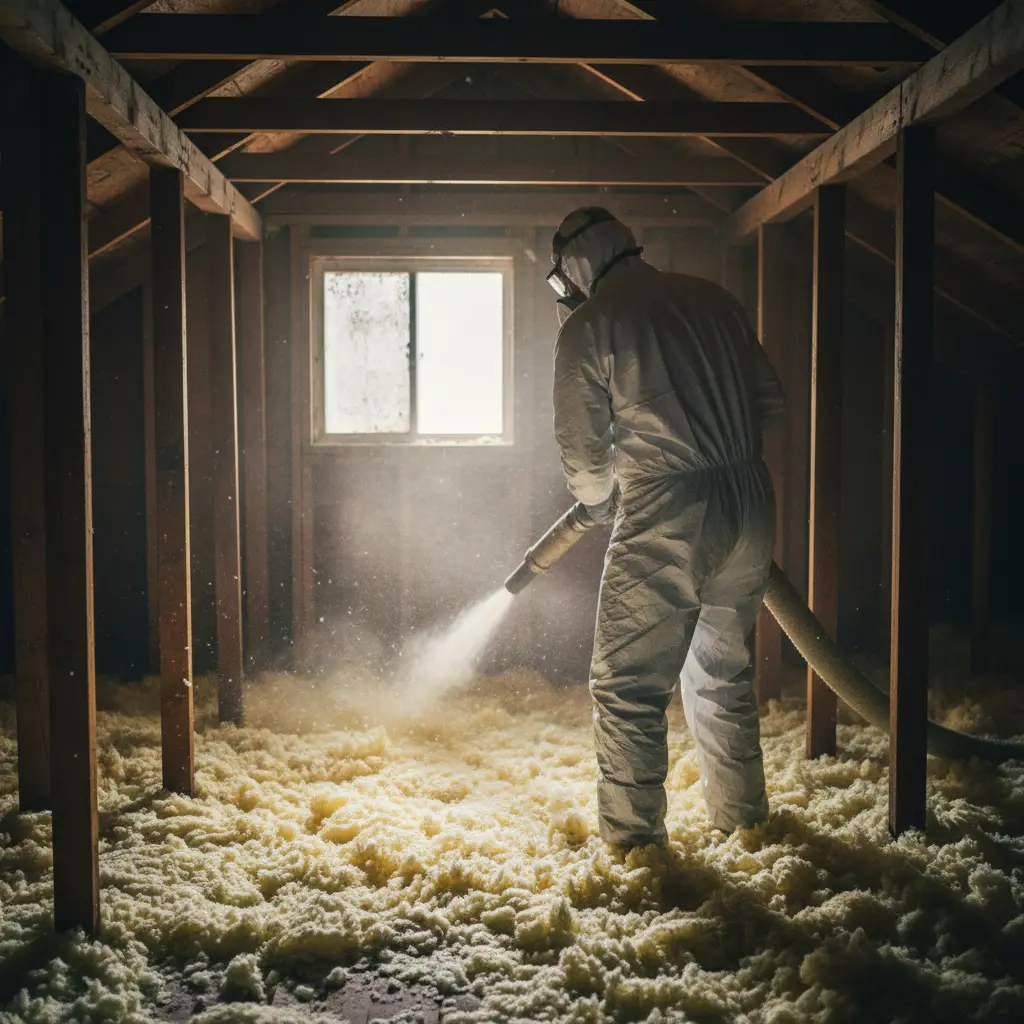
Our team in action — insulation professionals serving Orange
Why Insulation Removal Is Needed in Orange, CA
Orange, CA sits within IECC Climate Zone 8B, a hot-dry classification that generates extreme summer attic temperatures. During peak summer months — typically July and August — attic temperatures in unshaded Orange homes routinely reach 150°F to 160°F. At those temperatures, fiberglass batts lose loft, cellulose settles and compresses, and aged spray foam can delaminate from roof decking. Insulation that has degraded this way no longer achieves its rated R-value, making removal and replacement the only effective corrective action.
Rodent Infestation: Orange County’s urban wildlife pressure is significant. The roof rat (Rattus rattus), a species well established throughout Orange, routinely nests inside attic insulation. A single rat colony can destroy hundreds of square feet of blown-in fiberglass or cellulose within one season, saturating the material with urine, feces, and nesting debris. Beyond the odor and structural concerns, rodent-contaminated insulation poses genuine hantavirus and leptospirosis risks. Neighborhoods with mature tree canopies — such as Old Towne Orange near Glassell Street and the Eichler-influenced streets near Grijalva Park — are particularly prone to roof rat intrusion because overhanging branches provide direct attic access.
Moisture and Mold from Weather Events: While Orange enjoys roughly 280 sunny days per year, the region is not immune to moisture events. The atmospheric river storms that struck Southern California in January and February 2023 — the most significant rainfall event in Orange County in decades — caused widespread roof leaks across Orange neighborhoods including Panorama Heights, Villa Park Road corridors, and the Mabury Ranch area. Water-infiltrated insulation loses its R-value almost immediately and becomes a substrate for mold growth within 24 to 72 hours. Mold-laden insulation cannot be remediated in place; it must be completely removed.
HVAC Duct Failures: Many Orange homes built in the 1970s and 1980s have flex duct systems running through the attic. When these ducts develop leaks — a common issue after decades of thermal cycling between Orange’s hot summers and cooler winters — conditioned air escapes directly into the attic space, creating sustained moisture conditions that degrade surrounding insulation from below. Duct leak rates of 20% to 30% are not uncommon in homes of this era.
Aging Material Past Service Life: Blown-in fiberglass has an effective service life of approximately 15 to 25 years depending on attic conditions. Cellulose, while treated with borate fire retardants, typically degrades faster in Orange’s heat-intense attic environment. Homes last re-insulated in the late 1990s or early 2000s may now be operating with insulation performing at a fraction of its original R-value — a primary driver of the elevated cooling costs that Orange homeowners on Southern California Edison’s tiered rate structure experience during summer peak demand periods.
Signs You Need Insulation Removal in Orange
Energy Performance Warning Signs
- Monthly SCE electricity bills exceeding $300–$400 during summer months despite average thermostat settings
- Rooms that cannot hold the set temperature, particularly second-floor bedrooms facing south or west
- HVAC system running continuously during Orange’s peak July and August heat waves
Visual and Physical Signs
- Visible rodent droppings, nesting materials, or chewed insulation visible from the attic hatch
- Dark staining, water marks, or a musty odor when opening the attic access panel
- Insulation that appears flattened, clumped, or significantly lower in depth than the tops of attic floor joists
- Visible mold growth on wood framing members adjacent to insulation material
Air Quality and Health Indicators
- Persistent musty or ammonia-like odor inside the living space without an identifiable source
- Unexplained respiratory irritation or allergy flare-ups affecting household members indoors
- Evidence of insulation fibers entering living spaces through ceiling penetrations or recessed lights
Urgency Indicators
If you observe active rodent activity, visible mold coverage exceeding a few square feet, or suspect water damage following a roof leak, treat this as an urgent situation requiring immediate professional evaluation. Delays allow contamination to spread and can create liability concerns during home sales.
Insulation Removal Methods and Approaches
Pneumatic Vacuum Removal
The most common method for blown-in cellulose or fiberglass. A large-diameter hose is run from the attic to a commercial vacuum truck or trailer outside the home. This method is fastest and most effective for open attic spaces. In typical Orange ranch homes with accessible attic floors, this method can clear a 1,500 sq. ft. attic in 2–4 hours.
Manual Batt Removal
Fiberglass or mineral wool batts installed between joists must be removed by hand — they cannot be vacuumed effectively. Technicians carefully pull each batt, bag it immediately to prevent fiber release, and follow with HEPA vacuuming. This is the standard approach in many Orange homes built between the 1960s and 1980s that received batt installation at construction.
Spray Foam Removal
Closed-cell or open-cell spray foam bonded to roof decking or wall cavities requires mechanical removal using scrapers, oscillating tools, and hand tools. This is the most labor-intensive method and is reserved for situations where spray foam has delaminated, been moisture-infiltrated, or needs to be cleared for roof decking replacement. Cost and timeline are higher than other methods.
Crawl Space Insulation Removal
Insulation installed between floor joists in crawl spaces beneath Orange’s older single-story homes is removed manually due to access constraints. Our crawl space insulation team uses low-profile vacuums and specialized tools designed for confined entry conditions. Vapor barrier inspection and replacement is typically coordinated with this work.
Ready for Insulation Removal? Get Your Free Estimate Today.
Next Level Insulation of Orange serves Orange and the surrounding area — we’ll be on-site within 24 hours.
📞 Call 714-266-2070Insulation Removal Cost in Orange, CA
Understanding the cost of insulation removal helps homeowners in Orange plan and budget appropriately. Pricing varies based on home size, insulation type, contamination level, and access conditions.
Typical Cost Ranges
- Small attic (under 1,000 sq. ft.): $500–$900 for standard blown-in removal
- Average Orange home attic (1,000–2,000 sq. ft.): $900–$1,800 depending on depth and contamination
- Larger attic (2,000–3,000 sq. ft.): $1,800–$3,200
- Rodent-contaminated insulation (add-on): $300–$800 for disinfection and decontamination
- Crawl space removal: $1.50–$3.00 per sq. ft. depending on access difficulty
- Spray foam removal: $3.00–$6.00 per sq. ft. due to labor intensity
Factors That Affect Your Orange Insulation Removal Cost
- Attic access: Many Orange Craftsman and Spanish Colonial homes have small attic hatches (under 22″ x 30″) that limit equipment access, increasing labor time
- Depth of existing insulation: Homes with 12″–16″ of settled cellulose require more vacuum time than homes with 6″ of degraded fiberglass
- Biological contamination: Rodent or mold contamination requires specialized PPE, disinfectants, and waste handling — all increasing cost
- Permit requirements: Some Orange insulation removal scopes may trigger a City of Orange building inspection; we advise on permit applicability at no charge
We provide free, no-obligation estimates with itemized breakdowns. Call 714-266-2070 to schedule yours. Many projects also qualify for Southern California Edison rebates when paired with new qualifying insulation installation.
Insulation Removal Service Areas in Orange, CA
Old Towne Orange
The historic core of Orange around the Plaza, with homes dating to the 1890s through 1930s, presents unique challenges including knob-and-tube wiring concerns, extremely small attic clearances, and the possibility of vermiculite or early cellulose insulation. We assess older materials carefully before removal begins.
Panorama Heights
This hillside neighborhood features homes built predominantly in the 1960s and 1970s with varied roof pitches and split-level floor plans that complicate standard attic access. Residents here frequently report high cooling bills due to south- and west-facing attic exposures.
Mabury Ranch and East Orange
Newer master-planned communities built in the 1980s and 1990s often have larger attic footprints. Original blown-in fiberglass from construction may now be 25–35 years old and well past effective service life, particularly in areas that saw roof impact during the 2023 storm events.
Serrano Heights
This planned community near the Irvine Regional Park boundary features modern construction with tile roofs. While homes are newer, pest pressure from adjacent open-space areas is higher, and rodent-damaged insulation is a common service request in this neighborhood.
Insulation Maintenance Tips for Orange Homeowners
- Inspect your attic annually in October — after summer heat stress and before winter rain season begins. Look for signs of settling, moisture, or rodent activity.
- Trim trees away from the roofline — maintain at least 4 feet of clearance between branches and the roof to reduce roof rat access, a major issue in older Orange neighborhoods with mature landscaping.
- Check and seal attic vent screens — hardware cloth with 1/4″ mesh prevents rodents from entering through ridge and soffit vents. Inspect screens after every significant windstorm.
- Address roof leaks within 24–48 hours — given Orange’s periodic atmospheric river events, a fast response to any roof leak prevents insulation from becoming saturated and developing mold.
- Have HVAC ducts inspected every 5 years — leaking flex ducts in attics contribute to insulation moisture damage and significantly reduce system efficiency.
- Monitor SCE summer bills — a sudden 15%–20% increase in cooling costs during comparable weather years often signals insulation degradation worth investigating.
- Schedule professional insulation depth checks every 10 years — especially in homes older than 20 years where settling may have reduced effective R-value below Title 24 minimums.
Why Choose Next Level Insulation of Orange
Next Level Insulation of Orange is a locally focused insulation contractor serving homeowners throughout Orange, CA. Our team understands the specific building types, climate conditions, and pest pressures that make insulation removal in Orange different from projects in other parts of Southern California. We do not treat every job as a generic attic cleaning — we bring location-specific expertise to each project.
We provide comprehensive insulation services under one roof, including attic insulation, blown-in insulation, spray foam insulation, fiberglass insulation, attic cleaning, rodent proofing, and crawl space insulation. This means the team that removes your old insulation is the same team that installs your new system — ensuring continuity, accountability, and a better-performing final result.
We use commercial-grade equipment, EPA-registered disinfectants, and proper waste disposal protocols. Every project begins with a free, no-obligation inspection. Call us at 714-266-2070 to speak with an Orange insulation specialist today.
Frequently Asked Questions About Insulation Removal in Orange, CA
How much does insulation removal cost in Orange, CA?
Most residential insulation removal projects in Orange range from $900 to $3,200 depending on attic size, insulation type, and contamination level. Smaller jobs under 1,000 sq. ft. may start around $500, while larger or heavily contaminated attics can exceed $3,000. We provide free itemized estimates before any work begins.
How long does insulation removal take?
A typical Orange single-story home attic (1,200–1,800 sq. ft.) takes 4 to 8 hours for full removal, HEPA cleanup, and disinfection. Larger two-story homes or heavily contaminated attics may require a full day. We complete most projects in a single visit.
Do I need a permit for insulation removal in Orange, CA?
Insulation removal alone generally does not require a permit from the City of Orange. However, if removal is combined with attic structural work, electrical updates (such as replacing recessed fixtures for IC-rated alternatives), or HVAC duct replacement, a permit may be required. We clarify permit requirements for your specific project at no charge.
Is old insulation in Orange homes likely to contain asbestos?
Homes built before 1980 in Orange may contain asbestos in older vermiculite attic insulation. Standard fiberglass batts and cellulose blown-in insulation do not contain asbestos. If we observe vermiculite or other suspect materials during inspection, we will recommend laboratory testing before any removal proceeds. Licensed asbestos abatement is required if testing returns a positive result.
Can I stay in my home during insulation removal?
In most cases, yes. Our containment protocols prevent insulation dust and contaminants from entering living areas. For rodent-contaminated attics with significant biological hazard, we may recommend temporary relocation of infants, elderly occupants, or individuals with respiratory conditions during the work and airing-out period. We discuss this case by case during your assessment.
How soon after removal can new insulation be installed?
New insulation can typically be installed the same day or the following day after removal, once disinfectant applications have dried and air sealing materials have cured. Combining removal and new installation in a coordinated project is the most cost-effective approach and minimizes disruption to Orange homeowners.
Will removing old insulation help reduce my SCE electricity bills?
Removing degraded insulation alone will not lower energy bills — but replacing it with properly installed, code-compliant insulation (R-38 or higher for Orange’s Climate Zone 8) typically produces significant savings. Orange homeowners who upgrade from degraded insulation to a new system commonly report 15%–30% reductions in cooling costs, with the greatest impact felt during Southern California’s peak summer rate periods.
Do you offer rodent proofing along with insulation removal?
Yes. We provide integrated rodent proofing services — sealing entry points, installing hardware cloth at vents, and treating affected areas — as part of a comprehensive attic restoration. Addressing the source of the rodent problem before installing new insulation is critical; otherwise, new material will be re-contaminated within one or two seasons.
Ready to Schedule Insulation Removal in Orange, CA?
If your Orange home has old, damaged, or contaminated insulation, the most important step you can take today is a professional assessment. At Next Level Insulation of Orange, we make the process straightforward — from our free initial inspection through complete removal, cleanup, and new installation readiness.
Do not let degraded insulation continue driving up your SCE bills or compromising your indoor air quality. Orange homeowners trust us for thorough, professional insulation removal that prepares their home for a properly performing upgrade.
Call us now at 714-266-2070 to speak directly with an Orange insulation specialist and schedule your free, no-obligation attic inspection. We serve all neighborhoods throughout Orange, CA, and are ready to help you get started today.