

Rim Joist Insulation in Simi Valley, CA
Energy-Saving Rim Joist Insulation for Simi Valley, CA Homes — Licensed & Insured
Need rim joist insulation in Simi Valley, CA? Next Level Insulation of Simi Valley seals crawl space rim joists to stop drafts & cut energy bills. Call (805) 774-1832.
- Licensed & Insured
- Locally Owned & Operated
- Free Inspection & Estimate
Request Your
Free EstimateRim joist insulation is one of the most impactful yet frequently overlooked upgrades a homeowner can make. The rim joist — the band of framing lumber that sits atop your foundation wall and closes off the floor framing system — is a primary gateway for cold air infiltration, moisture intrusion, and energy loss. In Simi Valley, CA, where temperatures can swing dramatically between scorching summer afternoons and cold winter nights, an uninsulated rim joist can silently drain hundreds of dollars from your energy budget every year.
At Next Level Insulation of Simi Valley, we specialize in sealing and insulating rim joists for homes and light commercial buildings throughout the Simi Valley area. Our team understands the unique construction styles found across local neighborhoods, from post-war tract homes in the Wood Ranch corridor to newer developments near Arroyo Simi. Whether your home has a crawl space or a full basement-style foundation, we deliver rim joist solutions that stop drafts, reduce energy bills, and protect your structure from moisture damage specific to Southern California’s coastal-influenced inland climate.
Call us today at (805) 774-1832 to schedule your free assessment.
Understanding Rim Joist Insulation
To understand why rim joist insulation matters, it helps to visualize the anatomy of a typical California wood-frame home. When a house is built on a raised foundation — common throughout Simi Valley’s hillside tracts and older flatland subdivisions — the floor system is elevated above grade. The rim joist (also called the band joist or header joist) is the perimeter framing member that caps the foundation wall and supports the first-floor decking. In older homes, this area was commonly left exposed or, at best, stuffed loosely with fiberglass batts that do little to stop air movement.
Historically, building codes prior to the 1990s had minimal requirements for rim joist insulation in California. Homes built during Simi Valley’s major growth periods — particularly the 1960s through 1980s, when developments like Royal/High Street, Stargaze, and the Madera tract were constructed — were routinely built without any meaningful air barrier at the rim joist. Title 24, California’s energy code, began tightening these standards in the 1990s and again in 2005, 2008, and 2019 updates, but existing homes remain unaddressed unless renovated.
Rim joists are particularly problematic because they sit at the intersection of three different building materials: the concrete or masonry foundation wall, the wood framing, and the subfloor sheathing. Each material expands and contracts at a different rate in response to temperature and humidity changes. Over time, this differential movement creates gaps — sometimes fractions of an inch, sometimes much larger — through which unconditioned air freely moves into your living space.
In a typical 2,000-square-foot Simi Valley home with a crawl space foundation, the combined rim joist area can exceed 200 linear feet, representing a significant thermal boundary. Studies by the Lawrence Berkeley National Laboratory have estimated that rim joists can account for 15 to 25 percent of a home’s total air leakage. That means nearly a quarter of the energy your HVAC system produces to heat or cool your home may be escaping — or invasive outdoor air may be entering — right at the foundation perimeter.
Modern rim joist insulation combines both an air barrier and a thermal layer in a single application. Spray foam insulation applied directly to the rim joist creates a continuous, monolithic seal that eliminates both air infiltration and conductive heat loss simultaneously. Other approaches, such as rigid foam board with acoustic sealant, can be effective in the right circumstances. The key is ensuring complete coverage without gaps or voids.
Why Rim Joist Insulation Is Needed in Simi Valley, CA
Extreme Temperature Swings
Simi Valley regularly experiences temperature differentials of 30 to 40 degrees Fahrenheit between daytime highs and overnight lows — particularly in fall and spring. In summer, downtown Simi Valley near Los Angeles Avenue can reach 105°F or higher during heat events, while nighttime temperatures drop into the mid-60s. This nightly cycling stresses building materials and accelerates the gap formation at rim joist connection points. The January 2021 freeze event, which brought overnight lows below 29°F to portions of Simi Valley — unusually severe for the region — caused visible cracking in foundation caulking and wood shrinkage that opened air pathways many homeowners did not discover until the following summer’s utility bills arrived.
Santa Ana Wind Events
Simi Valley is one of the Ventura County communities most directly exposed to Santa Ana wind events, which funnel through the Santa Susana Pass and the Simi Valley–San Fernando Valley corridor. Wind speeds during major Santa Ana events regularly exceed 40 mph in residential areas, and gusts of 65 mph or more have been recorded during events like the October 2019 Easy Fire. High-velocity wind pressure dramatically increases air infiltration through any unsealed gap at the foundation perimeter. Homes on the north-facing slopes above Sequoia Avenue and along Crestview Drive experience the highest wind exposure and are among the most likely to benefit from comprehensive rim joist sealing.
Soil Conditions and Foundation Movement
Much of Simi Valley sits on expansive clay soils — particularly in the Erringer Road, Madera, and Katherine Road neighborhoods — that absorb moisture and swell during winter rains, then contract sharply during the summer dry season. This soil movement causes minor but cumulative shifts in raised foundations, which progressively opens the gap between the foundation wall and the rim joist framing. Homes built on the alluvial fan soils near the Arroyo Simi channel are particularly susceptible to seasonal heaving that disrupts existing insulation and air seals.
Wildfire Smoke and Air Quality
The 2003 Simi Fire, the 2018 Woolsey Fire (which burned through adjacent Oak Park and Thousand Oaks neighborhoods), and the 2019 Easy Fire all produced weeks of degraded air quality in Simi Valley. Unsealed rim joists allow particulate-laden outdoor air to enter the subfloor cavity and migrate into living spaces. Properly sealed rim joists contribute to the building envelope’s ability to limit outdoor air intrusion during smoke events — a public health benefit increasingly recognized by Ventura County environmental health officials.
Moisture and Crawl Space Humidity
Despite its semi-arid climate, Simi Valley’s winter rainy season — typically November through March — can push groundwater close to the surface in low-lying areas near the Arroyo Simi floodplain. Crawl spaces beneath homes in the Tapo Canyon Road corridor and in older neighborhoods west of First Street regularly accumulate moisture that migrates upward through uninsulated rim joists, promoting wood rot, mold, and pest activity. Crawl space insulation combined with rim joist sealing addresses this issue comprehensively.
Signs You Need Rim Joist Insulation in Simi Valley
Energy and Comfort Symptoms
- Unusually cold floors during Simi Valley’s winter months, especially in rooms above the crawl space perimeter
- Drafts felt at floor level along exterior walls, particularly during Santa Ana wind events
- Higher-than-expected gas or electric bills during January and February heating season
- HVAC system running excessively without reaching thermostat setpoint
Visual and Physical Indicators
- Visible daylight or outdoor light visible through the rim joist area when inspecting your crawl space
- Fiberglass batts in the rim joist area that are discolored, compressed, or have fallen away from the framing
- Staining or efflorescence on the foundation wall directly below the rim joist, indicating moisture movement
- Rust or corrosion on metal bridging or joist hangers near the perimeter
Biological and Structural Warning Signs
- Musty odors in the living space, particularly in rooms adjacent to exterior walls at ground level
- Evidence of pest entry — carpenter ants, termites, or rodents — along the foundation perimeter
- Soft or springy floor decking near exterior walls that may indicate wood rot progressing from moisture infiltration
Urgency note: If you observe biological growth (mold, fungus) or structural softness, schedule an inspection immediately. These conditions can progress rapidly during Simi Valley’s rainy season. Call (805) 774-1832 for priority scheduling.
Our Rim Joist Insulation Process in Simi Valley
Initial Assessment and Access Evaluation (30–60 minutes)
We begin with a thorough inspection of your crawl space or basement perimeter. Our technicians assess access point size, clearance height, existing insulation condition, moisture levels, and any pest or mold activity. For Simi Valley homes with the tight crawl space clearances common in 1970s-era Tapo Street and Alamo Street neighborhoods, we document access challenges that affect the work plan before quoting.
Moisture and Mold Assessment (15–30 minutes)
Using calibrated moisture meters, we check wood framing at multiple points along the rim joist. Simi Valley’s clay soil neighborhoods frequently show elevated wood moisture content (above 19 percent) that must be addressed before insulating. If mold or rot is present, we coordinate remediation before proceeding. Crawl space encapsulation may be recommended as a companion service.
Existing Insulation Removal (1–4 hours depending on scope)
Old fiberglass batts, deteriorated rigid foam, or other failed insulation materials are safely removed and bagged for disposal. Our team uses personal protective equipment appropriate to Ventura County air quality regulations. Insulation removal is completed before any new material is installed to ensure a clean substrate.
Air Sealing and Gap Preparation (1–2 hours)
Before insulating, we seal plumbing penetrations, electrical chase openings, and foundation cracks with appropriate sealants rated for below-grade and subfloor environments. This step is critical in Simi Valley homes where foundation movement from expansive soils has created gaps that bypass the insulation layer entirely.
Insulation Application (2–6 hours depending on linear footage)
Depending on the selected method, we apply closed-cell spray foam, cut-and-cobble rigid foam with spray foam edge sealing, or a hybrid system. Our technicians are trained specifically in the temperature and humidity conditions typical of Simi Valley’s crawl space environment, which affect spray foam cure rates and adhesion properties.
Quality Verification (30–60 minutes)
We perform a visual inspection of every linear foot of treated rim joist, checking for voids, incomplete coverage, or areas of insufficient thickness. Thermal imaging may be used for verification on larger projects.
Site Cleanup and Documentation (30 minutes)
We remove all debris, restore any access panels, and provide you with a written summary of work completed, materials used, and R-values achieved — useful documentation for Ventura County Energy Upgrade California rebate applications.
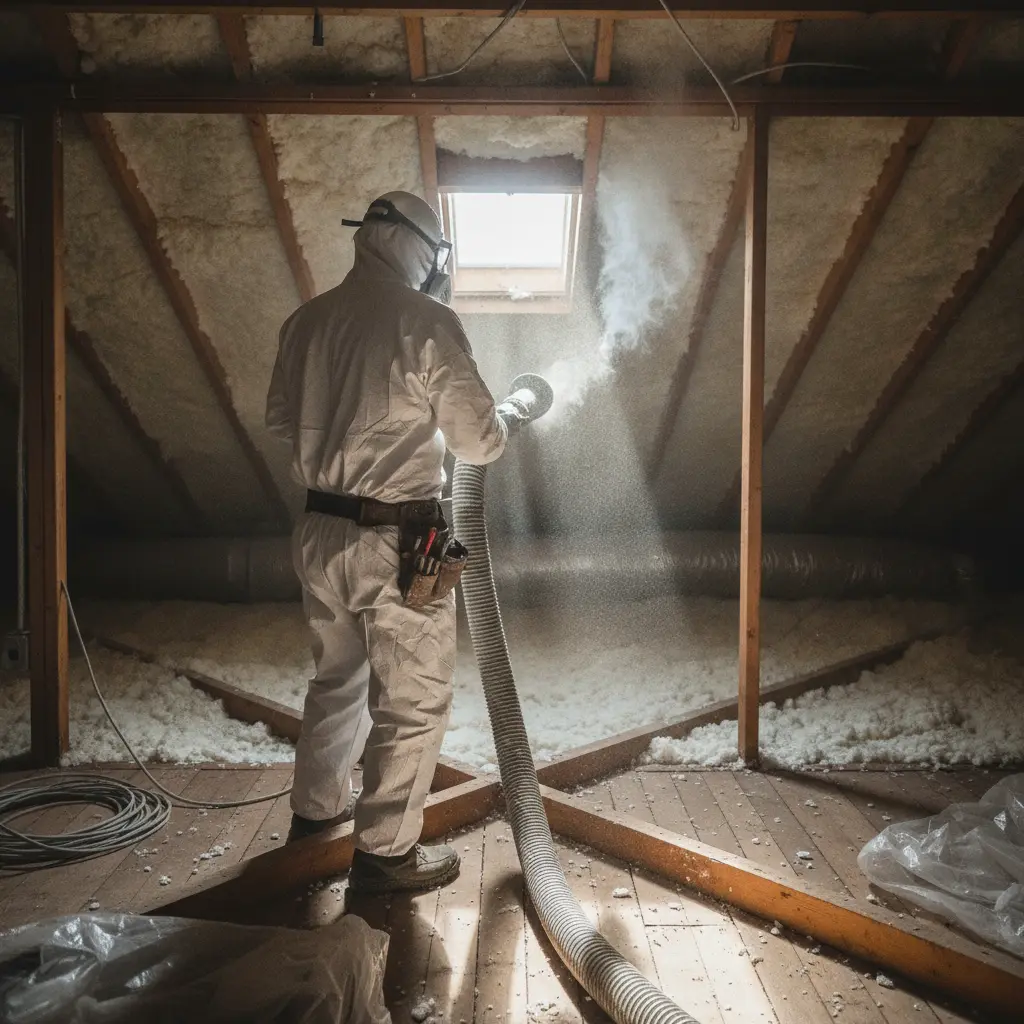
Our team in action — insulation professionals serving Simi Valley
Rim Joist Insulation Methods We Use in Simi Valley
Closed-Cell Spray Foam (Most Recommended for Simi Valley)
Two-pound closed-cell spray polyurethane foam is our primary recommendation for Simi Valley rim joists. Applied at 2 inches of thickness, it achieves approximately R-12 to R-13 while simultaneously creating a Class II vapor retarder and a complete air barrier. The closed-cell structure is impervious to the moisture infiltration common in Arroyo Simi corridor homes and stands up to the wood movement caused by seasonal soil expansion in clay-heavy neighborhoods. Learn more about our spray foam insulation services.
Open-Cell Spray Foam
Open-cell foam is occasionally appropriate for interior-side rim joist applications in Simi Valley homes where moisture levels are consistently low and R-value requirements are moderate. At 3.5 inches thickness, it achieves approximately R-13. It is less suitable for homes near the Arroyo Simi floodplain or those with documented moisture history.
Rigid Foam Board with Spray Foam Edge Seal (Cut-and-Cobble)
For homeowners managing costs, pre-cut rigid foam panels (typically 2-inch polyisocyanurate or extruded polystyrene at R-10 to R-13) fitted between joists and sealed at all edges with spray foam or acoustical sealant offer a durable, DIY-compatible option when installed professionally. This approach works well in drier Simi Valley neighborhoods such as Wood Ranch and Bridle Path where moisture concerns are lower.
Hybrid Systems
In some cases — particularly in older Simi Valley homes with irregular joist spacing or non-standard framing from custom construction periods — a hybrid approach combining rigid foam for the field area and spray foam for transitions, penetrations, and irregular gaps provides the best result at a reasonable cost.
Ready for Rim Joist Insulation? Get Your Free Estimate Today.
Next Level Insulation of Simi Valley serves Simi Valley and the surrounding area — we’ll be on-site within 24 hours.
📞 Call (805) 774-1832Rim Joist Insulation Cost in Simi Valley, CA
Understanding the investment involved in rim joist insulation helps Simi Valley homeowners plan effectively. Costs vary based on linear footage, access conditions, existing material removal needs, and selected insulation method.
Typical Cost Ranges
- Closed-cell spray foam (professional installation): $3.00 to $6.00 per board foot, or approximately $1,200 to $3,500 for a typical 1,500–2,500 sq ft Simi Valley home
- Open-cell spray foam: $1.50 to $3.00 per board foot, or approximately $700 to $2,200 for a similarly sized home
- Rigid foam cut-and-cobble with spray foam edge seal: $800 to $2,000 installed for a typical home, depending on accessibility
- Existing insulation removal (if required): $200 to $600 as an add-on service, depending on scope
Factors Affecting Your Simi Valley Project Cost
- Crawl space clearance: Homes in older Simi Valley neighborhoods with 18-inch or less clearance require more labor time, increasing cost by 15 to 25 percent
- Linear footage: Larger homes in Wood Ranch or the Belwood tract have proportionally greater perimeters
- Moisture remediation: Homes near the Arroyo Simi with active moisture issues may require drying and mold treatment before insulation
- Combo services: Bundling rim joist insulation with crawl space insulation or attic insulation typically reduces per-service cost by 10 to 20 percent
Return on Investment
The U.S. Department of Energy estimates rim joist air sealing and insulation can reduce home energy use by 5 to 15 percent annually. For a Simi Valley household spending $2,400 per year on energy, that represents $120 to $360 in annual savings — meaning most projects pay back within 4 to 10 years, and California utility rebates through SoCalGas and Southern California Edison can accelerate that timeline significantly.
Contact us at (805) 774-1832 for a free, no-obligation estimate specific to your Simi Valley home.
Simi Valley Neighborhoods We Serve
Wood Ranch (Built primarily 1985–2000)
Wood Ranch homes feature larger footprints and generally better crawl space clearance than older neighborhoods, but many were built just before California’s 1990s rim joist code updates. Residents here frequently report cold floor complaints during January and February and benefit greatly from closed-cell spray foam applications that complement the neighborhood’s newer HVAC systems.
Madera / Katherine Road Corridor (Built primarily 1965–1978)
These mid-century tracts sit on some of Simi Valley’s most expansive clay soils. Foundation movement is a documented issue, and rim joists in this area frequently show significant gaps at the sill plate. Homeowners here should prioritize both air sealing and moisture management as part of any rim joist project.
Royal / Stargaze / High Street Corridor (Built primarily 1958–1972)
Simi Valley’s earliest large-scale residential tracts include modest homes with low crawl spaces and minimal original insulation. These homes see the greatest energy improvement from rim joist upgrades and are strong candidates for comprehensive insulation replacement programs.
Bridle Path / Oakridge Estates (Built primarily 1978–1990)
Custom and semi-custom hillside homes in these areas face elevated wind exposure from the Santa Susana foothills. Santa Ana wind infiltration through unsealed rim joists is a consistent complaint among homeowners here, making complete air-barrier installation a high priority.
Rim Joist Insulation Maintenance Tips for Simi Valley Homeowners
- Annual crawl space inspection: Before Simi Valley’s rainy season (November), visually inspect your crawl space access for signs of moisture, pest activity, or displaced insulation.
- Check for pest entry points: After major Santa Ana wind events, inspect the exterior foundation perimeter for new gaps or displaced sill gasket material that could allow rodent entry alongside air infiltration.
- Monitor crawl space humidity: If your home is in the Arroyo Simi flood corridor, maintain a crawl space humidity level below 60 percent using a battery-operated hygrometer — sustained humidity above this level accelerates wood moisture content and can compromise insulation adhesion.
- Recheck after seismic activity: Simi Valley sits near the Santa Susana fault zone. After any earthquake above 3.5 magnitude, inspect rim joist areas for new cracks or gaps in foam seals.
- Clear crawl space vents as appropriate: For conditioned crawl spaces, ensure vapor barrier integrity is maintained and is not displaced by weather events or pest activity.
- Watch for floor temperature changes: A sudden return of cold floors in winter can indicate that foam has separated from framing — a sign worth investigating before the next heating season.
- Schedule professional re-inspection every 5–7 years: Building movement in Simi Valley’s clay-soil neighborhoods is cumulative. A brief professional inspection can catch small gaps before they become significant energy loss pathways.
Why Choose Next Level Insulation of Simi Valley
Next Level Insulation of Simi Valley is a locally focused insulation contractor serving the Simi Valley community and surrounding areas across Ventura and Los Angeles counties. We are not a national franchise dispatching unfamiliar technicians — we are a team that understands the specific building stock, soil conditions, and climate patterns of the Santa Susana Valley firsthand.
We offer the full spectrum of insulation and building envelope services under one roof, including spray foam insulation, attic insulation, blow-in insulation, crawl space encapsulation, crawl space insulation, insulation removal, and insulation replacement. This means your rim joist project can be seamlessly integrated with any other insulation work your home needs — saving you coordination time and often reducing overall project cost.
Every project begins with a thorough, honest assessment. We recommend what your home actually needs, not the most expensive option. We serve customers throughout Simi Valley as well as neighboring communities including Moorpark, Thousand Oaks, Camarillo, Santa Clarita, Woodland Hills, Calabasas, and beyond.
Call us at (805) 774-1832 to speak with a local expert today.
Frequently Asked Questions: Rim Joist Insulation in Simi Valley, CA
How much does rim joist insulation cost in Simi Valley?
For a typical Simi Valley home of 1,500 to 2,500 square feet, rim joist insulation using closed-cell spray foam typically costs between $1,200 and $3,500 installed. Rigid foam board alternatives run $800 to $2,000. Homes with difficult crawl space access or those requiring moisture remediation beforehand may see higher totals. We provide free on-site estimates with no obligation. Call (805) 774-1832 to schedule yours.
How long does rim joist insulation installation take in Simi Valley?
Most Simi Valley single-family home rim joist projects are completed in one day. Homes with crawl space clearances under 18 inches — common in the Madera and Royal Street tracts — may require a day and a half. If existing insulation removal is needed, that adds approximately 2 to 4 hours to the total timeline.
Will rim joist insulation make a noticeable difference in my Simi Valley home?
Yes — most Simi Valley homeowners report noticeably warmer floors and reduced drafts within the first heating season after installation. The effect is especially pronounced in homes on the north-facing slopes above Sequoia and Crestview avenues, which receive the most direct Santa Ana wind exposure. Energy bill reductions of 5 to 15 percent are typical.
Is rim joist insulation required by code in Simi Valley?
California’s Title 24 energy code requires rim joist insulation in new construction. For existing homes undergoing permitted renovations, requirements depend on the scope of the project. Regardless of code requirements, rim joist insulation is one of the highest-ROI improvements available for pre-1990s homes throughout Simi Valley.
What is the difference between open-cell and closed-cell spray foam for rim joists?
Closed-cell foam is denser, achieves higher R-value per inch (approximately R-6 to R-7 per inch versus R-3.5 to R-4 for open-cell), and acts as a vapor retarder. For Simi Valley rim joists — particularly in moisture-prone neighborhoods near the Arroyo Simi — closed-cell is generally the preferred choice. Open-cell may be appropriate in drier, well-drained locations where cost is a priority consideration.
Can I combine rim joist insulation with other insulation services?
Absolutely, and we encourage it. Bundling rim joist insulation with crawl space insulation, crawl space encapsulation, or attic insulation typically reduces the overall per-service cost by 10 to 20 percent and maximizes the energy performance improvement to your Simi Valley home. We can assess your entire building envelope and recommend the most cost-effective combination for your situation.
Are there rebates available for rim joist insulation in Simi Valley?
Yes. Southern California Gas Company and Southern California Edison both offer rebates through their Energy Upgrade California programs for qualifying air sealing and insulation improvements, including rim joist work. Ventura County homeowners may also qualify for federal tax credits under the Inflation Reduction Act for insulation improvements. We can help you identify applicable programs during your estimate appointment.
Does rim joist insulation help during Simi Valley’s wildfire smoke events?
A properly sealed rim joist contributes to the overall building envelope tightness, which reduces outdoor air infiltration during smoke events — an important consideration given Simi Valley’s proximity to the Santa Susana Mountains and the documented air quality impacts of fires like the 2019 Easy Fire and 2018 Woolsey Fire. While rim joist sealing alone does not make a home smoke-proof, it is a meaningful component of a comprehensive envelope-tightening strategy.
Get a Free Rim Joist Insulation Estimate in Simi Valley Today
If your Simi Valley home has cold floors, high energy bills, or visible gaps at the foundation perimeter, rim joist insulation is likely one of the best investments you can make this year. Next Level Insulation of Simi Valley is ready to evaluate your home, explain your options in plain language, and deliver a professional installation that stands up to Simi Valley’s demanding climate conditions — from summer heat to Santa Ana winds to winter rain.
We proudly serve Simi Valley and all surrounding communities including Thousand Oaks, Moorpark, Camarillo, Santa Clarita, Woodland Hills, Calabasas, Chatsworth, Agoura Hills, and beyond.
Call us now at (805) 774-1832 to schedule your free, no-obligation assessment. You can also reach us through our website contact form. Our team is available Monday through Saturday to serve Ventura County homeowners looking for expert insulation solutions they can trust.
Next Level Insulation of Simi Valley — Simi Valley’s local rim joist insulation experts.