

Air Sealing in Simi Valley, CA
Professional Air Sealing in Simi Valley, CA — Licensed, Insured & Locally Owned
Professional air sealing in Simi Valley, CA. Blower door testing, attic & crawl space sealing. Reduce energy bills & wildfire smoke. Call (805) 774-1832 today.
- Licensed & Insured
- Locally Owned & Operated
- Free Inspection & Estimate
Request Your
Free EstimateAir sealing is the process of identifying and closing gaps, cracks, and openings in your home’s building envelope — the barrier between your conditioned living space and the outside environment. In Simi Valley, CA, where temperatures routinely swing from scorching summer highs above 100°F in the Santa Susana Pass area to cool, dry winter nights, an unsealed home loses conditioned air at an alarming rate, driving up energy bills and reducing indoor comfort year-round.
At Next Level Insulation of Simi Valley, we specialize in comprehensive air sealing services tailored to the unique architectural styles, climate conditions, and building codes of the greater Simi Valley area. Whether you own a 1970s tract home in Wood Ranch, a newer build near the Rancho Madera community, or a hillside property exposed to fierce Santa Ana wind events, our team delivers precise, lasting solutions. Call us today at (805) 774-1832 to schedule your assessment.
Understanding Air Sealing
Air sealing is one of the most foundational yet frequently overlooked components of home energy performance. Unlike insulation — which slows the transfer of heat through solid materials — air sealing targets the invisible movement of air through unintended pathways: gaps around plumbing penetrations, cracks at top plates, unsealed attic hatches, and spaces around recessed lighting canisters, among dozens of other common culprits.
Historically, residential construction in Southern California, including throughout Simi Valley, prioritized speed and cost over airtightness. The massive housing booms of the 1960s and 1970s, which filled neighborhoods like Tapo Canyon Estates and Sycamore Park with thousands of ranch-style homes, relied on building practices that left substantial air leakage by today’s standards. Modern building science has since established that typical homes of that era leak air at a rate equivalent to leaving a window wide open 24 hours a day.
The science of building performance matured significantly in the 1970s following the oil embargo, and blower door testing — the diagnostic gold standard for measuring a home’s air leakage rate — became widely adopted by the 1980s. Today, California’s Title 24 energy code requires newly constructed homes to meet strict air leakage thresholds, but millions of existing homes in Ventura County and the San Fernando Valley corridor remain well outside those standards.
Air sealing applies to virtually all residential building types found in Simi Valley: single-story ranch homes, two-story Spanish-style construction, split-level hillside designs, mobile homes in communities like Tierra Rejada, and newer planned-development homes in areas like Big Sky. Each building type presents unique air leakage pathways and demands a tailored approach. The attic is typically the highest-priority zone, as hot attic air infiltrating living spaces during Simi Valley summers can add hundreds of dollars annually to cooling costs.
When combined with attic insulation and spray foam insulation, air sealing creates a complete thermal and pressure boundary that dramatically reduces energy consumption and improves year-round comfort.
Why Air Sealing Is Needed in Simi Valley, CA
The Santa Ana Wind Effect
Simi Valley sits in a valley basin framed by the Santa Susana Mountains to the north and the Simi Hills to the south, a topography that channels and amplifies the Santa Ana winds. During major wind events — such as the December 2017 Thomas Fire wind event that recorded gusts exceeding 80 mph in surrounding areas — pressures against home envelopes spike dramatically. These repeated pressure cycles physically stress the caulking, gaskets, and framing connections throughout a home, causing existing seals to crack and creating new gaps over time. Even during typical Santa Ana conditions, sustained winds of 30–50 mph create stack effect pressures that pull conditioned air out of lower levels while drawing hot or cold outside air through upper-level gaps.
Temperature Extremes Unique to the Simi Valley Basin
The National Weather Service consistently records Simi Valley temperatures that diverge significantly from coastal communities just 20 miles away. Summer highs at the Simi Valley Airport weather station regularly reach 104°F to 108°F, while coastal Malibu on the same afternoon may sit at 75°F. This inland temperature amplification means attics in Simi Valley homes routinely reach 150°F to 160°F in July and August. Without air sealing, that superheated attic air infiltrates living spaces through top-plate gaps, attic hatch perimeters, and recessed light fixtures — forcing air conditioning systems to work 25–40% harder than they otherwise would.
Low Humidity and Building Material Shrinkage
Simi Valley’s semi-arid climate, classified as a BSk (cold semi-arid/steppe) climate under the Köppen system, produces extremely low relative humidity, often dropping below 10% during Santa Ana events. Wood framing members shrink and expand with these humidity fluctuations, progressively enlarging gaps at top plates, rim joists, and rough openings. Homes built before 1990 — which represent a substantial portion of Simi Valley’s housing stock in neighborhoods like Madera Estates and Stratford Park — have experienced 30 or more years of this seasonal movement, leaving measurable gaps that a blower door test can quantify.
The Easy Fire and Wildfire Smoke Infiltration
The October 2019 Easy Fire burned more than 1,700 acres in the hills immediately adjacent to Simi Valley’s northwestern neighborhoods, including areas near Challenger Drive and Yosemite Avenue. Residents reported heavy smoke infiltration inside their homes even with windows and doors closed — a direct consequence of air leakage pathways. Homes with proper air sealing performed measurably better, keeping particulate matter out of living spaces. This wildfire smoke infiltration risk is a Simi Valley-specific reason to prioritize air sealing that simply does not apply to most other Southern California communities.
Crawl Space and Slab Conditions
Simi Valley has a mixed foundation landscape: many 1960s–1970s homes in the central valley floor sit on raised wood-frame foundations with vented crawl spaces, while newer construction tends toward concrete slab. Crawl spaces in unsealed homes draw in cold or damp air during winter nights, creating cold floors and moisture pathways. Our crawl space encapsulation and crawl space insulation services address these lower-envelope leakage points comprehensively.
Signs You Need Air Sealing in Simi Valley
Comfort and Temperature Issues
- Rooms that are noticeably hotter than others during Simi Valley’s summer afternoons, particularly second-floor bedrooms
- Drafts felt near electrical outlets, baseboards, or recessed light fixtures during windy conditions
- Cold floors during winter mornings, especially in homes with crawl spaces
- HVAC system running continuously during heat waves without achieving the thermostat setpoint
Indoor Air Quality Red Flags
- Smoke odor penetrating indoors during nearby wildfire events or Red Flag Warning days
- Excessive dust accumulation, particularly fine particulate dust consistent with air drawn through attic spaces
- Musty or earthy odors entering from crawl spaces or attics
Energy Bill Indicators
- Utility bills from Southern California Edison or SoCalGas that spike disproportionately in July–September or December–January
- Cooling costs exceeding $250/month in summer for a typical Simi Valley 1,800–2,200 sq ft home
Urgency Indicators
- Visible daylight around attic hatch perimeters or top plate areas
- Insulation that is visibly disturbed, indicating air movement through the insulation layer
- A home that has never had a blower door energy audit performed
Our Air Sealing Process in Simi Valley
Initial Consultation and Energy Audit Scheduling (Day 1)
We begin with a phone consultation to understand your home’s age, construction type, and primary concerns — whether that’s high summer cooling bills, wildfire smoke infiltration, or drafts during Santa Ana wind events. We then schedule a comprehensive on-site energy audit at a time convenient for your household.
Blower Door Diagnostic Testing (2–3 Hours On-Site)
Our certified technicians install a calibrated blower door in your home’s main entry and depressurize the building to a standard 50 Pascal pressure difference. This test reveals your home’s total air leakage rate in CFM50 (cubic feet per minute at 50 Pascals). California’s Title 24 standard targets 5 ACH50 or lower for existing homes; many Simi Valley homes built before 1985 test at 12–20 ACH50 or higher. We use infrared thermal imaging simultaneously to map the precise locations of leakage sites throughout the envelope.
Comprehensive Leakage Site Documentation (1–2 Hours)
Every identified leakage point is documented with photographs and mapped to a priority scale based on volume of leakage, accessibility, and impact on comfort. Common high-priority sites in Simi Valley homes include attic top plates, dropped soffit cavities in older ranch-style homes, whole-house fan openings, and crawl space rim joists.
Pre-Work Preparation and Material Staging (Morning of Installation)
We remove existing insulation only where necessary for access, stage low-VOC caulks, two-component spray foam, weatherstripping, and rigid foam blocking materials appropriate for Simi Valley’s temperature range. All materials are rated for the 150°F+ attic temperatures typical of the inland valley.
Systematic Air Sealing Application (4–8 Hours Depending on Home Size)
Working from attic to foundation, our team seals top plates with fire-rated spray foam, installs rigid foam dams at recessed fixtures, caulks around all penetrations, and addresses crawl space rim joists with cut-and-cobble rigid foam plus spray foam. We prioritize maintaining proper combustion air pathways for any gas appliances — a critical safety step specific to homes with older HVAC equipment common in Simi Valley’s 1970s–1990s construction.
Post-Sealing Blower Door Verification Test (1–2 Hours)
We conduct a second blower door test to quantify the improvement achieved and confirm we have met or exceeded the target ACH50 reduction. Most Simi Valley homes see a 35–55% reduction in air leakage rate after our comprehensive sealing service.
Final Report and Maintenance Briefing (30–45 Minutes)
We deliver a written report comparing pre- and post-treatment leakage rates, document all materials used, and walk you through our maintenance recommendations tailored to Simi Valley’s climate and seasonal wind patterns.
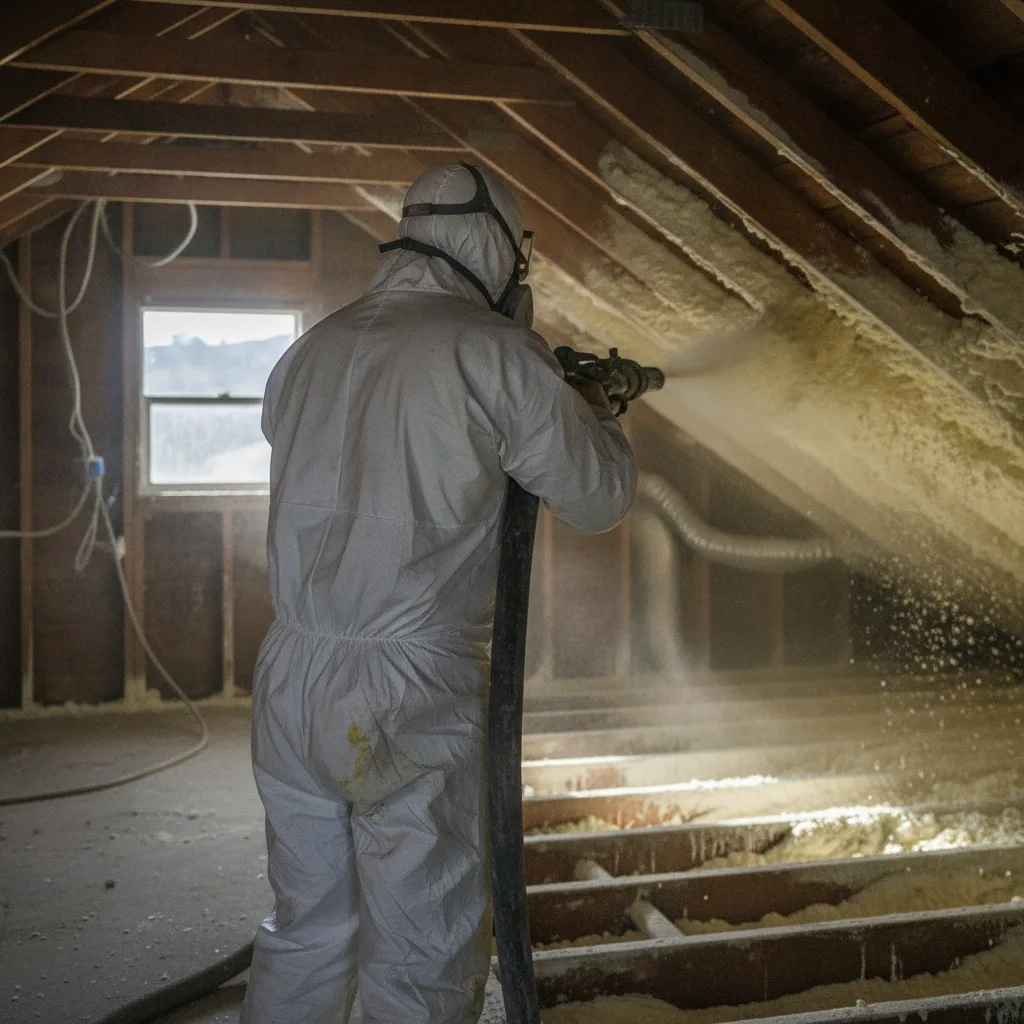
Our team in action — insulation professionals serving Simi Valley
Air Sealing Methods and Approaches We Use
Two-Component Spray Foam (Closed-Cell)
Closed-cell spray foam is our highest-performance sealing material, expanding to fill irregular gaps while creating both an air barrier and a vapor retarder. We use it primarily at rim joists, top plate penetrations, and large irregular openings. Its resistance to moisture makes it ideal for Simi Valley crawl spaces that experience ground moisture during the rainy season (November–March). Learn more about our spray foam insulation services.
One-Component Spray Foam (Expanding Sealant)
For medium-sized gaps (1/4 inch to 3 inches) around window rough openings, plumbing penetrations, and HVAC chase walls, single-component expanding foam provides a cost-effective and durable seal. We select low-expansion formulas for window and door frames to avoid warping — important in Simi Valley where wood frames have often dried and shifted significantly.
Caulk and Elastomeric Sealants
For narrow cracks, seams at drywall-to-framing interfaces, and exterior penetrations, we use high-temperature-rated silicone or elastomeric caulks capable of withstanding the thermal cycling that Simi Valley’s climate demands. Standard latex caulk fails prematurely in attic environments exceeding 140°F and is never used in those locations.
Rigid Foam Blocking with Spray Foam Perimeter Seal
Dropped soffits, open framing cavities, and attic hatch surrounds in older Simi Valley ranch homes often present large open areas that require rigid foam board cut to fit, then spray foamed around the perimeter. This “cut-and-cobble” method is one of the most effective approaches for the box soffit designs common in 1960s–1980s Simi Valley construction.
Weatherstripping and Door Sweeps
Attic access hatches and whole-house fan covers — extremely common in Simi Valley homes built before widespread central air adoption — are sealed with compression weatherstripping and insulated cover boxes that eliminate the single largest discrete air leakage point found in many area homes.
Ready for Air Sealing? Get Your Free Estimate Today.
Next Level Insulation of Simi Valley serves Simi Valley and the surrounding area — we’ll be on-site within 24 hours.
📞 Call (805) 774-1832Air Sealing Cost in Simi Valley, CA
Understanding the cost of air sealing in Simi Valley requires looking at several factors specific to local home characteristics, labor markets, and the scope of work required. Here is a transparent breakdown of typical pricing:
Typical Cost Ranges
- Basic air sealing (attic focus only, homes under 1,500 sq ft): $450–$850
- Comprehensive whole-home air sealing (1,500–2,500 sq ft): $900–$1,800
- Comprehensive whole-home air sealing including crawl space (2,000–3,000+ sq ft): $1,500–$3,200
- Blower door diagnostic testing only (credited toward work): $250–$400
Factors That Affect Your Air Sealing Cost
- Home size and story count: Two-story homes in areas like Wood Ranch have more complex envelope surfaces and longer top-plate runs than single-story ranch homes.
- Existing insulation removal: If attic insulation must be removed to access top plates, this adds $300–$600. See our insulation removal services for details.
- Number of penetrations: Older Simi Valley homes with original cast-iron plumbing and knob-and-tube electrical updates often have more penetrations than newer construction.
- Crawl space conditions: Homes in low-lying areas of the Simi Valley floor with accessible, dry crawl spaces cost less to seal than homes with limited access or moisture issues.
Return on Investment
Based on DOE data and local utility rates from Southern California Edison’s tiered pricing structure, Simi Valley homeowners typically recover air sealing costs within 3–6 years through reduced HVAC energy consumption. Homes that combine air sealing with blow-in insulation see accelerated payback periods. California utilities also periodically offer rebates through the Energy Upgrade California program — ask us about current available incentives when you call.
Neighborhoods We Serve in Simi Valley
Wood Ranch
Developed primarily in the 1980s and 1990s, Wood Ranch homes are typically two-story, Mediterranean or Spanish-style construction with tile roofs and more complex attic geometries than the valley-floor ranch homes. These properties often have cathedral ceilings and multiple HVAC zones, creating challenging air sealing conditions at ceiling-to-wall transitions and skylight wells.
Sycamore Park and Tapo Canyon Estates
These central Simi Valley neighborhoods contain a high concentration of 1965–1978 ranch-style homes, many with original whole-house fans, open-web floor trusses over crawl spaces, and dropped soffit cabinetry — all high-priority air leakage sources that our team addresses daily.
Madera Estates and Stratford Park
Located in the eastern portions of the valley, these neighborhoods were developed through the 1970s and 1980s and include a mix of single-story and split-level homes on slightly elevated terrain, where Santa Ana wind exposure is higher and air sealing benefits are particularly pronounced.
Big Sky and Rancho Madera
Newer planned communities developed in the 2000s and 2010s with larger footprints (2,500–4,000+ sq ft), these homes benefit from air sealing to correct construction deficiencies common in high-volume tract building and to keep pace with California Title 24 energy performance improvements.
Air Sealing Maintenance Tips for Simi Valley Homeowners
- Inspect attic hatch weatherstripping annually before summer: The thermal expansion cycles of Simi Valley summers compress and degrade foam weatherstripping faster than in cooler climates. Replace it every 3–5 years.
- Re-caulk exterior penetrations after major Santa Ana wind events: Check caulking around hose bibs, electrical conduit entries, and HVAC line sets after any wind event exceeding 50 mph.
- Keep crawl space vents operational but inspect seals seasonally: During Simi Valley’s dry summer season, ensure crawl space vent covers close fully at night to limit warm air infiltration into the floor system.
- Check recessed light fixture gaskets every 5 years: Heat degradation in Simi Valley attics accelerates gasket deterioration; replacement is inexpensive and restores a significant air seal.
- After any plumbing or electrical work, require re-sealing: Contractor penetrations are a leading cause of air seal failure — always confirm gaps around new work are sealed before closing walls or attic access.
- Schedule a follow-up blower door test every 7–10 years: This quantifies any degradation in your air barrier and identifies new leakage pathways before they substantially impact energy bills.
- During wildfire season, close all fireplace dampers completely: Chimney flues are significant air leakage pathways; an inflatable damper balloon provides excellent seasonal sealing when the fireplace is not in use.
Why Choose Next Level Insulation of Simi Valley
Next Level Insulation of Simi Valley is a locally focused insulation and air sealing company built specifically to serve Ventura County and the surrounding San Fernando Valley communities. Our technicians work in Simi Valley homes every week and understand the specific challenges that come with the area’s climate extremes, aging housing stock, wildfire smoke infiltration risks, and Santa Ana wind pressures in ways that a generic regional contractor simply cannot replicate.
We offer a complete suite of building envelope services under one roof: air sealing, attic insulation, spray foam insulation, blow-in insulation, insulation removal, insulation replacement, crawl space encapsulation, and crawl space insulation. This means you work with one trusted team from diagnostic testing through final verification, with no coordination gaps between subcontractors.
Our diagnostic-first approach — beginning every project with blower door testing and thermal imaging before any materials are applied — ensures you receive targeted, evidence-based work rather than a generic treatment. We serve not only Simi Valley but all surrounding communities including Thousand Oaks, Moorpark, Camarillo, Chatsworth, Woodland Hills, and Santa Clarita. Call us at (805) 774-1832 to speak with a local specialist today.
Frequently Asked Questions About Air Sealing in Simi Valley
How much does air sealing cost in Simi Valley, CA?
Most Simi Valley homeowners invest between $900 and $1,800 for a comprehensive whole-home air sealing service on a 1,500–2,500 sq ft home. Smaller attic-only treatments start around $450, while larger homes with crawl spaces may reach $3,200 or more. We provide detailed written estimates after our diagnostic blower door assessment so there are no surprises.
How long does air sealing take?
For a typical Simi Valley single-story ranch home (1,600–2,000 sq ft), the complete process — including pre- and post-blower door testing — takes one full day (7–8 hours). Two-story homes or those with complex attic geometries like Wood Ranch properties may require two days. You can remain in the home during most of the work.
Will air sealing cause any indoor air quality or ventilation problems?
This is an important and frequently asked question. A very tight home requires mechanical ventilation to maintain healthy indoor air quality. We assess your existing ventilation during the audit phase and, if necessary, recommend or install appropriate mechanical ventilation solutions before completing air sealing. We never seal a home to a point that compromises combustion appliance safety or occupant health.
Does air sealing really reduce wildfire smoke infiltration in Simi Valley homes?
Yes — significantly. Research from the Lawrence Berkeley National Laboratory found that reducing home air leakage by 50% can cut outdoor particulate matter infiltration by a similar proportion during smoke events. Given Simi Valley’s documented wildfire exposure — including the 2003 Simi Fire, the 2018 Woolsey Fire in adjacent areas, and the 2019 Easy Fire — this is one of the most compelling local reasons to invest in professional air sealing.
What is a blower door test and is it required?
A blower door test uses a calibrated fan mounted in your doorway to pressurize or depressurize your home, allowing precise measurement of air leakage and identification of leakage locations. While not legally required for existing homes in Simi Valley, we strongly recommend it as the foundational step of any air sealing project. Without it, air sealing is essentially guesswork.
Can I air seal my home myself?
Homeowners can address minor leakage around window frames and door thresholds with consumer-grade caulk and weatherstripping. However, the highest-impact leakage sites — attic top plates, dropped soffit cavities, crawl space rim joists, and penetrations through the fire-rated envelope — require professional equipment, fire-rated materials, and knowledge of building science principles to address safely and effectively. Improper sealing near combustion appliances can also create dangerous depressurization conditions.
Do you serve areas outside Simi Valley?
Yes. Next Level Insulation of Simi Valley serves a wide regional area including Thousand Oaks, Moorpark, Camarillo, Chatsworth, Woodland Hills, Calabasas, Santa Clarita, Oxnard, Agoura Hills, Westlake Village, North Hollywood, Oak Park, Beverly Hills, San Fernando, Malibu, Fillmore, Port Hueneme, and Santa Paula. Call us at (805) 774-1832 to confirm service availability at your address.
How soon will I notice a difference after air sealing?
Many Simi Valley homeowners report noticeably improved comfort — fewer drafts, more even room temperatures — within the first week after sealing, particularly during evening Santa Ana wind conditions. Utility bill reductions typically become measurable in the first full billing cycle following treatment, with the largest savings appearing on the first full summer cooling season bill after service.
Get Your Air Sealing Estimate in Simi Valley Today
Don’t let Simi Valley’s extreme summer heat, aggressive Santa Ana winds, or wildfire smoke season find your home’s building envelope unprepared. Next Level Insulation of Simi Valley is ready to diagnose your home’s air leakage, deliver a transparent written estimate, and complete high-quality, lasting air sealing work that you’ll feel — and see on your utility bills — for years to come.
Call us directly at (805) 774-1832 to speak with a Simi Valley air sealing specialist, or reach out online to schedule your blower door diagnostic assessment. We proudly serve Simi Valley and all surrounding communities throughout Ventura County and the greater San Fernando Valley. Take your home’s comfort and efficiency to the next level — contact us today.