

Spray Foam Insulation in Simi Valley, CA
Energy-Saving Spray Foam Insulation for Simi Valley, CA Homes — Licensed & Insured
Need spray foam insulation in Simi Valley, CA? Next Level Insulation offers expert installation for attics, crawl spaces & more. Call (805) 774-1832 for a free estimate.
- Licensed & Insured
- Locally Owned & Operated
- Free Inspection & Estimate
Request Your
Free EstimateSpray foam insulation is one of the most advanced and effective insulation solutions available for homeowners and businesses in Simi Valley, CA. Applied as a liquid that expands into a rigid, airtight foam, this technology seals gaps, reduces energy loss, and creates a thermal barrier that traditional insulation materials simply cannot match.
Simi Valley’s unique climate — characterized by scorching inland summers that regularly push past 100°F, cool winter nights, and the persistent threat of seasonal Santa Ana winds — creates conditions that demand high-performance insulation. Standard fiberglass batts often fall short in this environment, leaving homes uncomfortable and energy bills climbing year after year.
At Next Level Insulation of Simi Valley, we specialize in delivering professional spray foam insulation solutions tailored specifically to the construction styles, climate demands, and energy challenges that define this community. Whether you own a ranch-style home in Wood Ranch or a commercial property near the Simi Valley Town Center, we have the expertise to bring your building’s energy performance to the next level.
Call us today at (805) 774-1832 to schedule your free assessment.
Understanding Spray Foam Insulation
Spray foam insulation is a two-component polyurethane material that, when mixed and applied by a trained technician, expands rapidly to fill cavities, seal air leaks, and create a continuous thermal envelope. It comes in two primary forms: open-cell and closed-cell spray foam, each engineered for specific applications and performance goals.
Open-cell spray foam is a softer, more flexible material that expands dramatically — sometimes up to 100 times its original volume — making it ideal for interior wall cavities, attic spaces, and soundproofing applications. It achieves an R-value of approximately R-3.5 to R-4 per inch. Closed-cell spray foam, by contrast, is denser and more rigid, offering R-values between R-6 and R-7 per inch, along with moisture resistance and structural reinforcement properties that make it invaluable in crawl spaces, exterior walls, and areas prone to humidity intrusion.
Spray foam insulation became widely adopted in residential and commercial construction throughout Southern California during the building booms of the 1980s and 1990s, as energy codes tightened and homeowners began prioritizing comfort alongside efficiency. In Ventura County communities like Simi Valley, the technology gained particular traction because of the inland valley’s extreme temperature swings, which exposed the limitations of fiberglass batt insulation that had been standard in most tract homes built during the city’s rapid growth period of the 1960s through the 1980s.
Today, spray foam insulation is applied across a wide range of building types common in Simi Valley: single-family ranch homes, split-level residences, wood-frame commercial buildings, tilt-up industrial facilities near the Simi Valley Freeway (SR-118) corridor, and newer mixed-use developments. The material bonds directly to wood, concrete, metal, and masonry substrates, making it one of the most versatile insulation solutions in the contractor’s toolkit.
Beyond thermal performance, spray foam insulation provides measurable air sealing benefits, often reducing a home’s air infiltration by 40% or more compared to fiberglass batts alone. This is especially significant in Simi Valley, where gaps in building envelopes allow not only conditioned air to escape but also wildfire smoke and airborne particulates to enter during fire events — a growing concern for residents throughout the region.
For related insulation services, explore our attic insulation solutions and crawl space encapsulation services.
Why Spray Foam Insulation Is Needed in Simi Valley, CA
Extreme Seasonal Temperature Swings
Simi Valley regularly records summer high temperatures between 95°F and 108°F, with heat events occasionally breaching 110°F during prolonged inland heat waves — including the historic September 2022 heat event when Ventura County temperatures shattered records across multiple stations. At the same time, winter nights in the valley can drop to the low 30s°F, particularly in higher-elevation neighborhoods like Wood Ranch and Royal High Estates. This 60°F to 70°F annual temperature differential places extraordinary demands on HVAC systems and insulation alike.
Older homes built in the 1970s and 1980s — which make up a substantial share of Simi Valley’s residential stock — were often insulated to standards far below current California Title 24 energy code requirements. Many have attic insulation measuring just R-11 to R-19, when modern performance standards recommend R-38 to R-60 for Ventura County’s climate zone (Zone 6 under California’s climate zone map).
Santa Ana Wind Events and Air Infiltration
Simi Valley sits directly in the path of Santa Ana wind patterns that funnel through the Santa Susana Pass and surrounding gaps in the mountain ranges. During peak wind events — which typically occur between October and March and can sustain gusts of 50 to 70 mph — homes experience dramatically increased air infiltration through gaps in wall assemblies, attic bypasses, and penetrations around plumbing and electrical fixtures. Traditional fiberglass batts, which are air-permeable by design, provide virtually no resistance to this infiltration. Spray foam’s air-sealing properties make it uniquely qualified to address this challenge.
Wildfire Smoke Infiltration
The Easy Fire of October 2019 burned more than 1,700 acres in areas directly adjacent to Simi Valley, and the Saddleridge Fire of the same month threatened communities across nearby Chatsworth and Granada Hills. Smoke infiltration during these events exposed how poorly sealed most homes in the region truly are. Spray foam insulation, when applied to attic bypasses, rim joists, and wall cavities, dramatically reduces the pathways through which wildfire smoke penetrates living spaces — a benefit that resonates deeply with Simi Valley families who lived through those events.
Aging Housing Stock and Energy Code Gaps
The Royal Avenue corridor, the neighborhoods surrounding Erringer Road, and the tracts east of Stearns Street include thousands of homes constructed between 1965 and 1985 — built before California’s modern Title 24 energy standards were fully established. These properties commonly suffer from inadequate wall insulation (often just R-11 fiberglass in 2×4 framing), uninsulated rim joists, and attic bypasses that allow conditioned air to escape freely into unconditioned spaces.
Moisture and Condensation in Crawl Spaces
While Simi Valley is arid overall, certain lower-lying neighborhoods near the Arroyo Simi — including areas south of Los Angeles Avenue — experience seasonal moisture intrusion in crawl spaces. Without proper insulation and encapsulation, this moisture promotes mold growth, wood rot, and degradation of existing fiberglass insulation, creating both structural and indoor air quality problems that spray foam and crawl space encapsulation effectively address.
Signs You Need Spray Foam Insulation in Simi Valley
Energy and Comfort Warning Signs
- Monthly energy bills consistently 20% or more above neighbors’ bills for comparable home sizes
- Rooms along exterior walls or above the garage that are noticeably hotter in summer or colder in winter
- HVAC system running continuously during Simi Valley heat events without reaching set temperature
- Uneven temperatures between floors or between rooms on the same floor
Physical and Structural Signs
- Visible gaps around pipes, wires, or ducts where they pass through walls, floors, or ceilings
- Drafts felt near electrical outlets on exterior walls, particularly during Santa Ana wind events
- Attic insulation that appears thin, compressed, or has fallen away from wall cavities
- Moisture staining or mold odor in crawl spaces beneath the home
Urgency Indicators
- Your home was built before 1990 and has never had a professional insulation assessment
- You experienced smoke intrusion during the Easy Fire (2019) or any subsequent fire event
- Current insulation is fiberglass batts with visible compression, gaps, or moisture damage
- Pest activity has been detected in attic or crawl space areas, disturbing existing insulation
Our Spray Foam Insulation Process in Simi Valley
Our installation process is designed to deliver consistent, high-performance results while respecting your home and schedule. Each project is adapted to the specific construction style and conditions common in Simi Valley’s neighborhoods.
Free On-Site Assessment (1–2 Hours)
A certified technician visits your property to inspect existing insulation, identify air leakage pathways, assess crawl space and attic conditions, and document the building’s current thermal performance. We pay particular attention to attic bypasses, rim joist areas, and penetrations common in Simi Valley’s wood-frame construction. We note whether your home is in a higher-elevation area like Wood Ranch — where thermal demands differ from valley-floor properties.
Customized Proposal and Material Selection (24–48 Hours)
Based on our assessment, we prepare a detailed proposal specifying whether open-cell or closed-cell spray foam (or a combination) is recommended, the target R-values for your climate zone, and any preparatory work required. We align our recommendations with California Title 24 and Ventura County building department requirements.
Site Preparation (2–4 Hours on Installation Day)
Before any spray foam is applied, we protect surfaces, fixtures, and belongings with heavy-duty masking and sheeting. Ventilation is established to manage off-gassing during and after application. Occupants and pets are advised to vacate the property for a minimum of 24 hours following closed-cell application.
Insulation Removal (If Required, 4–8 Hours)
Where existing fiberglass or blown-in insulation is damaged, contaminated, or inadequate, our team performs professional removal using HEPA-filtered vacuum equipment before spray foam application. See our insulation removal services for details.
Spray Foam Application (4–8 Hours Depending on Scope)
Our trained technicians apply spray foam in controlled passes, building up to the specified thickness. Attic applications in Simi Valley’s tile-roofed homes require careful attention to ridge and soffit ventilation configurations. Crawl space applications use closed-cell foam on foundation walls and rim joists for maximum moisture resistance.
Quality Inspection and Thickness Verification (1–2 Hours)
We use calibrated probes to verify foam thickness and R-value throughout the installation area, documenting results for your records and any required building permit inspections.
Final Walkthrough and Cleanup (1 Hour)
We conduct a final walkthrough with the homeowner, explain re-entry timing, answer questions, and ensure the site is clean and all masking materials removed.
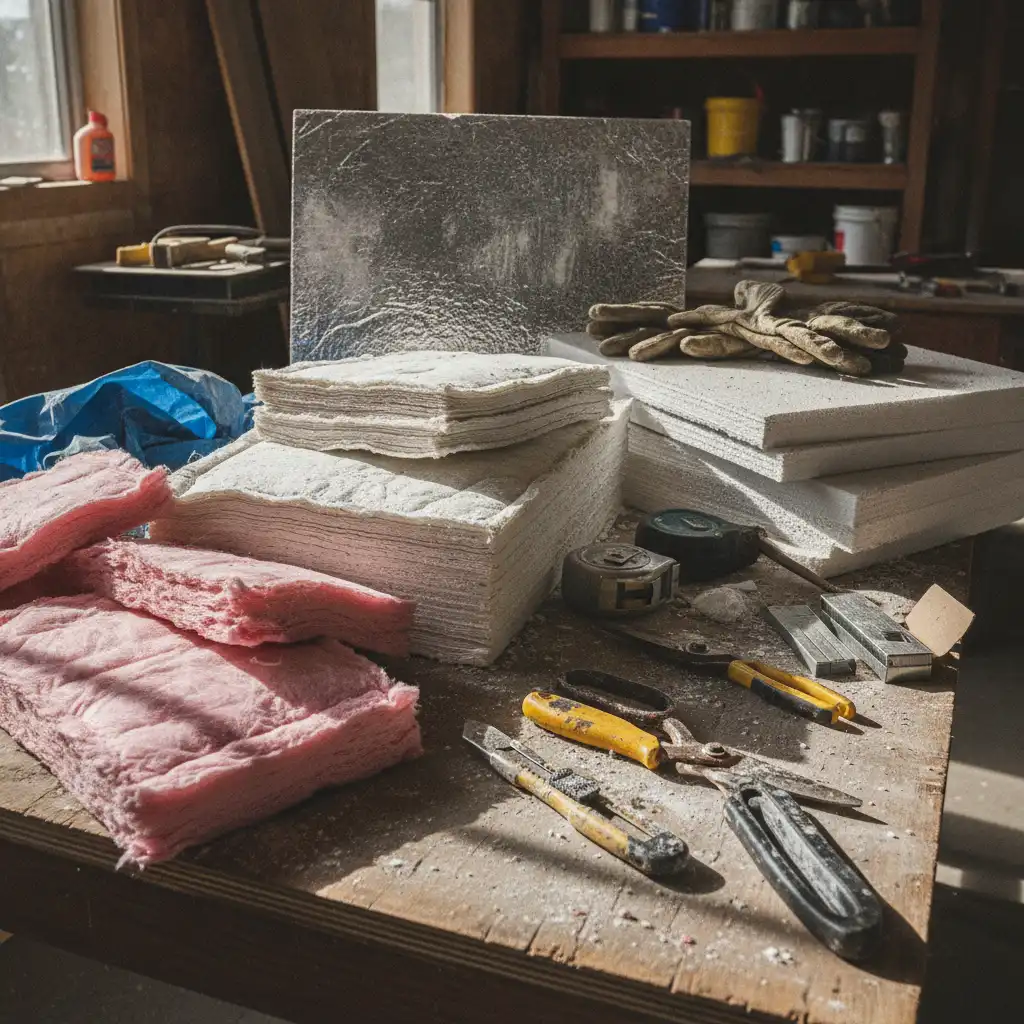
Our team in action — insulation professionals serving Simi Valley
Spray Foam Insulation Methods and Approaches
Closed-Cell Spray Foam
With an R-value of R-6 to R-7 per inch and a vapor-retarding density of approximately 2 lb/ft³, closed-cell spray foam is the preferred choice for Simi Valley crawl spaces, rim joists, and exterior wall cavities in homes near the Arroyo Simi where seasonal moisture is a concern. It also adds measurable structural rigidity to wall assemblies — a benefit in areas subject to seismic activity along the nearby Santa Susana fault zone.
Open-Cell Spray Foam
Softer and more economical per inch, open-cell spray foam is ideal for interior attic applications in Simi Valley’s ranch-style and split-level homes. Applied at 5.5 to 7 inches in roof deck applications, it achieves R-20 or greater while providing excellent sound attenuation — particularly useful for homes near the SR-118 Freeway corridor.
Hybrid Insulation Systems
For maximum performance, we frequently combine a 2-inch closed-cell base coat (for vapor control and structural rigidity) with open-cell fill to reach target R-values at lower overall cost. This hybrid approach is especially effective in Simi Valley attics where temperature extremes require both air sealing and high R-value performance.
Spray Foam for Crawl Space Encapsulation
Combined with full crawl space encapsulation, closed-cell spray foam applied to foundation walls and floor joists creates a conditioned crawl space that eliminates the moisture, mold, and pest infiltration issues common beneath older Simi Valley homes. This approach is particularly effective for properties south of Los Angeles Avenue where seasonal groundwater intrusion occurs.
Ready for Spray Foam Insulation? Get Your Free Estimate Today.
Next Level Insulation of Simi Valley serves Simi Valley and the surrounding area — we’ll be on-site within 24 hours.
📞 Call (805) 774-1832Spray Foam Insulation Cost in Simi Valley, CA
Understanding the investment required for spray foam insulation helps homeowners in Simi Valley make informed decisions. Costs vary based on foam type, application area, thickness required, and site-specific conditions.
Typical Cost Ranges
- Open-Cell Spray Foam: $1.00 to $1.50 per board foot (one square foot at one inch thick), translating to approximately $1,500 to $3,500 for a standard Simi Valley attic of 1,000–1,500 sq ft
- Closed-Cell Spray Foam: $1.75 to $3.00 per board foot, typically $2,500 to $6,500 for crawl space and rim joist applications in a 1,500–2,500 sq ft home
- Full Home Hybrid System: $4,500 to $12,000 depending on home size, existing conditions, and removal requirements
- Insulation Removal (If Required): $1.00 to $2.00 per square foot, adding $1,000 to $3,000 for a typical Simi Valley attic
Simi Valley-Specific Cost Factors
Homes in elevated neighborhoods like Wood Ranch with complex rooflines or steep-pitch tile roofs typically incur higher labor costs due to access difficulty. Properties near the SR-118 corridor that require soundproofing-grade open-cell applications may also see adjusted pricing. Ventura County permit fees for insulation work are generally modest — typically $75 to $200 — but are included in our project quotes when required.
Return on Investment
Simi Valley homeowners typically report energy savings of 20% to 40% on annual heating and cooling costs following spray foam installation, with payback periods of 4 to 8 years depending on home size and prior insulation condition. California’s TECH Clean initiative and SoCal Gas rebate programs may also provide additional financial incentives.
Contact us at (805) 774-1832 for a detailed, no-obligation cost estimate specific to your property.
Simi Valley Neighborhoods We Serve
Wood Ranch
This upscale planned community in eastern Simi Valley features homes largely built between 1987 and 2000, many with complex rooflines, vaulted ceilings, and tile roofing systems. These architectural features create challenging attic configurations where standard blown-in insulation performs poorly, and spray foam’s ability to coat irregular surfaces makes it the preferred solution.
Royal High Estates and Bridle Path
Located at higher elevations in northern Simi Valley, these neighborhoods experience more pronounced winter temperature drops and stronger exposure to downslope Santa Ana wind patterns. Homes here benefit significantly from closed-cell spray foam applications that provide both thermal resistance and air sealing against wind-driven infiltration.
Central Simi Valley (Erringer Road and Stearns Street Corridors)
The dense residential tracts between Erringer Road and Stearns Street include some of Simi Valley’s oldest housing stock, with thousands of homes built between 1965 and 1978. Many have original insulation that has never been replaced, making them prime candidates for insulation removal followed by spray foam upgrading.
Berylwood and Oakdale Neighborhoods
Properties in western Simi Valley closer to the Arroyo Simi channel experience greater seasonal moisture variation and are more likely to present crawl space insulation challenges. We serve these areas with targeted crawl space encapsulation and closed-cell spray foam solutions.
We also serve nearby communities including Chatsworth, Moorpark, Thousand Oaks, and Camarillo.
Maintaining Your Spray Foam Insulation in Simi Valley
One of spray foam insulation’s greatest advantages is its durability — properly installed foam can last the lifetime of the building. However, certain maintenance practices specific to Simi Valley’s environment will help protect your investment.
- Annual Attic Inspections: Schedule a visual inspection each fall before Santa Ana wind season to check for any pest intrusion, roof leak damage, or HVAC duct disconnections that could compromise foam performance.
- Crawl Space Moisture Monitoring: Install a hygrometer in encapsulated crawl spaces and check readings seasonally, particularly after winter rains when the Arroyo Simi watershed sees elevated groundwater.
- Protect Exposed Foam from UV: Any spray foam left exposed in garages or utility areas should be coated with an approved intumescent paint, as California fire code requires thermal barriers over exposed foam in occupied structures.
- Seal New Penetrations Promptly: If new plumbing, electrical, or HVAC work is performed, ensure contractors seal any new penetrations through the foam envelope immediately using compatible spray foam or caulk.
- Post-Wildfire Smoke Assessment: Following any nearby fire event, inspect HVAC filters and air handler equipment for particulate intrusion, and have a professional verify the integrity of your building envelope seals.
- Pest Management Coordination: Work with a licensed pest control operator familiar with Simi Valley’s rodent pressure (particularly roof rats and squirrels common in foothill neighborhoods) to prevent gnawing damage to foam.
Why Choose Next Level Insulation of Simi Valley
When you choose Next Level Insulation of Simi Valley, you work with a team that lives and operates in the same Ventura County communities as our clients. We understand the specific construction styles, climate challenges, and building code requirements that define insulation work in Simi Valley — knowledge that out-of-area contractors simply cannot replicate.
Our technicians are trained in the full spectrum of residential and commercial insulation services, including spray foam installation, attic insulation, blow-in insulation, insulation removal, and crawl space insulation. We approach every project with meticulous attention to detail, from proper surface preparation to thickness verification and final cleanup.
We serve not only Simi Valley but also surrounding communities throughout Ventura and Los Angeles Counties, including Thousand Oaks, Moorpark, Camarillo, Chatsworth, Woodland Hills, Calabasas, and beyond. Our deep regional experience allows us to adapt our methods to the specific conditions of every community we serve.
Ready to experience the difference professional spray foam insulation makes? Call Next Level Insulation of Simi Valley at (805) 774-1832 today.
Frequently Asked Questions About Spray Foam Insulation in Simi Valley
How much does spray foam insulation cost in Simi Valley, CA?
Costs typically range from $1.00 to $1.50 per board foot for open-cell foam and $1.75 to $3.00 per board foot for closed-cell foam. For a typical Simi Valley home, complete attic and crawl space spray foam projects range from $3,500 to $12,000 depending on home size, existing conditions, and whether insulation removal is needed first. We provide free, itemized estimates for every property.
How long does spray foam insulation installation take in Simi Valley?
Most residential spray foam projects in Simi Valley are completed in one to two days. A standard attic application in a 1,500–2,000 sq ft ranch-style home typically takes four to eight hours. Larger projects combining attic work, crawl space encapsulation, and wall cavity foam may require two full days. We will provide a specific timeline in your project proposal.
Do I need to leave my home during spray foam installation?
Yes. Occupants, children, and pets should vacate the property during closed-cell spray foam application and for a minimum of 24 hours afterward while off-gassing occurs. Open-cell applications generally require 2 to 8 hours of ventilation before re-entry. Our team will provide specific re-entry guidance based on your project’s scope.
Is spray foam insulation worth it for older homes in central Simi Valley?
Absolutely. Homes built in the 1965–1985 era in central Simi Valley along the Erringer Road and Stearns Street corridors are among the highest-opportunity properties for spray foam upgrades. Many have never had insulation updates and operate 30% to 50% less efficiently than current standards. Homeowners in these neighborhoods typically see the fastest return on investment due to the significant performance gap being closed.
Can spray foam insulation help with wildfire smoke infiltration in Simi Valley?
Yes. One of spray foam’s most valuable secondary benefits in fire-prone communities like Simi Valley is its ability to seal the gaps and bypasses through which wildfire smoke infiltrates homes. While it is not a complete solution on its own, professionally applied spray foam significantly reduces air infiltration pathways, helping maintain better indoor air quality during smoke events like those experienced during the Easy Fire of October 2019.
What is the difference between open-cell and closed-cell spray foam for Simi Valley homes?
Open-cell foam is softer, less expensive, and ideal for interior attic applications where high volume fill and sound dampening are priorities. Closed-cell foam is denser, moisture-resistant, and structurally reinforcing — making it the right choice for crawl spaces, exterior walls, and areas near moisture sources like the Arroyo Simi watershed. Many Simi Valley projects benefit from a hybrid approach combining both types.
Does spray foam insulation require a building permit in Simi Valley?
Permit requirements vary by project scope and location. The City of Simi Valley Building and Safety Division generally requires permits for insulation work that is part of a larger renovation or when work involves unvented attic assemblies. We handle the permit determination process as part of our project planning and include all required permit fees in our proposals.
How does spray foam compare to blown-in insulation for Simi Valley attics?
Blown-in insulation (cellulose or fiberglass) is air-permeable and settles over time, losing R-value performance. Spray foam creates a seamless, permanent air barrier that maintains its performance for the life of the building and provides the critical air sealing that blown-in products cannot achieve alone. For homes in Simi Valley exposed to Santa Ana winds and wildfire smoke risk, spray foam’s air-sealing capability offers advantages that blown-in insulation simply cannot match. Learn more on our blow-in insulation comparison page.
Get Your Free Spray Foam Insulation Estimate in Simi Valley Today
Whether you are dealing with sky-high summer energy bills, drafty rooms during Santa Ana wind events, moisture issues in your crawl space, or simply an aging home that has never been properly insulated, Next Level Insulation of Simi Valley is ready to help.
Our team serves homeowners and businesses throughout Simi Valley — from Wood Ranch and Royal High Estates to the central residential tracts along Erringer Road — as well as communities across Ventura and Los Angeles Counties including Thousand Oaks, Moorpark, Camarillo, Chatsworth, and Woodland Hills.
Take the first step toward a more comfortable, energy-efficient home today. Call us at (805) 774-1832 to schedule your free, no-obligation on-site assessment. Our experts will evaluate your property, explain your options, and provide a detailed, transparent quote — at no cost to you.
Next Level Insulation of Simi Valley — Bringing Simi Valley Homes to the Next Level of Performance.