

Soundproofing Insulation in Santa Clarita, CA
Expert Soundproofing Insulation in Santa Clarita, CA — Storm-Tested, Warranty-Backed
Get expert soundproofing insulation in Santa Clarita, CA. Next Level Insulation reduces SR-14 freeway & rail noise. Free estimates — call (661) 582-0187.
- Licensed & Insured
- Locally Owned & Operated
- Free Inspection & Estimate
Request Your
Free EstimateSoundproofing insulation is a specialized application of insulation materials designed to reduce, absorb, and block unwanted noise transmission between rooms, floors, and exterior walls. Unlike standard thermal insulation, soundproofing insulation targets sound wave energy — both airborne noise like traffic and voices, and impact noise like footsteps and vibrations from mechanical systems.
Santa Clarita presents a unique acoustic environment. The city’s position along the SR-14 (Antelope Valley Freeway) corridor, its proximity to Union Pacific rail lines, and its rapid residential development across neighborhoods like Canyon Country and Stevenson Ranch mean that noise intrusion is a daily reality for thousands of homeowners and business owners alike.
At Next Level Insulation of Santa Clarita, we bring deep regional knowledge and hands-on expertise to every soundproofing project. Whether you live near the Metrolink station in Newhall or operate a business beside the Valencia Town Center retail corridor, we deliver soundproofing insulation solutions sized and specified for the Santa Clarita Valley’s specific noise challenges. Call us today at (661) 582-0187 to schedule your assessment.
Understanding Soundproofing Insulation
Soundproofing insulation works through four fundamental acoustic mechanisms: absorption, damping, decoupling, and mass addition. Each mechanism targets a different aspect of how sound energy travels through building materials, and effective soundproofing typically combines two or more of these strategies for comprehensive noise control.
Absorption refers to materials that capture sound wave energy and convert it to a negligible amount of heat. Dense-pack cellulose, mineral wool (also known as rock wool or slag wool), and open-cell spray foam are all absorption-focused materials. Damping uses constrained-layer compounds applied between rigid surfaces to reduce the vibration energy that transmits structural noise. Decoupling physically separates wall or floor assemblies so sound cannot travel through a continuous rigid path. Mass simply adds weight to a wall or ceiling assembly — heavier assemblies vibrate less, blocking more sound.
Historically, dedicated soundproofing was considered a luxury reserved for recording studios and high-end hotels. This changed significantly in the early 2000s as national building codes, including California’s Title 24 energy standards, began requiring higher-performance wall assemblies that incidentally improved acoustic performance. By the time Santa Clarita’s population surpassed 200,000 residents in the late 2000s, builder-grade homes in master-planned communities across Saugus and Fair Oaks Ranch were still being constructed with minimal acoustic consideration — creating the large installed base of under-performing homes that drives demand for retrofit soundproofing today.
Residential building types in Santa Clarita most commonly in need of soundproofing insulation include single-family tract homes built between 1988 and 2010 across Canyon Country and Stevenson Ranch, two-story condominiums and townhomes in the Valencia area, commercial-to-residential mixed-use structures near the Newhall corridor, and multi-family rental properties in the Sand Canyon Road communities. Each building type presents its own acoustic pathway challenges, requiring tailored material selection and installation strategy.
Understanding the science behind soundproofing ensures that every dollar invested in insulation delivers measurable, lasting noise reduction rather than superficial improvement. Learn more about our insulation installation services
Why Soundproofing Insulation Is Needed in Santa Clarita, CA
SR-14 and Interstate 5 Traffic Noise
The Antelope Valley Freeway (SR-14) runs directly through the heart of Santa Clarita, with traffic volumes exceeding 130,000 vehicles per day near the I-5 interchange in Valencia according to Caltrans 2022 traffic counts. Homes within 1,500 feet of the SR-14 corridor — including significant residential clusters in Canyon Country east of Soledad Canyon Road and neighborhoods abutting the freeway in Saugus — regularly experience exterior noise levels between 65 and 72 decibels during peak commute hours. California’s noise standards for residential land use set a goal of 65 dB exterior and 45 dB interior. Without adequate soundproofing insulation, homes near SR-14 can experience interior noise levels 15 to 20 decibels above comfortable thresholds.
Union Pacific and Metrolink Rail Corridors
The Union Pacific main line and Metrolink Antelope Valley Line both pass through the Santa Clarita Valley, with active rail operations running through Newhall and alongside the Golden Valley Road residential corridor. Metrolink’s Newhall Station sees dozens of daily train movements, and low-frequency vibration from freight trains — which can measure 75 dB or higher at close range — penetrates standard drywall and fiberglass batt insulation with minimal attenuation. Homes within a quarter mile of the rail corridor in Newhall and North Newhall require higher-mass and decoupled wall assemblies to achieve acceptable indoor noise levels.
Construction and Development Activity
Santa Clarita’s active master-planned community development — including ongoing projects in Skyline Ranch and the broader FivePoint Valencia development planned for up to 21,500 new homes — means that construction noise from grading, heavy equipment, and framing operations is a persistent, multi-year reality for existing residents in nearby neighborhoods like Castaic and Stevenson Ranch. During peak construction phases, ambient daytime noise near active grading sites can sustain levels of 80 to 85 dB.
Santa Ana Wind Events and HVAC Noise
Santa Clarita sits in the path of seasonal Santa Ana wind events, which funnel through the Soledad Pass and down the valley floor. Wind-driven noise against poorly sealed wall assemblies and attic cavities can generate interior noise levels that disrupt sleep and concentration. Additionally, the region’s extreme summer temperatures — regularly exceeding 100°F in July and August — force HVAC systems to run at high capacity for extended daily cycles, with compressor and air handler noise penetrating inadequately insulated walls and ceilings.
Attached and Multi-Family Housing Density
Valencia’s planned community design includes a significant stock of attached townhomes and condominiums, particularly in the Westridge, West Creek, and Northbridge communities. Party wall noise — footsteps, voices, plumbing — is among the most common complaints from homeowners in these attached-unit developments, and builder-grade assemblies rarely achieve the STC 50 rating that California’s building code recommends for attached residential units.
Signs You Need Soundproofing Insulation
Noise Intrusion from Outside
- You can clearly hear SR-14 or I-5 traffic from inside your living room with windows closed
- Metrolink or freight train passages are audible and disruptive throughout your home
- Neighborhood construction from nearby Skyline Ranch or FivePoint development sites penetrates your home office or bedroom
- Santa Ana wind events create noticeable whistling or rumbling through exterior walls
Interior-to-Interior Noise Problems
- Conversations from adjoining rooms are clearly intelligible through shared walls
- Footsteps from the floor above are loud enough to interrupt sleep or concentration
- Plumbing noise — flushing, pipe vibration — travels audibly through walls and ceilings
- Home theater or music audio bleeds into adjacent bedrooms
Mechanical and HVAC Noise
- Air handler or furnace noise from attic-mounted systems is audible in living areas below
- HVAC ductwork vibration creates persistent low-frequency hum in ceilings
Urgency Indicators
- Noise disruption is causing sleep deficits or work-from-home productivity losses
- Rental property tenant complaints about noise have become frequent
- You are listing your home for sale and need to address a known noise issue
Our Soundproofing Insulation Process
Acoustic Assessment and Noise Mapping (Day 1 — 1 to 2 Hours)
We begin every project with a structured site walk and noise mapping session. Using calibrated sound level meters, we measure decibel readings in each room at representative times of day, identify primary noise pathways — whether freeway flanking from SR-14, rail vibration from the Metrolink corridor, or party wall transmission in a Valencia townhome — and document existing insulation conditions in walls, attic, and crawl space. This step ensures our recommendations are grounded in actual acoustic data specific to your property’s location within Santa Clarita.
Proposal and Material Specification (Days 2 to 3)
Based on the acoustic assessment, we prepare a detailed written proposal specifying materials, installation methods, projected STC and IIC ratings, and cost. We explain how each material choice addresses Santa Clarita’s specific noise sources — for example, recommending mineral wool over fiberglass batts for homes near the rail corridor because of mineral wool’s superior low-frequency absorption.
Preparation and Protection (Installation Day — First 30 to 60 Minutes)
Before any work begins, we protect flooring, furniture, and HVAC registers with professional-grade poly sheeting. For attic or crawl space work, we establish clean access routes compliant with Santa Clarita’s residential access requirements.
Existing Insulation Removal if Required (2 to 4 Hours)
Many Santa Clarita homes built between 1990 and 2005 contain degraded fiberglass batt insulation that must be removed before soundproofing materials can be correctly installed. We handle complete insulation removal using HEPA-filtered vacuum equipment. Learn about our insulation removal services
Soundproofing Insulation Installation (4 to 8 Hours Depending on Scope)
Our installation crews apply the specified soundproofing system — dense-pack cellulose, mineral wool batts, spray foam, or a combined assembly — following manufacturer specifications and California Title 24 compliance requirements. All penetrations and gaps are sealed with acoustic sealant to eliminate flanking paths.
Quality Verification and Post-Installation Measurement (1 Hour)
After installation is complete, we perform a follow-up sound level measurement in treated spaces to verify noise reduction performance. We compare pre- and post-installation readings and provide you with a written summary of achieved results.
Cleanup and Final Walkthrough (30 to 45 Minutes)
We remove all protective sheeting, vacuum work areas, and conduct a room-by-room walkthrough with the homeowner to confirm satisfaction and answer any follow-up questions about maintenance.
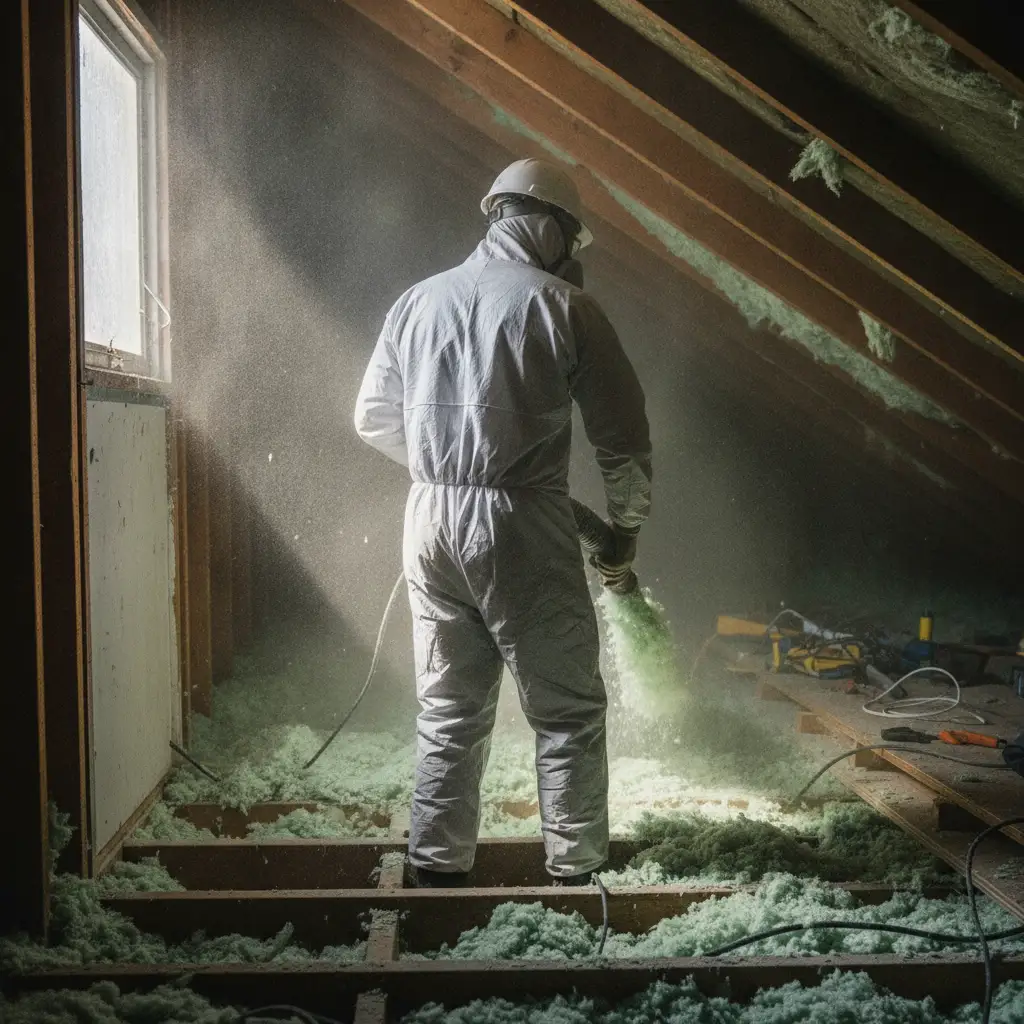
Our team in action — insulation professionals serving Santa Clarita
Soundproofing Insulation Methods and Approaches
Dense-Pack Cellulose Insulation
Dense-pack cellulose is blown into existing wall cavities at densities of 3.5 to 4.0 pounds per cubic foot, filling all voids and providing both thermal and acoustic performance. This method is ideal for Santa Clarita homes built in the 1990s where wall cavities are accessible through attic or crawl space, or where small drill-and-fill access points can be used to avoid full drywall demolition. Cellulose achieves STC ratings of 44 to 46 in standard wood-framed wall assemblies. Learn more about our blow-in insulation services
Mineral Wool (Rock Wool) Batt Insulation
Mineral wool batts — such as Rockwool Safe’n’Sound — are the preferred choice for new construction or open-wall renovation projects, particularly in homes near the Metrolink rail corridor in Newhall where low-frequency noise control is critical. Mineral wool is non-combustible, moisture-resistant (important during Santa Clarita’s wet winter seasons), and achieves STC ratings of 45 to 52 depending on wall assembly design.
Spray Foam Insulation
Open-cell spray foam provides excellent absorption of mid- to high-frequency airborne noise and is particularly effective for attic decks and roof lines in Canyon Country homes exposed to SR-14 traffic noise. Closed-cell spray foam adds mass and an air seal, reducing flanking noise through gaps and penetrations. Learn more about spray foam insulation
Crawl Space and Floor Insulation
For two-story homes and condominiums where impact noise from upper floors is a concern, we install high-density insulation batts in floor joist cavities combined with resilient channel systems when structural access permits. Learn more about crawl space insulation
Combined Acoustic Assemblies
For maximum noise reduction in homes near major noise sources, we design multi-layer assemblies combining insulation, acoustic sealant, and decoupling components to achieve STC ratings of 55 or higher.
Ready for Soundproofing Insulation? Get Your Free Estimate Today.
Next Level Insulation of Santa Clarita serves Santa Clarita and the surrounding area — we’ll be on-site within 24 hours.
📞 Call (661) 582-0187Soundproofing Insulation Cost in Santa Clarita, CA
Soundproofing insulation costs in Santa Clarita vary based on the scope of treatment, materials selected, accessibility of wall and ceiling cavities, and the severity of the noise problem being addressed. Below are representative cost ranges based on typical Santa Clarita residential projects.
Typical Cost Ranges
- Single room dense-pack cellulose treatment (existing walls, no drywall removal): $800 to $1,800
- Single room mineral wool batt installation (open walls or new construction): $1,200 to $2,500
- Full home dense-pack cellulose soundproofing (1,500 to 2,000 sq ft home): $4,500 to $9,000
- Attic spray foam soundproofing for traffic noise: $2,000 to $6,000 depending on attic square footage
- Party wall treatment for Valencia or Stevenson Ranch townhome: $1,500 to $4,000 per shared wall
- Combined acoustic assembly with decoupling (premium): $3,500 to $8,000 per room
Factors That Affect Pricing
- Whether existing insulation must be removed before soundproofing materials are installed
- Wall cavity accessibility — retrofit blow-in work is less costly than open-wall installations
- Number of floors and total linear feet of treated wall or ceiling area
- Proximity to high-intensity noise sources like SR-14 or the Union Pacific rail line, which may require premium-grade assemblies
- Current material costs, which fluctuate with regional supply chain conditions in the Los Angeles metro area
We provide detailed written estimates following every acoustic assessment so there are no surprises. Call (661) 582-0187 for your free cost consultation. Learn more about soundproofing insulation costs in Santa Clarita
Neighborhoods We Serve in Santa Clarita and Surrounding Areas
Canyon Country
Canyon Country’s residential tracts, largely built between 1985 and 2005 along Soledad Canyon Road and Sand Canyon Road, sit within close proximity to SR-14 and experience significant freeway and wind-channeling noise. Many homes here have original fiberglass batt insulation that provides minimal acoustic benefit. We frequently perform dense-pack cellulose retrofits and attic spray foam applications in Canyon Country.
Newhall
Newhall’s older residential and mixed-use stock — including homes built in the 1960s and 1970s near the Metrolink station and the Union Pacific corridor — requires specialized low-frequency noise treatment. We have experience retrofitting Newhall’s older balloon-frame and platform-frame structures with modern soundproofing assemblies.
Stevenson Ranch
Stevenson Ranch’s planned community townhomes and single-family homes near the I-5 and SR-126 interchange corridors represent a significant portion of our party wall and freeway noise soundproofing projects. Homes here are typically 1990s to early 2000s construction with standard 2×4 framing.
Castaic and Valencia
We also serve Castaic, Porter Ranch, Northridge, Granada Hills, Chatsworth, Mission Hills, Sylmar, North Hills, Canoga Park, San Fernando, and Simi Valley. View all of our service areas
Soundproofing Insulation Maintenance Tips for Santa Clarita Homeowners
- Inspect attic insulation annually for settling. Santa Clarita’s extreme summer heat — with July temperatures routinely above 100°F — can accelerate settling in cellulose insulation, reducing both acoustic and thermal performance over time.
- Seal new wall penetrations immediately. Any new electrical outlet, cable, or plumbing penetration through a treated wall must be sealed with acoustic caulk to prevent creating new sound flanking paths.
- Check crawl space insulation after wet winters. Santa Clarita’s periodic heavy rainfall events — such as the atmospheric river events of early 2023 — can introduce moisture into crawl spaces, degrading insulation performance. Learn about crawl space encapsulation
- Maintain weatherstripping on doors and windows. Soundproofing insulation performs best when the entire building envelope is tight. Worn weatherstripping on exterior doors is a common flanking path for freeway noise.
- Inspect HVAC duct connections in treated attics. Loose duct joints allow both air and sound to bypass insulated assemblies.
- Avoid compressing batt insulation during storage use. Homeowners who store items in insulated attic spaces should ensure that nothing is placed directly on top of insulation batts, as compression reduces acoustic performance.
- Schedule a professional reassessment every 5 to 7 years. Material performance, building settling, and new noise sources (like expanding development in the FivePoint Valencia community) may warrant insulation system updates.
Why Choose Next Level Insulation of Santa Clarita
Next Level Insulation of Santa Clarita is a locally focused insulation contractor with deep familiarity with the Santa Clarita Valley’s unique noise environment. We understand how the SR-14 freeway corridor, Metrolink rail operations, Santa Ana wind events, and the Valley’s rapid residential development combine to create noise challenges that generic insulation solutions don’t adequately address.
Our team has hands-on experience with the full range of building types found across Santa Clarita — from 1960s Newhall bungalows to 2000s Canyon Country tract homes to Valencia planned community townhomes. We select materials and installation methods based on the specific acoustic profile of each project, not a one-size-fits-all approach.
We offer a complete range of related insulation services including spray foam insulation, attic insulation, blow-in insulation, crawl space encapsulation, and insulation removal and replacement — meaning we can address your entire building envelope in a single coordinated project rather than requiring you to coordinate multiple contractors.
We serve homeowners, landlords, and commercial clients throughout Santa Clarita and the surrounding San Fernando Valley and Simi Valley communities. Call us at (661) 582-0187 to speak with a local soundproofing specialist.
Frequently Asked Questions About Soundproofing Insulation in Santa Clarita
How much does soundproofing insulation cost in Santa Clarita?
Costs vary significantly based on scope and materials. A single-room retrofit using dense-pack cellulose typically runs $800 to $1,800. A full-home treatment for a 1,500 to 2,000 square foot Santa Clarita tract home ranges from $4,500 to $9,000. Homes near SR-14 or the Metrolink corridor that require premium acoustic assemblies may see higher costs. We provide free, itemized estimates after an on-site acoustic assessment.
How long does a soundproofing insulation installation take?
A single-room retrofit can typically be completed in one day. A whole-home soundproofing project for an average Santa Clarita tract home generally takes two to four days depending on the number of rooms treated, whether existing insulation removal is required, and the complexity of the acoustic assembly specified.
Will soundproofing insulation completely eliminate freeway noise from SR-14?
No insulation system eliminates all exterior noise, but a properly designed and installed soundproofing assembly can reduce perceived noise levels by 50 to 70 percent. For a Canyon Country home currently experiencing 70 dB interior noise from SR-14 traffic, a comprehensive soundproofing treatment targeting the building’s primary flanking paths can realistically achieve interior levels of 45 to 50 dB — within California’s recommended residential interior noise guideline.
Can soundproofing insulation be installed without tearing out drywall?
In many cases, yes. Our dense-pack cellulose blow-in method uses small drilled access holes to fill existing wall cavities without requiring full drywall removal. This is the most common approach for 1990s and 2000s Santa Clarita tract homes where walls are already closed. New construction or renovation projects with open wall framing can take advantage of batt insulation installation without any drywall disruption.
What is the difference between soundproofing insulation and regular thermal insulation?
Standard fiberglass batt insulation is designed primarily for thermal resistance (R-value) with limited acoustic benefit. Soundproofing insulation — such as dense-pack cellulose, mineral wool, or combined decoupling assemblies — is engineered to maximize sound transmission loss (STC rating) and impact isolation (IIC rating). For Santa Clarita homes near SR-14 or the Metrolink line, standard insulation alone provides inadequate noise control.
Does Santa Clarita have any local regulations about soundproofing in residential buildings?
California’s Title 24 Building Energy Efficiency Standards and California Building Code Section 1207 establish minimum acoustic performance requirements for new residential construction, including an STC of 50 for party walls in multi-family housing. Retrofit projects are not subject to the same mandatory standards, but meeting or exceeding these benchmarks is our target for all soundproofing installations.
Is soundproofing insulation worth it for a rental property in Santa Clarita?
Yes. Santa Clarita’s rental market is competitive, and tenant retention is directly linked to quality-of-life factors including interior noise levels. Landlords with properties near SR-14, the Metrolink corridor, or active development zones in Castaic and Canyon Country frequently see improved tenant satisfaction and reduced turnover after soundproofing upgrades. The investment typically recovers through extended tenancies within 12 to 24 months.
What areas near Santa Clarita do you serve?
In addition to all Santa Clarita communities — including Valencia, Newhall, Canyon Country, Saugus, and Stevenson Ranch — we serve Castaic, Porter Ranch, Granada Hills, Northridge, North Hills, Chatsworth, Canoga Park, Mission Hills, Sylmar, San Fernando, and Simi Valley. View our complete service area
Get Your Free Soundproofing Insulation Assessment in Santa Clarita Today
If freeway noise from SR-14, rail vibration from the Metrolink corridor, or party wall noise in your Valencia townhome is affecting your quality of life, Next Level Insulation of Santa Clarita is ready to help. Our team will come to your home, measure actual noise levels, identify the primary sound pathways, and provide a clear, written proposal for a soundproofing insulation solution tailored to your property and your budget.
Don’t settle for sleepless nights or distracted workdays. Santa Clarita’s noise environment is real — and so are the solutions. Contact us today to take the first step toward a quieter, more comfortable home or business.
Call us at (661) 582-0187 to schedule your free acoustic assessment. We proudly serve all of Santa Clarita and the surrounding San Fernando Valley communities.