

Roof Insulation in Santa Clarita, CA
Expert Roof Insulation in Santa Clarita, CA — Storm-Tested, Warranty-Backed
Need roof insulation in Santa Clarita, CA? Next Level Insulation installs R-38 to R-60 attic systems for homes across the Santa Clarita Valley. Call (661) 582-0187 for a free estimate.
- Licensed & Insured
- Locally Owned & Operated
- Free Inspection & Estimate
Request Your
Free EstimateRoof insulation is the thermal and moisture barrier installed between your living space and the extreme outdoor temperatures that define Santa Clarita’s climate. By creating a continuous layer of resistance against heat transfer, roof insulation keeps conditioned air inside your home and prevents the punishing summer heat from driving up your energy bills month after month.
Santa Clarita sits in a high-desert valley where summer temperatures routinely push past 100°F and rooftop surface temperatures can exceed 160°F on a cloudless July afternoon. Without adequate roof insulation, that heat radiates directly into your attic and then into every room below. Winter nights also dip into the 30s, creating a year-round demand for a properly insulated thermal envelope.
At Next Level Insulation of Santa Clarita, our team installs, removes, and upgrades roof insulation systems specifically designed for the building styles, climate conditions, and energy codes governing homes and commercial properties throughout the Santa Clarita Valley. Call us at (661) 582-0187 to schedule your assessment today.
Understanding Roof Insulation in Santa Clarita, CA
Roof insulation refers to any material or system placed at the roofline or within the attic assembly to resist the flow of heat between the exterior environment and interior living spaces. The science behind it is straightforward: heat always moves from warmer areas to cooler ones, and insulation slows that movement by trapping millions of tiny air pockets within its structure. The effectiveness of any insulation product is measured by its R-value — a number that quantifies thermal resistance. The higher the R-value, the slower heat moves through the material.
Historically, homes built in the Santa Clarita Valley before the 1980s received minimal insulation because energy was cheap and building codes required little. The communities of Newhall and Canyon Country, which developed rapidly after World War II and again through the 1970s, feature thousands of ranch-style homes and split-level houses whose original attic insulation amounts to just 2 to 3 inches of deteriorated fiberglass batts — delivering an effective R-value of R-6 or lower. Modern California Title 24 energy code requires a minimum of R-38 for attic assemblies in Climate Zone 9, which covers most of the Santa Clarita area, meaning many older homes are operating at a fraction of the required thermal protection.
The Santa Clarita Valley experienced dramatic population growth following the incorporation of the City of Santa Clarita in 1987. Master-planned communities like Valencia, Stevenson Ranch, and portions of Canyon Country were built through the 1990s and 2000s and generally received better insulation than earlier construction. However, even those homes are now 20 to 30 years old, and blown-in cellulose or fiberglass insulation from that era has often settled, compacted, or been disturbed by HVAC contractors, creating gaps and voids in coverage.
Commercial and industrial buildings along Soledad Canyon Road, Golden Valley Road, and the industrial parks near Magic Mountain Parkway present their own challenges. Large flat or low-slope roofs absorb enormous amounts of solar radiation, and many of these buildings rely on outdated spray-applied or board insulation systems that have never been updated to meet modern energy performance benchmarks.
Understanding the specific age and construction type of your Santa Clarita property is the starting point for designing a roof insulation solution that actually performs under local conditions.
Why Roof Insulation Is Needed in Santa Clarita, CA
Santa Clarita’s climate is classified as a semi-arid, hot-summer Mediterranean climate (Köppen BSk/Csa boundary), and that designation carries real consequences for every home and building in the valley. The combination of intense solar radiation, dramatically low humidity, and wide diurnal temperature swings creates thermal stress on buildings that is more severe than almost anywhere else in the greater Los Angeles region.
Extreme Summer Heat Loads: The National Weather Service station at the Santa Clarita Valley records average July highs of 97°F, but the infamous 2020 heat dome event pushed temperatures at Newhall and Canyon Country monitoring stations to 117°F on September 6, 2020 — one of the highest readings ever recorded in the valley’s history. On such days, an uninsulated or under-insulated attic acts as a heat reservoir. Studies from Lawrence Berkeley National Laboratory show that attic air temperatures in poorly insulated homes can reach 150°F to 160°F during extreme heat events, forcing HVAC systems to run continuously and dramatically accelerating equipment wear.
Santa Ana Wind Events: Each autumn and winter, Santa Ana winds sweep through the passes surrounding the Santa Clarita Valley — including Weldon Canyon, the Newhall Pass, and the San Francisquito Canyon corridor — at sustained speeds of 40 to 70 mph with gusts exceeding 90 mph. These events strip moisture from roofing materials, infiltrate gaps in attic assemblies, and can displace loose-fill insulation within attic cavities. The November 2019 Easy Fire, which burned portions of Simi Valley and threatened Newhall-area neighborhoods, underscored both the fire risk associated with desiccating winds and the importance of maintaining sealed, code-compliant attic assemblies that don’t allow embers to enter through unprotected vents.
Wildfire Ember Intrusion: Following Calfire’s post-fire investigations of structures lost in the 2016 Sand Fire (which burned 41,432 acres in the Santa Clarita Valley and destroyed dozens of homes in Bouquet Canyon and Sand Canyon), researchers confirmed that ember intrusion through attic vents was a leading cause of ignition. Properly air-sealed and insulated attic assemblies with compliant vent covers provide an additional layer of protection against this specific threat.
Soil and Foundation Interaction: The Santa Clarita Valley is underlain partly by expansive clay soils — particularly in the older hillside communities of Canyon Country and portions of Stevenson Ranch. Temperature cycling accelerates soil movement, which stresses crawl space structures and subflooring in homes with combination slab and raised-foundation designs. Adding roof insulation reduces the magnitude of temperature swings transmitted into the building structure, reducing long-term stress on framing members.
Utility Costs: Southern California Gas and Southern California Edison both serve Santa Clarita, and electricity rates in SCE’s territory have increased by over 30% since 2019. Homeowners with inadequate roof insulation in neighborhoods like Granada Hills (on the valley’s south face), Porter Ranch, and Northridge report average summer cooling bills of $350 to $500 per month. Upgrading to code-minimum R-38 insulation typically reduces cooling loads by 15% to 25%, delivering measurable savings within the first billing cycle after installation.
Signs You Need Roof Insulation Service
Energy Performance Indicators
- Monthly SCE electricity bills exceeding $300 during June, July, and August even with a modern HVAC system
- HVAC system running continuously for more than 20 minutes per cycle on days above 95°F
- Thermostat set points that simply cannot be maintained during afternoon peak heat hours
Physical Conditions in the Attic
- Existing insulation depth below 10 inches (indicating R-value likely below R-30)
- Visible gaps, voids, or pathways created by HVAC ducts, electrical wiring, or pest intrusion
- Insulation that appears dark, matted, dusty, or compressed — all signs of air filtration damage or moisture exposure
- Evidence of rodent nesting, pest damage, or moisture staining on existing insulation batts
Comfort and Structural Symptoms
- Upstairs rooms that are noticeably hotter than downstairs rooms, particularly in two-story tract homes common in Valencia and Canyon Country
- Ice dams or frost accumulation at eave edges during January cold snaps in the Castaic and Stevenson Ranch foothills
- Musty odors entering living spaces from the attic, suggesting moisture accumulation within insulation layers
Urgency Note: Any sign of moisture intrusion within attic insulation should be treated as an immediate concern because mold can develop within 24 to 48 hours in the warm, humid micro-environments created by leaking roofs or condensation problems.
Our Roof Insulation Process in Santa Clarita
Comprehensive Attic and Roofline Assessment (1–2 Hours)
Our certified technician accesses your attic assembly and performs a full inspection using a calibrated insulation depth probe and thermal imaging camera. We document existing R-values, identify air-sealing deficiencies, evaluate ventilation adequacy, and check for any signs of moisture, pest activity, or structural concerns. In Santa Clarita, we specifically assess ember-intrusion risk through gable and soffit vents, which is a unique local concern given the valley’s wildfire history.
Removal of Damaged or Inadequate Existing Insulation (2–8 Hours)
When existing insulation is contaminated, compressed below functional R-value, or pest-damaged, we remove it using high-powered vacuum extraction equipment that captures material without spreading particulates into living spaces. All removed material is bagged and disposed of in compliance with Los Angeles County regulations. Learn more about our insulation removal service
Air Sealing and Penetration Sealing (1–3 Hours)
Before any new insulation is installed, we seal every penetration — top plates, recessed light cans, HVAC boot connections, plumbing chases, and attic access hatches — using two-part spray foam or fire-rated caulk. This step is critical in Santa Clarita’s climate because unsealed penetrations allow superheated attic air to bypass insulation layers entirely.
Vent Baffling and WUI Compliance Review (1–2 Hours)
We install rafter baffles to maintain required ventilation channels and, where applicable, review vent covers for compliance with California’s Wildland-Urban Interface (WUI) construction standards — a requirement in Fire Hazard Severity Zones that include many Santa Clarita neighborhoods.
Insulation Installation (2–6 Hours)
New insulation is installed to meet or exceed California Title 24 Climate Zone 9 requirements (minimum R-38, recommended R-49 to R-60 for maximum performance). We install blow-in fiberglass, cellulose, or spray foam depending on your specific roofline geometry, budget, and performance goals. Explore our spray foam insulation options
Post-Installation Quality Verification (30–60 Minutes)
We perform a final depth check across a grid of measurement points and provide photographic documentation of completed work. Every installation meets California Energy Commission reporting requirements.
Client Walkthrough and Maintenance Briefing
We walk you through what was completed, how to monitor attic conditions going forward, and what Santa Clarita-specific seasonal events — Santa Ana winds, summer heat events — you should watch for.
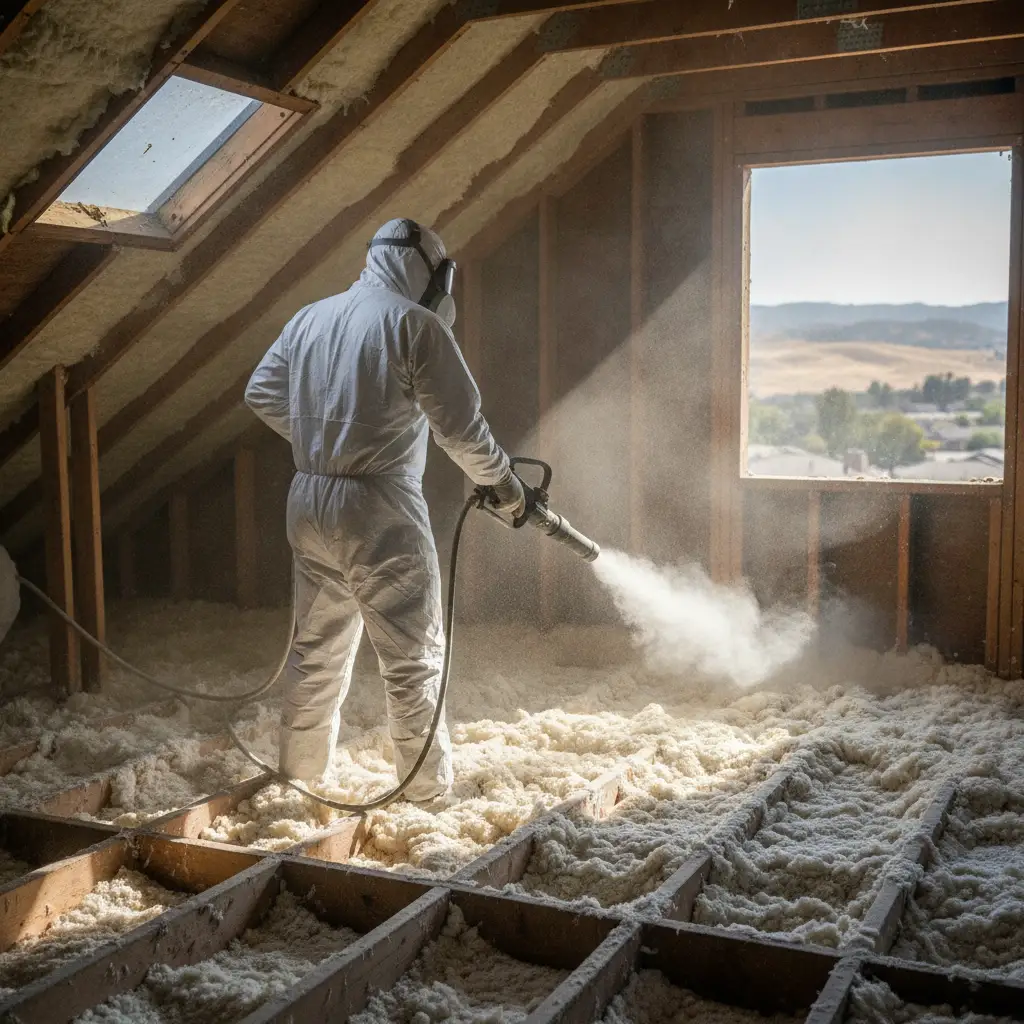
Our team in action — insulation professionals serving Santa Clarita
Roof Insulation Methods and Approaches
Blown-In Fiberglass Insulation
Loose-fill fiberglass is our most commonly installed product for open attic cavities in Santa Clarita homes. It achieves R-38 at approximately 12 inches of depth and is non-combustible — an important consideration in the Valley’s fire-prone environment. It installs quickly, conforms to irregular framing, and does not settle as dramatically as older cellulose products. Ideal for: tract homes built in Valencia, Canyon Country, and Stevenson Ranch from the 1990s through 2010s. Learn more about blow-in insulation
Spray Foam Insulation
Two-component closed-cell or open-cell spray polyurethane foam (SPF) is applied directly to the underside of roof decking in unvented attic assemblies, or to specific penetration points and irregular cavities. Closed-cell spray foam delivers R-6.5 per inch and doubles as an air and vapor barrier — making it the highest-performance option available. Particularly effective for cathedral ceiling sections, metal-frame commercial roofs along the Highway 14 corridor, and homes in Castaic where temperature extremes are greatest. Explore spray foam insulation
Attic Blow-In Cellulose
Recycled cellulose remains a cost-effective option and carries a high recycled content. It performs well in conditioned attic spaces but requires attention to moisture management in Santa Clarita’s occasional monsoon-season humidity events. See our full attic insulation services
Rigid Board Insulation
Polyisocyanurate or EPS rigid boards are installed above roof decking on flat and low-slope commercial roofs — common on the industrial and retail buildings throughout the City of Santa Clarita’s commercial corridors. Boards deliver consistent R-values without settling and are compatible with most commercial roofing membrane systems.
Insulation Replacement
For homes where existing insulation is simply outdated rather than damaged, a targeted replacement upgrade — removing the old material and installing a fresh, full-depth system — restores full thermal performance. Learn about insulation replacement
Ready for Roof Insulation? Get Your Free Estimate Today.
Next Level Insulation of Santa Clarita serves Santa Clarita and the surrounding area — we’ll be on-site within 24 hours.
📞 Call (661) 582-0187Roof Insulation Cost in Santa Clarita, CA
Understanding the cost of roof insulation helps Santa Clarita homeowners and property managers budget accurately and evaluate proposals. Prices vary based on attic square footage, current insulation condition, access difficulty, and product selected.
Typical Price Ranges
- Blown-in fiberglass to R-38 (standard attic): $1.50 to $2.50 per square foot installed. For a typical 1,500 sq ft Santa Clarita ranch home, expect $2,250 to $3,750 for attic coverage.
- Blown-in fiberglass to R-49 or R-60 (premium performance): $2.00 to $3.50 per square foot, or $3,000 to $5,250 for the same home footprint.
- Closed-cell spray foam (unvented attic or cathedral ceiling): $5.00 to $8.00 per square foot installed, making it the premium-tier option.
- Insulation removal only (prior to replacement): $1.00 to $2.00 per square foot, or $1,500 to $3,000 for a typical residential attic.
- Combined removal and re-installation: $3.00 to $5.50 per square foot depending on product selected.
Location-Specific Cost Factors in Santa Clarita
Homes in the hillside communities of Canyon Country and Castaic often have attic access points that require additional labor due to steep roof pitches and limited hatch clearances, adding $200 to $600 to standard project costs. Homes built in Wildland-Urban Interface zones may require ember-resistant vent upgrades alongside insulation work, adding $300 to $800 depending on the number of vents. California’s active utility rebate programs — including SCE’s Home Energy Efficiency Rebate program — can offset $200 to $500 of project costs for qualifying upgrades to R-49 or above.
Call (661) 582-0187 for a free, no-obligation estimate specific to your Santa Clarita property.
Santa Clarita Neighborhoods We Serve
Canyon Country
Canyon Country’s housing stock spans from post-war ranch homes built in the 1950s and 1960s to larger estates developed through the 2000s. The older homes along Soledad Canyon Road frequently have original fiberglass batt insulation at R-6 to R-11 — far below current standards. The area’s hillside terrain also creates access challenges that our crews are equipped to handle efficiently.
Stevenson Ranch
Developed primarily between 1991 and 2005, Stevenson Ranch homes generally have better original insulation than older Santa Clarita neighborhoods, but 20 to 30 years of settling and HVAC service access has created gaps in many attic assemblies. Two-story Mediterranean-style homes here often have complex rooflines with cathedral ceiling sections requiring spray foam application.
Newhall
As one of Santa Clarita’s oldest communities, Newhall contains Craftsman bungalows and early mid-century homes that predate modern insulation requirements entirely. Many properties here benefit most from complete removal and replacement rather than top-off upgrades.
Castaic
Castaic’s elevation and proximity to the Tehachapi Mountain foothills creates some of the most extreme temperature swings in the Santa Clarita area. Homes here experience wider diurnal ranges and benefit most from high-performance R-49 to R-60 attic systems. We also serve surrounding communities including Canoga Park, Chatsworth, Mission Hills, Sylmar, Granada Hills, Porter Ranch, and more.
Roof Insulation Maintenance Tips for Santa Clarita Homeowners
- Inspect attic depth annually in October: Before Santa Ana wind season intensifies, verify that your insulation depth is consistent across the attic floor. A simple ruler check can confirm whether settled or disturbed material has reduced effective R-value.
- Clear attic vents after wind events: Following Santa Ana wind episodes, check soffit and gable vents for debris, displaced screening, or insulation that has migrated toward vent openings.
- Check attic access hatch insulation and weatherstripping: Attic hatches are a primary air leakage point. Verify that hatch covers remain in position and that gaskets have not dried and cracked — a common issue in Santa Clarita’s low-humidity environment.
- Schedule post-HVAC service inspections: Any time an HVAC technician accesses your attic, have them note whether they disturbed insulation. Even minor displacement can create significant thermal bypass points.
- Monitor for pest activity: Roof rats and squirrels are active throughout the Santa Clarita Valley. Evidence of nesting within attic insulation should prompt immediate pest remediation followed by insulation inspection.
- Confirm vent cover integrity in WUI zones: If your home is in a designated Fire Hazard Severity Zone, inspect attic vent screens each fall for corrosion, damage, or gaps larger than 1/16 inch per California WUI requirements.
- Review utility bills each June: A sudden increase in cooling costs relative to prior years — without a change in usage habits — often indicates insulation degradation and warrants a professional assessment.
Why Choose Next Level Insulation of Santa Clarita
Next Level Insulation of Santa Clarita is a locally focused insulation contractor serving homeowners, property managers, and commercial building owners throughout the Santa Clarita Valley and surrounding communities. We are not a national franchise dispatching unfamiliar crews — we are a team that lives and works in this valley and understands what the Newhall Pass wind events, the Sand Fire rebuilding wave, and the relentless July heat demand from a properly installed insulation system.
Our technicians are trained in California Title 24 compliance requirements for Climate Zone 9, WUI fire-resilient attic assembly best practices, and the full range of insulation products from blown-in fiberglass to closed-cell spray foam. Every project we complete is designed around the specific thermal performance goals, building construction, and budget of the individual property — not a one-size-fits-all specification.
We offer free on-site assessments with thermal documentation so you can see exactly what you have before committing to any work. Our service area covers all of Santa Clarita as well as neighboring communities including Castaic, Stevenson Ranch, Porter Ranch, Northridge, Granada Hills, Simi Valley, and San Fernando. Contact us to schedule your free assessment or call (661) 582-0187 today.
Frequently Asked Questions About Roof Insulation in Santa Clarita
How much does roof insulation cost in Santa Clarita, CA?
For most Santa Clarita residential attics, blown-in fiberglass insulation to California’s required R-38 minimum costs between $1.50 and $2.50 per square foot installed. A typical 1,500 square foot home will see project totals ranging from $2,250 to $3,750. Projects requiring removal of old insulation before installation add $1.00 to $2.00 per square foot. Spray foam applications for cathedral ceilings or unvented attic assemblies range from $5.00 to $8.00 per square foot. California utility rebates from SCE can offset $200 to $500 for qualifying upgrades.
What R-value is required for roof insulation in Santa Clarita?
Santa Clarita falls within California Energy Commission Climate Zone 9. California Title 24 requires a minimum of R-38 for attic insulation in this zone. However, for maximum energy performance in Santa Clarita’s extreme summer heat — where attic temperatures can exceed 150°F on peak days — we recommend R-49 to R-60, which can reduce cooling loads by an additional 10% to 15% compared to R-38 alone.
How long does roof insulation installation take?
A standard residential blown-in attic insulation project in Santa Clarita typically takes one full day — approximately 4 to 8 hours including assessment, any minor air sealing, and installation. Projects requiring full insulation removal before installation may require two days. Commercial flat-roof insulation projects vary based on roof area and system complexity.
Is my Santa Clarita home in a Wildland-Urban Interface zone, and does that affect insulation work?
Many Santa Clarita neighborhoods — including portions of Canyon Country, Newhall, Castaic, and Stevenson Ranch — are designated as Fire Hazard Severity Zones under CAL FIRE mapping. In these areas, attic vent covers must meet California WUI requirements (maximum 1/16-inch mesh screening). When we complete attic insulation work in WUI zones, we simultaneously verify vent compliance and can upgrade vent covers as part of the project scope.
How do I know if I need full insulation removal or just a top-off?
A top-off — adding new insulation over existing material — is appropriate when existing insulation is clean, structurally intact, free of pest contamination, and has been properly air-sealed. Full removal is necessary when existing insulation shows signs of rodent nesting, moisture damage, mold, or has been so severely disturbed that air-sealing cannot be achieved without starting fresh. Our assessment process documents exactly which scenario applies to your home before we recommend any work.
Can roof insulation help during Santa Ana wind events?
Yes — in two important ways. First, a well-air-sealed and insulated attic assembly significantly reduces infiltration of cold, dry Santa Ana air into living spaces, maintaining interior comfort without overcorrecting your thermostat. Second, a properly insulated attic with compliant WUI vent covers reduces the risk of ember intrusion during wind-driven wildfire events, which is a documented life-safety concern in the Santa Clarita Valley based on post-fire research following the 2016 Sand Fire.
Do you offer crawl space insulation services in addition to roof insulation?
Yes. Next Level Insulation of Santa Clarita installs crawl space insulation and performs crawl space encapsulation for homes with raised foundations — common in older Newhall and Canyon Country neighborhoods. A whole-home thermal envelope approach that addresses both the roof assembly and the crawl space delivers the most comprehensive energy performance improvements.
How soon will I notice a difference after roof insulation installation?
Most Santa Clarita homeowners notice improved comfort — particularly on the upper floors of two-story homes — within the first warm day after installation. Utility bill savings become measurable within the first full billing cycle, typically 30 days after completion. The greatest savings are realized during June through September, when cooling demand in the Santa Clarita Valley is at its highest.
Get Your Free Roof Insulation Assessment in Santa Clarita Today
If your Santa Clarita home is uncomfortable during summer heat waves, your SCE bills are climbing, or you simply haven’t had your attic inspected in the last five years, now is the time to act. Next Level Insulation of Santa Clarita provides free, no-obligation on-site assessments with thermal documentation so you know exactly what your attic contains and what it would take to bring it to peak performance for our demanding valley climate.
We serve all of Santa Clarita, Newhall, Canyon Country, Stevenson Ranch, Castaic, Valencia, and surrounding communities including Granada Hills, Porter Ranch, Northridge, Simi Valley, and San Fernando. Our team is ready to schedule your assessment at your convenience.
Call us now at (661) 582-0187 or submit a service request online to get started. Don’t let another Santa Clarita summer pass with an under-insulated attic costing you money and comfort every single day.