

Mineral Wool Insulation in Santa Clarita, CA
Energy-Saving Mineral Wool Insulation for Santa Clarita, CA Homes — Licensed & Insured
Get expert mineral wool insulation in Santa Clarita, CA. Next Level Insulation offers fire-resistant, energy-efficient solutions for homes. Call (661) 582-0187 for a free estimate.
- Licensed & Insured
- Locally Owned & Operated
- Free Inspection & Estimate
Request Your
Free EstimateMineral wool insulation — also known as rock wool or slag wool — is a dense, fire-resistant insulation material spun from volcanic rock or industrial slag into a fibrous mat that delivers superior thermal and acoustic performance. For homeowners and commercial property owners throughout Santa Clarita, CA, mineral wool offers a compelling combination of heat control, fire safety, and moisture resistance that standard fiberglass batts simply cannot match.
Santa Clarita’s unique climate profile — characterized by scorching summers that regularly push past 100°F in neighborhoods like Canyon Country and Stevenson Ranch, combined with crisp winter nights in the higher elevations near Castaic — demands an insulation material engineered to perform under thermal extremes. Mineral wool’s melting point exceeds 2,000°F and its dense composition resists the convective airflow that robs fiberglass of efficiency during Santa Clarita’s notorious Santa Ana wind events.
At Next Level Insulation of Santa Clarita, our team brings hands-on experience installing mineral wool in the region’s diverse building stock — from 1970s-era Newhall ranch homes to newer Valencia master-planned community builds. Call us today at (661) 582-0187 for a free assessment.
Understanding Mineral Wool Insulation
Mineral wool insulation is manufactured by melting natural basalt rock or recycled steel mill slag at temperatures exceeding 2,900°F and then spinning the molten material into fine, interlocking fibers. These fibers are then compressed into batts, boards, or loose-fill form. The result is a product with an R-value typically ranging from R-3.0 to R-3.3 per inch for standard batts, with high-density boards reaching R-4.2 per inch — making it one of the more thermally efficient batt-style insulation products available today.
The history of mineral wool dates to the 1840s when workers in Wales noticed that wind blowing across streams of molten slag produced fine, wool-like fibers. Commercial production began in earnest in the United States around 1875, and by the mid-20th century, mineral wool had become a staple in industrial and residential construction. Its fire-resistant properties made it the insulation of choice for steel-framed commercial buildings and multi-family residential structures throughout California’s postwar building boom — a boom that shaped much of the housing stock still standing in communities like Sylmar, San Fernando, and the older sections of Newhall.
Today’s mineral wool products have evolved significantly. Modern formulations incorporate up to 75% recycled content, making mineral wool one of the more environmentally responsible insulation choices available. Products like Rockwool SAFE’n’SOUND and Comfortbatt are specifically engineered for residential wall cavities, floor systems, and attic applications — all areas that Next Level Insulation of Santa Clarita regularly addresses throughout the region.
In Santa Clarita’s building landscape, mineral wool is particularly well-suited to the wood-framed single-family homes that dominate neighborhoods from Canyon Country to Porter Ranch. Its semi-rigid batt form allows it to friction-fit snugly into standard 2×4 and 2×6 stud bays without the sagging or settling that can reduce the long-term effectiveness of lighter materials. Additionally, its inherent moisture resistance — mineral wool does not absorb water readily and dries quickly when exposed to humidity — makes it an excellent choice for Santa Clarita’s microclimatic moisture variations, particularly in crawl spaces and lower-story wall assemblies near the Santa Clara River corridor.
For multi-family developments and mixed-use commercial projects along the Soledad Canyon Road and Golden Valley Road corridors, mineral wool board insulation provides the continuous insulation layers required by California’s Title 24 energy code while simultaneously meeting the fire-rating requirements of the California Building Code.
Why Mineral Wool Insulation Is Needed in Santa Clarita, CA
Santa Clarita sits in the southeastern corner of the western Transverse Ranges, a geographic position that creates a microclimate unlike anywhere else in Los Angeles County. The Santa Clarita Valley experiences what climatologists classify as a semi-arid BSk/BSh transitional climate — meaning residents deal with hot, dry summers, mild winters, and extreme diurnal temperature swings that can exceed 40°F within a single 24-hour period. This thermal volatility places enormous stress on a building’s thermal envelope, and inadequate insulation translates directly into runaway energy bills and uncomfortable living spaces.
During the summer months, Santa Clarita regularly records temperatures above 100°F — with Canyon Country and the eastern end of the valley frequently hitting 105°F to 108°F during peak heat events. The California Independent System Operator (CAISO) has identified the Santa Clarita Valley as one of the highest per-capita electricity demand zones in Southern California during heat emergencies, driven heavily by residential air conditioning loads. A typical under-insulated 1,800-square-foot home in Canyon Country can hemorrhage 30% to 40% of its conditioned air through poorly insulated walls and an attic with degraded fiberglass batts — translating to monthly cooling bills that can exceed $350 to $450 during July and August.
The Santa Ana wind events that sweep through the Santa Clarita Valley each fall and winter compound the problem. These offshore winds, which historically have gusted to 60–80 mph through the Newhall Pass and Soledad Canyon, create significant negative pressure differentials across building envelopes. Standard fiberglass batts — which rely partly on trapped air for insulation value — lose measurable R-value under these pressure conditions because the wind-driven pressure gradient drives convective airflow through the fibrous matrix. Mineral wool’s denser structure resists this convective bypass, maintaining its rated R-value even when the Diablo Winds are howling down from the Tehachapi foothills.
Fire risk is another compelling, locally specific reason to choose mineral wool in Santa Clarita. The Tick Fire of October 2019 forced the evacuation of over 40,000 residents from neighborhoods including Sayonara Drive, Plum Canyon, and portions of Canyon Country, burning more than 4,600 acres in the space of 48 hours. The Thomas Fire of December 2017 — which started near Thomas Aquinas College in Ventura County — sent embers raining across the western Santa Clarita Valley. Mineral wool’s non-combustible nature means it will not contribute to flame spread within a wall or attic assembly, providing critical additional minutes of protection during a wildfire event. In a community where wildland-urban interface (WUI) designations cover substantial portions of the city limits — including areas near Sand Canyon Road, Bouquet Canyon, and Copper Hill Drive — that added fire resistance is not a luxury; it is a necessity.
Finally, Santa Clarita’s seismic environment — the city sits proximate to the San Andreas Fault, the Sierra Madre Fault, and the Santa Susana Fault — means building assemblies must remain functional after ground shaking events. Mineral wool batts, unlike rigid foam boards, are flexible enough to accommodate minor structural movement without cracking or losing their friction fit in stud bays, preserving insulation integrity after a seismic event.
Signs You Need Mineral Wool Insulation in Santa Clarita
Energy Performance Red Flags
- Monthly SoCal Edison bills exceeding $300–$400 during summer months for a home under 2,000 square feet
- Rooms that remain 5°F or more warmer or cooler than the thermostat setting despite a functioning HVAC system
- HVAC system running nearly continuously during a 100°F+ Santa Clarita summer day
- Noticeable drafts near electrical outlets and light switches on exterior walls during Santa Ana wind events
Physical and Visible Symptoms
- Existing fiberglass batts in the attic or walls that appear yellowed, compressed, or have fallen out of position
- Visible gaps, voids, or missing insulation sections in the attic floor — a common issue in older Newhall and Canyon Country homes built before the 1990 Title 24 updates
- Moisture staining, mold spots, or rust on fasteners within wall cavities, indicating insulation that has absorbed water
- Pest damage — rodent nesting in fiberglass batts is a significant issue in the foothill communities bordering Castaic and Sand Canyon
Urgency Indicators
- Home is in a WUI Fire Hazard Severity Zone (FHSZ) and current insulation is combustible foam or degraded fiberglass
- Planning a remodel that opens wall cavities — this is the ideal moment to upgrade to mineral wool
- Home was built before 1978 and insulation has never been assessed or replaced
Our Mineral Wool Insulation Process
Free On-Site Assessment (1–2 Hours)
A Next Level Insulation technician visits your Santa Clarita property to perform a comprehensive thermal envelope assessment. We use an infrared thermometer and visual inspection to identify voids, compressed insulation, and air leakage points. We document the existing R-values in your attic, walls, and crawl space and compare them against California’s Title 24 requirements for Climate Zone 9 — the zone that covers most of the Santa Clarita Valley.
Customized Project Proposal (24–48 Hours)
We deliver a written proposal outlining recommended mineral wool product specifications, target R-values for each building assembly, estimated material quantities, and a fully itemized cost breakdown. We identify whether a building permit is required under the City of Santa Clarita’s building code — typically required for new insulation in conditioned spaces but often exempt for like-for-like replacement.
Old Insulation Removal (If Applicable) (Half Day to Full Day)
Where existing insulation is degraded, contaminated, or pest-damaged, our crew performs complete removal using commercial-grade vacuum equipment. All removed material is bagged, sealed, and disposed of in compliance with Los Angeles County waste regulations. Learn more about our insulation removal services
Air Sealing (2–4 Hours)
Before any mineral wool is installed, we seal all penetrations — electrical boxes, plumbing chases, top plates, and recessed light fixtures — with fire-rated caulk and spray foam. This step is critical in Santa Clarita’s older housing stock, where decades of settling have opened significant air leakage pathways.
Mineral Wool Installation (4–8 Hours Depending on Scope)
Batts are cut and friction-fit into wall cavities, floor joists, and attic knee walls. Our installers wear full respiratory protection — mineral wool fibers, while non-carcinogenic, are a respiratory irritant during installation. We ensure complete cavity fill with no voids or compression.
Quality Inspection and Documentation
A supervisor performs a post-installation walkthrough, verifying coverage, depth (measured in attic applications), and batt alignment. We photograph completed work and provide the homeowner with documentation suitable for a Title 24 compliance file or homeowner’s insurance record.
Cleanup and Homeowner Briefing (30–60 Minutes)
We remove all packaging, sweep work areas, and walk the homeowner through what was installed and maintenance expectations going forward.
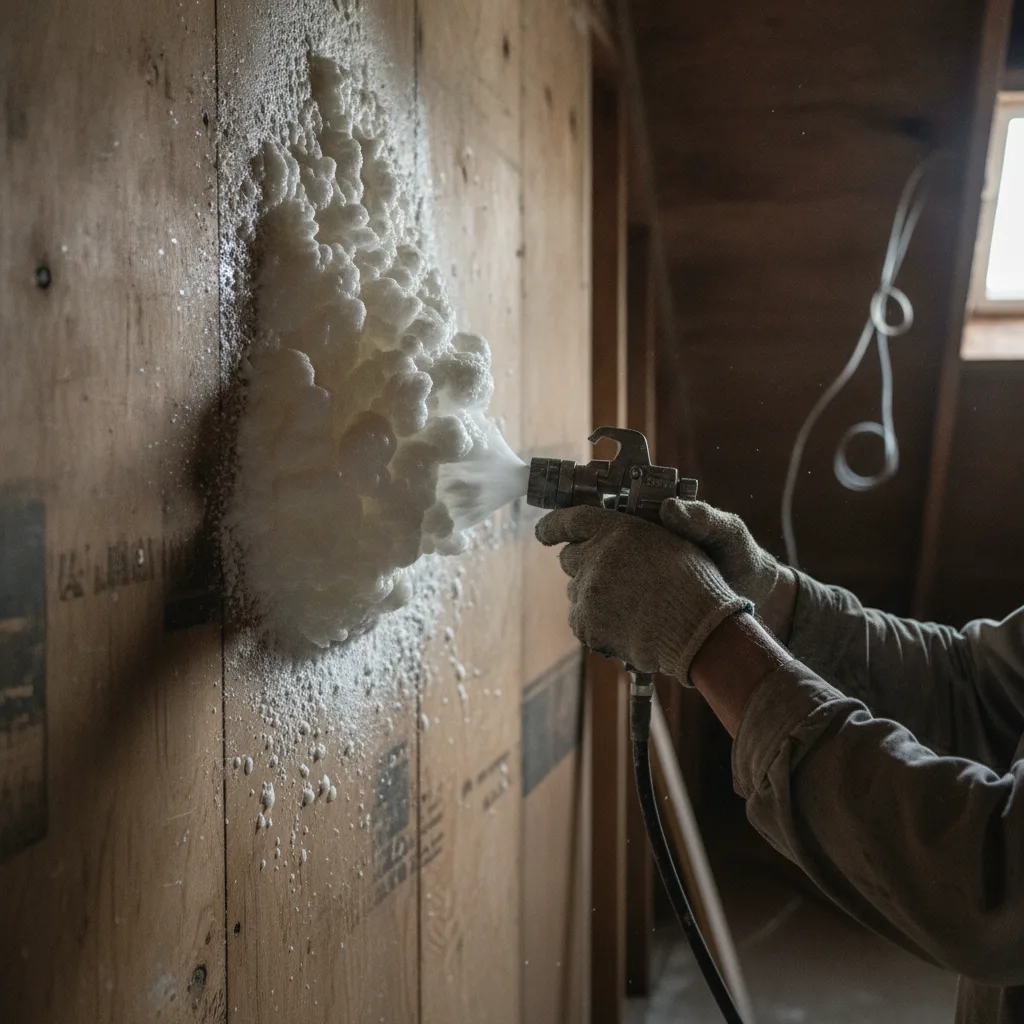
Our team in action — insulation professionals serving Santa Clarita
Mineral Wool Installation Methods and Approaches
Friction-Fit Batt Installation
The most common method for residential walls and attic floor systems. Mineral wool batts are sized to standard 16-inch and 24-inch on-center stud spacing. The semi-rigid nature of mineral wool means it holds its position without stapling — important in Santa Clarita’s high-wind environment where positive and negative pressure cycles can dislodge loosely installed batts over time. This method is ideal for new construction in developments like Skyline Ranch and Five Knolls, as well as remodels that open wall cavities.
Mineral Wool Board (Continuous Insulation)
Rigid mineral wool boards are installed on the exterior face of wall sheathing to create a continuous, uninterrupted thermal barrier. This approach eliminates thermal bridging through metal or wood studs — a significant energy loss pathway. California’s Title 24 increasingly requires continuous insulation in new commercial construction and multifamily buildings along Bouquet Canyon Road and Golden Valley Road corridors.
Hybrid Mineral Wool and Spray Foam Systems
For maximum performance in Santa Clarita’s WUI zones, we combine closed-cell spray foam at the air barrier plane with mineral wool fill in the remainder of the cavity. The spray foam provides air sealing and moisture control; the mineral wool provides fire resistance and acoustic dampening. Learn more about our spray foam insulation services
Attic Application with Mineral Wool Loose-Fill
For existing attic floors where access is limited, mineral wool can be blown in as loose-fill to achieve depth targets of R-38 to R-60, as required by California’s Title 24 for Climate Zone 9 attic assemblies. Learn more about our blow-in insulation services
Ready for Mineral Wool Insulation? Get Your Free Estimate Today.
Next Level Insulation of Santa Clarita serves Santa Clarita and the surrounding area — we’ll be on-site within 24 hours.
📞 Call (661) 582-0187Mineral Wool Insulation Cost in Santa Clarita
Mineral wool insulation typically costs more than standard fiberglass batts but less than closed-cell spray foam, positioning it as a premium-value mid-range option. In the Santa Clarita market, homeowners can expect the following general price ranges:
- Wall cavity mineral wool batt installation: $1.50–$2.75 per square foot of wall area, depending on stud spacing, access conditions, and whether old insulation removal is required.
- Attic mineral wool batt or blow-in: $1.80–$3.25 per square foot of attic floor area for installations targeting R-38 to R-60.
- Crawl space mineral wool floor insulation: $2.00–$3.50 per square foot, influenced heavily by crawl space height and accessibility. Learn more about crawl space insulation
- Complete whole-home mineral wool upgrade (1,800–2,400 sq ft home): $6,500–$14,000 depending on scope, existing conditions, and whether removal is included.
Santa Clarita-Specific Cost Factors
- Pest damage remediation: Homes in the foothill areas of Castaic, Sand Canyon, and Bouquet Canyon frequently require rodent exclusion and soiled material removal before new insulation can be installed — adding $500–$2,000 to project costs.
- Building permits: The City of Santa Clarita charges permit fees that typically range from $150–$400 for insulation projects requiring inspection.
- Utility rebates: SoCal Edison’s Energy Efficiency Programs have historically offered rebates of $0.10–$0.25 per square foot for qualifying attic insulation upgrades — potentially reducing net cost by $200–$600 on a typical project.
Call (661) 582-0187 for a no-obligation written estimate specific to your Santa Clarita property.
Santa Clarita Neighborhoods We Serve
Canyon Country
Canyon Country’s housing stock spans from 1960s-era single-story ranch homes along Whites Canyon Road to early-2000s two-story tract homes in the Mountainview neighborhood. Many of the older homes were built with R-11 wall insulation that is now compressed to effective R-7 or below. The extreme eastern valley heat exposure makes mineral wool wall upgrades particularly high-impact here.
Newhall
One of Santa Clarita’s oldest incorporated areas, Newhall features homes dating to the 1940s and 1950s with balloon-framed walls and virtually no original insulation. These properties benefit enormously from dense-pack mineral wool installed through drilled-in exterior wall access points, avoiding costly interior demolition.
Stevenson Ranch and Valencia
These master-planned communities feature largely 1990s–2010s construction with existing Title 24-compliant insulation that may nonetheless be aging or improperly installed. Mineral wool upgrades to attic assemblies and interior partition walls for acoustic control are common requests here.
Castaic and Northridge
Properties in the Castaic foothills and Northridge border areas face heightened wildfire exposure and benefit most from mineral wool’s non-combustible fire rating in attic and wall assemblies. Learn more about our attic insulation services
Mineral Wool Insulation Maintenance Tips for Santa Clarita Homeowners
- Inspect attic insulation annually — particularly after each fire season and any Santa Ana wind event exceeding 50 mph. Look for displaced batts near attic vents and ridge areas.
- Check for pest activity each spring — ground squirrels, roof rats, and mice are active throughout the Santa Clarita foothills. Mineral wool is less attractive to pests than fiberglass, but seal any new entry points promptly.
- Monitor crawl space vapor levels — Santa Clarita’s Santa Clara River corridor introduces seasonal moisture. Pair mineral wool crawl space insulation with a vapor barrier and ensure foundation vents are unobstructed. Learn about crawl space encapsulation
- Avoid compressing batts during storage — if accessing attic space for holiday storage, avoid stacking heavy boxes directly on mineral wool batts. Compression reduces R-value.
- Seal new penetrations immediately — any new plumbing, electrical, or HVAC penetrations through insulated assemblies should be re-sealed with fire-rated caulk within 30 days of work completion.
- Schedule a professional re-inspection every 5–7 years — particularly important in older Newhall and Canyon Country properties where settling continues to open new air leakage pathways.
- Keep gutters and roof flashing maintained — water infiltration from roof leaks will saturate mineral wool; while mineral wool dries efficiently, chronic moisture exposure still degrades long-term performance.
Why Choose Next Level Insulation of Santa Clarita
Next Level Insulation of Santa Clarita is a locally based insulation contractor with deep roots in the Santa Clarita Valley. Unlike large national franchise operators who send crews unfamiliar with local building conditions, our technicians live and work in the communities we serve — from Newhall to Stevenson Ranch, from Castaic to Canyon Country. We understand the specific demands that Santa Clarita’s semi-arid climate, wildland-urban interface fire exposure, and seismic environment place on building envelopes.
We work exclusively with professional-grade mineral wool products from established manufacturers and follow California Title 24 installation standards on every project. Our team is trained in the full spectrum of insulation services — insulation installation, spray foam, attic insulation, blow-in insulation, crawl space encapsulation, and insulation removal and replacement — meaning we can address every component of your home’s thermal envelope in a single relationship.
We offer transparent, itemized written estimates with no hidden fees, and we stand behind our work. Call (661) 582-0187 to speak with a local expert today.
Frequently Asked Questions About Mineral Wool Insulation in Santa Clarita
How much does mineral wool insulation cost in Santa Clarita?
In the Santa Clarita market, mineral wool batt installation typically ranges from $1.50 to $3.25 per square foot depending on the building assembly (walls vs. attic), access conditions, and whether existing insulation removal is needed. A complete whole-home project for an average 2,000-square-foot home generally falls in the $7,000–$13,000 range. SoCal Edison rebates may offset a portion of qualifying attic upgrades.
Is mineral wool better than fiberglass for Santa Clarita homes?
For most Santa Clarita applications, yes. Mineral wool outperforms standard fiberglass in several ways that are particularly relevant locally: it maintains its R-value better under the pressure differentials created by Santa Ana winds, it is non-combustible — a critical advantage in WUI zones near Canyon Country and Castaic — and it is more moisture-resistant, which benefits crawl space and lower-wall applications near the Santa Clara River.
How long does mineral wool insulation last?
Mineral wool insulation has an effective service life of 50+ years under normal conditions. Unlike fiberglass, it does not compress or settle significantly over time, so the R-value you install today should still be present decades later — provided the installation is protected from chronic moisture intrusion or pest damage.
Does mineral wool insulation help with noise reduction in Santa Clarita?
Yes. Mineral wool’s dense, fibrous structure makes it one of the best batt-style acoustic insulators available. Homeowners in neighborhoods near the I-5 / SR-14 interchange corridor, along Soledad Canyon Road, or adjacent to commercial zones on Magic Mountain Parkway frequently choose mineral wool specifically for its sound-dampening properties in interior partition walls and floor-ceiling assemblies.
Do I need a permit to install mineral wool insulation in Santa Clarita?
It depends on the scope of work. The City of Santa Clarita generally requires a building permit for new insulation installation in conditioned spaces, but like-for-like replacement in an existing attic may qualify for an exemption. Next Level Insulation of Santa Clarita manages the permit determination and application process on behalf of our clients.
How long does a mineral wool insulation project take?
A single-room or attic-only project can typically be completed in one day. A whole-home upgrade — including insulation removal, air sealing, and full mineral wool installation — generally takes two to three days for an average Santa Clarita single-family residence. We schedule projects to minimize disruption and can often begin within one to two weeks of estimate approval.
Can mineral wool be installed in older Newhall homes with irregular stud spacing?
Absolutely. Mineral wool batts can be field-cut with a bread knife or serrated blade to fit non-standard cavity widths. Our crews are experienced with the varied framing conditions found in Newhall’s pre-1960 housing stock, including balloon framing and irregular stud spacing that can trip up less experienced installers.
Is mineral wool insulation safe for my family?
Yes. Modern mineral wool products are classified as non-carcinogenic by the International Agency for Research on Cancer (IARC). Once installed, the fibers are encapsulated within wall or attic assemblies and pose no health risk to occupants. Our installation crews wear appropriate respiratory protection during installation to manage temporary fiber exposure during the work process.
Get a Free Mineral Wool Insulation Estimate in Santa Clarita
If your Santa Clarita home is losing its battle against triple-digit summer heat, punishing Santa Ana winds, or the ever-present wildfire risk that defines life in our valley, mineral wool insulation is one of the most effective upgrades you can make. Next Level Insulation of Santa Clarita is ready to assess your property, explain your options, and deliver a transparent written estimate — at no cost and no obligation.
We proudly serve Santa Clarita, Canyon Country, Newhall, Valencia, Stevenson Ranch, Castaic, Simi Valley, Porter Ranch, Granada Hills, Northridge, Chatsworth, Canoga Park, Mission Hills, Sylmar, North Hills, and the broader San Fernando Valley region.
Call us at (661) 582-0187 to schedule your free on-site assessment. Our team is standing by to help you take your home’s comfort and energy efficiency to the next level.