

Basement Insulation in Santa Clarita, CA
Energy-Saving Basement Insulation for Santa Clarita, CA Homes — Licensed & Insured
Need basement insulation in Santa Clarita, CA? Next Level Insulation offers expert installation, spray foam & more. Call (661) 582-0187 for a free estimate today.
- Licensed & Insured
- Locally Owned & Operated
- Free Inspection & Estimate
Request Your
Free EstimateBasement insulation is the process of applying thermal and moisture barriers to your basement walls, floors, and ceiling to regulate temperature, prevent moisture intrusion, and improve overall energy efficiency throughout your home. In Santa Clarita, CA, where summer temperatures routinely climb above 100°F in the Santa Clarita Valley and winter nights can dip into the upper 30s, an uninsulated or under-insulated basement creates significant energy loss and comfort problems year-round.
At Next Level Insulation of Santa Clarita, our team specializes in basement insulation solutions tailored to the unique climate, soil conditions, and building stock found throughout the Santa Clarita Valley. Whether you own a newer tract home in Stevenson Ranch or an older property in Newhall, we bring localized expertise and professional-grade materials to every project. Call us today at (661) 582-0187 to schedule your free assessment and take the first step toward a more comfortable, energy-efficient home.
Understanding Basement Insulation
Basement insulation encompasses a range of techniques designed to create a thermal boundary between the conditioned living space of your home and the unconditioned or semi-conditioned area below. Historically, basements in California were less common than in colder northeastern states, largely because the moderate coastal climate reduced the need for frost-protected foundations. However, as the Santa Clarita Valley experienced explosive residential development from the 1980s onward, builders began incorporating partial basements, daylight basements, and below-grade storage areas into many home designs to maximize square footage on hillside lots.
The science behind basement insulation centers on controlling three primary forces: conductive heat transfer through concrete walls and slabs, convective air movement through gaps and penetrations, and moisture migration driven by vapor pressure differentials. Concrete and masonry, the dominant materials in Santa Clarita basement construction, have an R-value of less than 1 per inch, meaning they provide almost no inherent thermal resistance. Without added insulation, these surfaces act as massive thermal sinks in summer and radiators of cold in winter.
Modern basement insulation systems typically address the rim joist area where the floor framing meets the foundation wall, the interior or exterior of concrete block or poured-concrete walls, and the floor assembly above an unconditioned space. In Santa Clarita’s Mediterranean-continental climate, vapor management is equally important because moisture can be driven inward during both the wet winter months and the dry summer months depending on indoor humidity conditions created by air conditioning.
Residential structures in Santa Clarita range from 1960s ranch-style homes in the Newhall area to 2000s-era master-planned communities like those found in Valencia and Canyon Country. Each building era brought different foundation designs, framing methods, and pre-existing insulation conditions, all of which influence the right approach for a modern basement insulation upgrade. Understanding that history allows our team to diagnose existing deficiencies accurately and recommend solutions that will perform reliably for decades.
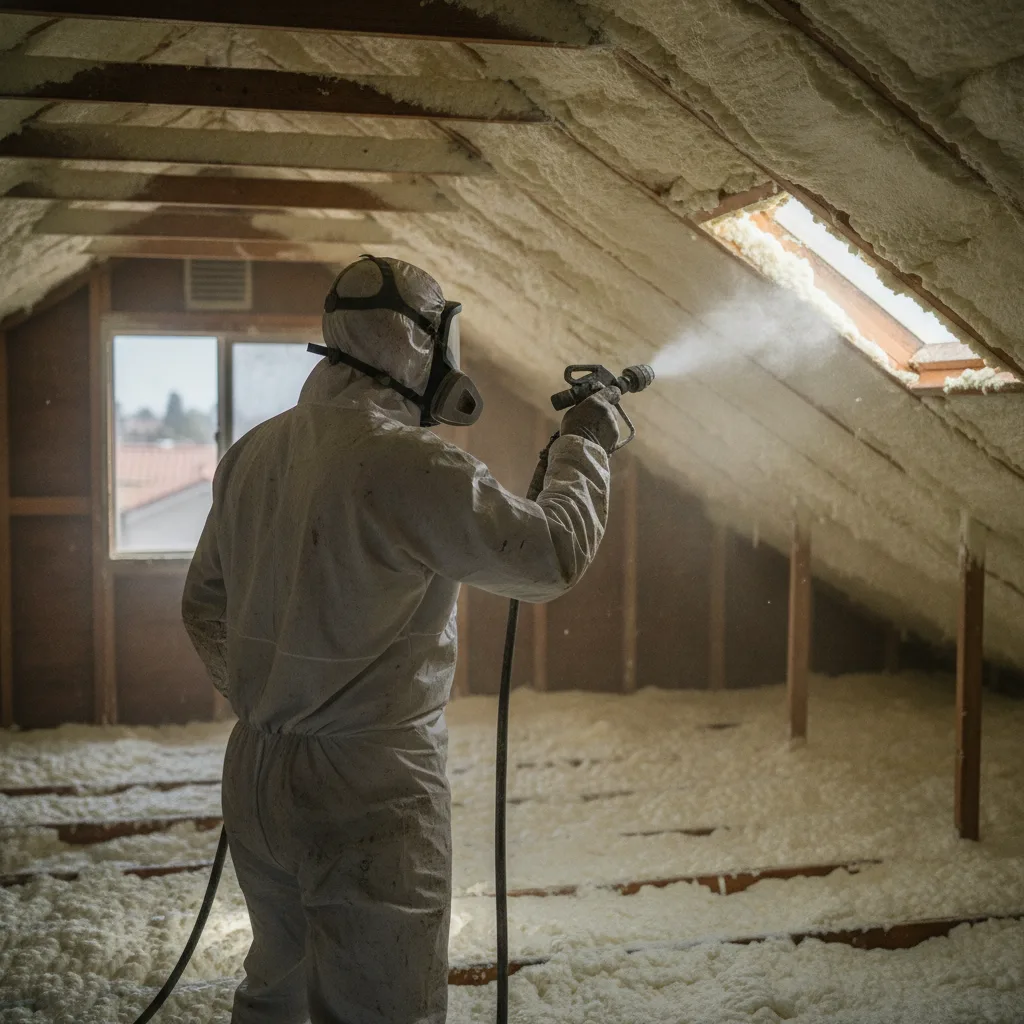
Our team in action — insulation professionals serving Santa Clarita
Why Basement Insulation Is Needed in Santa Clarita, CA
Extreme Seasonal Temperature Swings
The Santa Clarita Valley sits at an elevation ranging from roughly 1,200 to over 2,500 feet across its residential neighborhoods, making it significantly hotter in summer and colder in winter than coastal Los Angeles communities just 30 miles to the south. The area experiences an average of 20 to 25 days per year above 100°F, with record highs exceeding 113°F during events like the September 2022 heat wave that broke records throughout the region. In January, overnight lows in neighborhoods like Castaic and Canyon Country can fall to 35°F or below. This 70-plus-degree annual temperature swing means that uninsulated concrete basement walls and floors experience enormous thermal cycling, driving up heating and cooling costs by an estimated 15 to 25 percent for homes without proper below-grade insulation.
Santa Ana Wind Events and Building Pressurization
Santa Clarita is located in a corridor heavily affected by Santa Ana wind events, which typically occur between October and March and can drive sustained winds of 40 to 60 mph through the Newhall Pass and Soledad Canyon areas. These high-pressure wind events dramatically affect building pressurization, forcing unconditioned air through every gap in the building envelope. Basement rim joists and wall penetrations are particularly vulnerable during these events. Homes in the Placerita Canyon and Sand Canyon neighborhoods, which sit in natural wind channels, experience especially pronounced air infiltration that a properly air-sealed and insulated basement can significantly mitigate.
Alluvial Soil Conditions and Ground Moisture
Much of the Santa Clarita Valley floor is underlain by alluvial fan deposits originating from the Santa Clara River and its tributaries. These sandy-gravelly soils drain relatively well during dry periods but can become saturated quickly during the winter rainy season. After significant rain events such as the atmospheric river storms of January and February 2023, which delivered over 8 inches of rain in some Santa Clarita locations within a two-week period, hydrostatic pressure against basement walls increases substantially. Without a vapor barrier integrated into the insulation system, moisture can wick through poured concrete walls and create conditions conducive to mold growth, wood rot at the sill plate, and reduced insulation effectiveness.
Wildfire Recovery and Rebuilding
The Tick Fire of October 2019 burned approximately 4,600 acres in the Canyon Country area, and the Saddle Ridge Fire burned another 8,700 acres across portions of Porter Ranch and Sylmar in the same month. Many homes rebuilt or repaired in the aftermath of these fires were required to meet updated Title 24 California Energy Code standards, which specify minimum R-values for below-grade assemblies. Homeowners who did not go through a full rebuild but sustained smoke and water damage may also face degraded existing insulation that now fails to meet current performance standards.
Aging Housing Stock in Newhall and Canyon Country
Original residential development in the Newhall area dates to the 1920s and 1930s, with significant expansion through the 1960s. Many of these older homes feature uninsulated or minimally insulated basements and crawl spaces that were never upgraded to reflect modern energy standards. Adding appropriate basement insulation to these older structures delivers an immediate return on investment through reduced utility bills and improved occupant comfort during Santa Clarita’s hottest and coolest months.
Signs You Need Basement Insulation in Santa Clarita
Temperature and Comfort Issues
- Floors above the basement feel noticeably cold in winter or uncomfortably warm in summer
- Basement spaces remain 15°F or more cooler or warmer than living areas despite HVAC operation
- Heating and cooling systems run longer cycles than expected for Santa Clarita’s climate
- Drafts detectable at the base of walls or around floor perimeters during Santa Ana wind events
Moisture and Structural Indicators
- Visible condensation or efflorescence (white mineral deposits) on concrete basement walls
- Musty odors suggesting mold or mildew growth in the below-grade space
- Peeling paint or staining on basement walls following winter rains
- Wood rot or discoloration at the sill plate or rim joist area
Energy Performance Red Flags
- SCE or SoCal Gas utility bills that increased significantly after purchasing the home
- Home energy audit results showing below-grade areas as major loss zones
- Insulation that is visibly deteriorated, compressed, or absent in the basement area
Urgency Indicators
If you notice active moisture intrusion, visible mold growth, or pest activity in an uninsulated basement space, these conditions warrant immediate professional evaluation. Delaying can result in structural damage and air quality problems that affect the entire home.
Basement Insulation Methods and Approaches
Closed-Cell Spray Foam Insulation
Closed-cell spray foam is the highest-performing option for Santa Clarita basements because it simultaneously provides insulation (approximately R-6 to R-7 per inch), an air barrier, and a Class II vapor retarder in a single application. It is the preferred choice for rim joist cavities and for basement walls in homes with documented moisture intrusion. Its rigidity also adds minor structural reinforcement to rim joist assemblies in areas of seismic activity. Learn more about our spray foam insulation services
Rigid Foam Board Insulation
Polyisocyanurate or extruded polystyrene (XPS) rigid foam panels are commonly applied to interior concrete basement walls, providing R-values of R-5 to R-6.5 per inch. This method is cost-effective for large flat wall surfaces and is particularly well-suited to the poured-concrete basements common in Valencia and Stevenson Ranch developments from the 1990s and 2000s.
Blown-In Insulation
Cellulose or fiberglass blown-in insulation is primarily used in floor assemblies above unconditioned basement spaces, filling joist bays to achieve R-19 or higher. This method works well in the older balloon-frame and platform-frame construction found in Newhall-area homes. Explore our blow-in insulation options
Fiberglass Batt Insulation
Pre-cut fiberglass batts are a lower-cost option for floor assemblies and can be suitable where moisture risk is low and existing framing is in good condition. They are typically combined with a separate air sealing step to compensate for their inherently permeable nature.
Hybrid Systems
Many Santa Clarita basements benefit most from a hybrid approach: closed-cell spray foam at the rim joist and lower wall section where moisture risk is highest, paired with rigid foam board or blown-in insulation for the remainder of the assembly. This optimizes performance per dollar invested.
Ready for Basement Insulation? Get Your Free Estimate Today.
Next Level Insulation of Santa Clarita serves Santa Clarita and the surrounding area — we’ll be on-site within 24 hours.
📞 Call (661) 582-0187Basement Insulation Cost in Santa Clarita, CA
The cost of basement insulation in Santa Clarita varies based on the basement’s square footage, the chosen insulation method, existing conditions requiring remediation, and material pricing at the time of your project. The following ranges reflect typical project costs in the Santa Clarita market.
Typical Cost Ranges
- Rim Joist Spray Foam Sealing Only: $500–$1,500 for most single-family homes
- Full Basement Wall Insulation (Rigid Foam or Spray Foam): $3,000–$8,000 for a 1,000–1,500 sq. ft. basement footprint
- Floor Assembly Blown-In or Batt Insulation: $1,500–$4,000 depending on joist depth and access conditions
- Complete Basement Insulation System (All Surfaces): $5,000–$14,000 for a comprehensive upgrade
Factors Affecting Your Santa Clarita Project Cost
- Existing moisture damage requiring remediation before installation
- Basement height and accessibility for equipment and crew
- Distance from our service base in Santa Clarita (affecting travel time for outlying areas like Simi Valley or Castaic)
- Current material costs, which have fluctuated due to supply chain conditions affecting polyurethane foam components
- Whether insulation removal of old, deteriorated materials is required before new installation
Potential Savings and Incentives
Southern California Edison and SoCal Gas both offer rebates for qualifying insulation upgrades. The federal Inflation Reduction Act also provides a tax credit of up to 30 percent of insulation material costs (up to $1,200 annually) for owner-occupied primary residences. Our team can help identify which incentives apply to your specific Santa Clarita project. Call (661) 582-0187 for a free detailed estimate.
Santa Clarita Neighborhoods We Serve
Newhall
As one of the oldest settled areas of the Santa Clarita Valley, Newhall contains a significant number of homes built between the 1940s and 1970s with original, unimproved basement and crawl space conditions. These structures frequently require insulation removal of deteriorated fiberglass before modern systems can be installed. Learn about our insulation removal services
Canyon Country
Canyon Country’s hillside lots, many developed in the 1980s and 1990s, often feature daylight basements and split-level foundations where grade changes create partial below-grade exposures. The proximity to the 2019 Tick Fire burn area means some homes in this neighborhood have replacement insulation needs tied to post-fire rebuilding requirements.
Stevenson Ranch
Stevenson Ranch’s planned community homes, most built from the late 1990s through the mid-2000s, used builder-grade insulation that has now reached the end of its effective lifespan in many cases. Homes here sit at elevations that amplify both summer heat gain and winter cold, making basement insulation upgrades particularly cost-effective.
Castaic
Castaic’s location at higher elevation near the I-5 corridor subjects homes to greater winter temperature extremes than lower valley areas. Many properties near Castaic Lake feature partial basements or subgrade utility rooms that benefit significantly from spray foam wall insulation to prevent pipes from chilling and to improve whole-home energy performance.
Basement Insulation Maintenance Tips for Santa Clarita Homeowners
- Inspect after heavy rain events: Following the winter atmospheric river storms that periodically affect the Santa Clarita Valley, check basement walls for new efflorescence or moisture staining that could indicate water infiltration compromising your insulation.
- Check for pest entry points annually: Rodents and insects prevalent in the chaparral zones surrounding Santa Clarita neighborhoods can breach insulation systems. Inspect visible foam and batt materials for burrowing or nesting damage each fall before the rainy season.
- Monitor indoor humidity levels: Maintain basement relative humidity below 60 percent using a hygrometer. If levels consistently exceed this threshold despite insulation, additional vapor management may be needed.
- Keep exterior grade sloped away from foundation: Ensure the soil grade around your home directs water away from basement walls, reducing hydrostatic pressure and the moisture load on your insulation system.
- Clear dryer vents and exhaust penetrations: Ensure all combustion and exhaust penetrations through insulated basement assemblies remain properly sealed and unobstructed.
- Schedule a professional re-inspection every 5–7 years: Insulation systems in seismically active regions like Santa Clarita can shift slightly over time. Periodic professional inspection ensures continued performance and catches any developing issues early.
- Verify HVAC equipment clearances: Ensure new insulation has not restricted airflow to any basement-located HVAC equipment, water heaters, or ventilation systems.
Why Choose Next Level Insulation of Santa Clarita
Next Level Insulation of Santa Clarita is a locally operated insulation company with deep familiarity with the specific climate, building stock, and regulatory requirements of the Santa Clarita Valley. We do not apply one-size-fits-all solutions. Instead, every project begins with a thorough site assessment that accounts for your home’s age, construction type, lot characteristics, and the specific neighborhood conditions that affect performance.
Our team is experienced with California Title 24 Energy Code requirements for Climate Zone 9, which governs insulation standards for Santa Clarita properties. We work across the full range of insulation services, including attic insulation, crawl space insulation, crawl space encapsulation, and insulation replacement, allowing us to address your home’s entire thermal envelope in a coordinated way.
We serve homeowners throughout Santa Clarita and surrounding communities including Castaic, Stevenson Ranch, Newhall, Canyon Country, Valencia, Simi Valley, Granada Hills, Porter Ranch, and more. Call us at (661) 582-0187 to schedule your free consultation with a local expert who understands your neighborhood.
Frequently Asked Questions About Basement Insulation in Santa Clarita
How much does basement insulation cost in Santa Clarita, CA?
Costs vary by project scope and method. A rim joist air-sealing project typically runs $500–$1,500, while a full basement wall and floor insulation system can range from $5,000 to $14,000 for a typical Santa Clarita single-family home. We provide free, itemized estimates so you know exactly what you are paying for before any work begins. Call (661) 582-0187 to schedule yours.
Do Santa Clarita homes really need basement insulation given the warm climate?
Absolutely. While Santa Clarita is not a cold-climate city, the valley experiences significant temperature extremes in both directions. Summer heat above 100°F and winter nights in the mid-30s create major energy loads that uninsulated basements fail to address. Additionally, moisture from the winter rainy season makes vapor management through proper insulation essential for preventing mold and structural damage.
How long does a basement insulation project take?
Most residential basement insulation projects in Santa Clarita take one to three days depending on the size of the space, the method being used, and whether any existing insulation removal is required. We provide a project-specific timeline in your written proposal.
Is spray foam insulation safe for my family?
Closed-cell and open-cell spray foam insulation products are safe once fully cured, which occurs within 24 hours of application. During installation, our technicians use appropriate respiratory protection and recommend homeowners and pets vacate the work area until the foam has fully cured. We use professional-grade products that comply with all applicable California VOC regulations.
Do I need a permit for basement insulation in Santa Clarita?
In most cases, insulation installed within existing walls or floor assemblies without structural modification does not require a permit from the City of Santa Clarita’s Building and Safety Division. However, if spray foam is applied to interior wall surfaces that will be left exposed, fire-code-compliant covering may be required. We will advise you on any permitting requirements specific to your project during the assessment phase.
Will basement insulation help with noise reduction?
Yes. Dense-pack blown-in cellulose and closed-cell spray foam both provide meaningful sound attenuation. This is particularly beneficial for Santa Clarita homeowners near the I-5 and SR-14 corridors in Newhall and Canyon Country, where traffic noise can be a quality-of-life concern.
What happens to my existing insulation if it is damaged?
Our team offers professional insulation removal services. If existing materials are deteriorated, pest-infested, or contaminated by moisture or smoke, we safely remove and dispose of them before installing your new system. This ensures the new insulation adheres properly and performs as designed from day one.
Can basement insulation help with wildfire smoke infiltration?
Thorough air sealing as part of a basement insulation project can meaningfully reduce the infiltration of wildfire smoke particles, which is a documented air quality concern for Santa Clarita residents during fire season. While insulation alone is not a complete smoke filtration solution, reducing air changes through the building envelope lowers the amount of outdoor particulate matter entering your home during events like those experienced during the 2019 Tick Fire and Saddle Ridge Fire.
Get a Free Basement Insulation Estimate in Santa Clarita Today
If your Santa Clarita home has an uninsulated or under-insulated basement, every season without proper insulation costs you money and comfort. Whether you are dealing with high utility bills, uncomfortable temperature variations, moisture concerns after winter rains, or simply want to bring your home up to California Title 24 standards, Next Level Insulation of Santa Clarita is ready to help.
Our team serves homeowners throughout Santa Clarita and the surrounding communities of Castaic, Stevenson Ranch, Canyon Country, Newhall, Simi Valley, Granada Hills, Porter Ranch, and beyond. Contact us today for a free, no-obligation on-site assessment and written estimate.
Call us at (661) 582-0187 — our local team is standing by to answer your questions and schedule your appointment at a time that works for you.