

Floor Insulation in Simi Valley, CA
Energy-Saving Floor Insulation for Simi Valley, CA Homes — Licensed & Insured
Need floor insulation in Simi Valley, CA? Next Level Insulation offers expert crawl space & floor insulation installation. Free estimates — call (805) 774-1832 today!
- Licensed & Insured
- Locally Owned & Operated
- Free Inspection & Estimate
Request Your
Free EstimateFloor insulation is the process of installing thermal and acoustic barriers beneath the living surfaces of your home — between floor joists, under subfloors, and within crawl spaces — to prevent heat loss, reduce energy costs, and improve indoor comfort year-round. At Next Level Insulation of Simi Valley, we specialize in delivering professional floor insulation solutions tailored specifically to the homes and conditions found throughout Simi Valley and the surrounding Ventura County region.
Simi Valley’s unique combination of hot, dry summers, cooler valley nights, and expansive ranch-style and tract home construction creates specific thermal challenges that demand expert floor insulation strategies. Homes built on raised foundations with unconditioned crawl spaces are especially vulnerable to heat gain in summer and radiant heat loss during winter nights, when temperatures can dip into the low 40s°F. Our team understands the local building stock, soil conditions, and climate patterns that affect your floors — and we bring the tools, materials, and local knowledge to solve them effectively.
Call us today at (805) 774-1832 to schedule a free floor insulation assessment.
Understanding Floor Insulation in Simi Valley, CA
Floor insulation refers to any thermally resistant material installed beneath the floor surface of a structure to slow the transfer of heat between conditioned living spaces and unconditioned areas below — whether that’s an open crawl space, a ventilated basement, or a concrete slab. The primary goal is to maintain a consistent interior temperature without forcing your HVAC system to work harder than necessary.
The concept of floor insulation dates back to early 20th-century construction practices, when builders began recognizing that ground-level cold and moisture were major contributors to discomfort in residential homes. As energy codes evolved through the 1970s energy crisis and into California’s modern Title 24 Energy Code standards, floor insulation became not just a comfort upgrade but a code requirement for new construction and many renovation projects.
In Simi Valley specifically, the majority of residential housing stock was developed in rapid waves between the 1960s and the early 1990s, with large suburban tract developments constructed across the valley floor and into the surrounding hillside communities. Many of these homes — particularly those built before 1980 — were constructed with minimal or no floor insulation, especially in crawl space areas beneath raised wood-frame floors. The Santa Susana Mountains to the north and the Rocketdyne hillsides to the west created natural barriers that influenced how neighborhoods were built, with many homes featuring pier-and-beam or raised slab foundations that left the floor system fully exposed to outdoor air movement.
Today, floor insulation is commonly installed using fiberglass batts fitted between floor joists, spray foam applied to the underside of the subfloor, blown-in loose-fill insulation, or rigid foam boards — each method offering distinct performance advantages depending on the construction type, moisture conditions, and access limitations of your specific home. Simi Valley homes with dirt-floor crawl spaces or older ventilated crawl spaces are among the most common candidates for floor insulation upgrades, as these conditions allow unconditioned air to directly contact the underside of your living space floors throughout the year.
Understanding your home’s foundation type, crawl space condition, and current insulation status is the essential first step before selecting any floor insulation approach. Learn more about crawl space insulation options
Why Floor Insulation Is Needed in Simi Valley, CA
Simi Valley’s climate and local geography create a set of conditions that make floor insulation not just beneficial, but essential for residential comfort and long-term home health. Located in a semi-arid inland valley at an elevation of roughly 900 feet above sea level, Simi Valley experiences a significant daily temperature swing — commonly ranging 25°F to 35°F between daytime highs and nighttime lows during both summer and winter months. This diurnal shift means the ground beneath your home cools dramatically at night, creating a persistent cold surface that radiates upward into your floors without proper insulation barriers in place.
During summer months, Simi Valley regularly records temperatures between 95°F and 105°F during heat events. The valley is prone to hot, dry Santa Ana wind conditions — particularly during the October-through-December fire weather season — which drive low humidity levels and elevated temperatures into the region. Under these conditions, the soil beneath raised foundations heats significantly, and without floor insulation, radiant heat transfer through the floor system can raise indoor temperatures by 5°F to 10°F even when air conditioning is running. This forces HVAC systems to cycle more frequently, increasing energy consumption and utility costs for Simi Valley homeowners.
The 2003 Simi Valley-area wildfires and the 2018 Woolsey Fire — which burned along the western boundary of Simi Valley near the Santa Susana Pass and affected communities including Oak Park and Thousand Oaks — highlighted how quickly outdoor air quality and thermal conditions can deteriorate in the region. Homes with poorly insulated floors and crawl spaces during such events experience greater infiltration of smoke, ash particulates, and extreme heat, compounding indoor air quality problems.
Specific Simi Valley neighborhoods face distinct floor insulation challenges. Homes in the Wood Ranch area, built primarily in the 1980s and 1990s along the southeastern edge of the valley, often feature raised wood-frame foundations with ventilated crawl spaces that allow cool air to circulate underneath — beneficial in concept, but problematic when insulation has degraded or was never installed to modern R-19 or R-25 standards. The Bridle Path community near the Chumash Indian Museum features many custom and semi-custom homes on hillside lots where crawl spaces can be unevenly accessible and exposed to greater wind exposure from the Tierra Rejada Valley corridor.
Moisture is another critical factor. Although Simi Valley receives an average of only 14–16 inches of annual rainfall, most of that precipitation falls between November and March, often in concentrated storm events associated with atmospheric river systems — as was the case during the significant January and February 2023 storms that brought record rainfall across Ventura County. During these events, unconditioned crawl spaces beneath homes in lower-lying neighborhoods near Tapo Canyon Road and the Arroyo Simi flood channel can experience moisture intrusion and condensation on floor joists, conditions that degrade existing insulation and promote mold growth within 24 to 48 hours of sustained exposure. Explore crawl space encapsulation as a moisture solution
Signs You Need Floor Insulation in Simi Valley
Temperature and Comfort Indicators
- Floors feel noticeably cold to the touch during winter mornings, even when indoor heat is running
- Significant temperature differences between the first floor and upper levels of your home
- Drafts or cool air movement that seems to originate from beneath the floor surface
- HVAC system running longer cycles or struggling to maintain set temperatures during Simi Valley summer heat events
Energy and Utility Warning Signs
- Unexplained increases in monthly Southern California Gas Company or electric utility bills
- Energy audit results showing below-standard R-values under floor systems
- Home failing California Title 24 compliance inspections during renovation permitting
Physical and Structural Symptoms
- Visible deterioration, sagging, or missing insulation batts visible when inspecting your crawl space
- Pest activity (rodent nesting) within existing crawl space insulation
- Musty or mildew odors rising from floor surfaces, indicating moisture-compromised insulation
- Water staining or efflorescence on crawl space walls or floor joists after winter rain events
Urgency Indicators
If you notice any combination of pest infiltration, moisture damage, or insulation that is visibly falling from floor joists, these conditions require immediate professional assessment to prevent structural wood rot and escalating remediation costs. Call (805) 774-1832 for a prompt evaluation.
Our Floor Insulation Process in Simi Valley
Free On-Site Assessment (Day 1 — 1 to 2 Hours)
Our technician visits your Simi Valley home to conduct a thorough inspection of your floor system, crawl space condition, foundation type, and existing insulation. We assess moisture levels using calibrated meters, check for pest activity, and measure crawl space dimensions and joist spacing. This site-specific data directly informs the insulation strategy we recommend.
Detailed Proposal and Material Selection (Day 1–2)
Based on the assessment, we prepare a written proposal outlining recommended insulation type, R-value targets meeting or exceeding California Energy Code requirements, material quantities, and project timeline. For Simi Valley homes with older ventilated crawl spaces, we will also present crawl space encapsulation options where moisture control is indicated.
Existing Insulation Removal (Day of Installation or Prior Day — 2 to 4 Hours)
Where existing degraded, pest-damaged, or moisture-compromised insulation is present, our team performs complete removal and disposal before new installation begins. This step is critical in many pre-1985 Simi Valley homes where original fiberglass batts have compressed to near-zero effective R-value over decades. Learn about our insulation removal services
Crawl Space Preparation and Air Sealing (2 to 3 Hours)
We seal penetrations, pipe chases, and rim joist gaps using spray foam or caulk before installing floor insulation. This air-sealing step significantly improves thermal performance and is especially important in Simi Valley homes where Santa Ana wind pressure differences can drive unconditioned air through small gaps at high velocity.
Floor Insulation Installation (4 to 8 Hours Depending on Area)
We install the selected insulation system — fiberglass batts, spray foam, or blown-in insulation — according to manufacturer specifications and California Title 24 guidelines. Batts are fitted snugly between floor joists with vapor retarder facing positioned correctly for Simi Valley’s mixed climate zone (CEC Climate Zone 9).
Final Inspection and Documentation (1 Hour)
Upon completion, our technician performs a final walkthrough with the homeowner, documents the installed R-values and materials, and provides a project completion report suitable for permit records or home resale documentation.
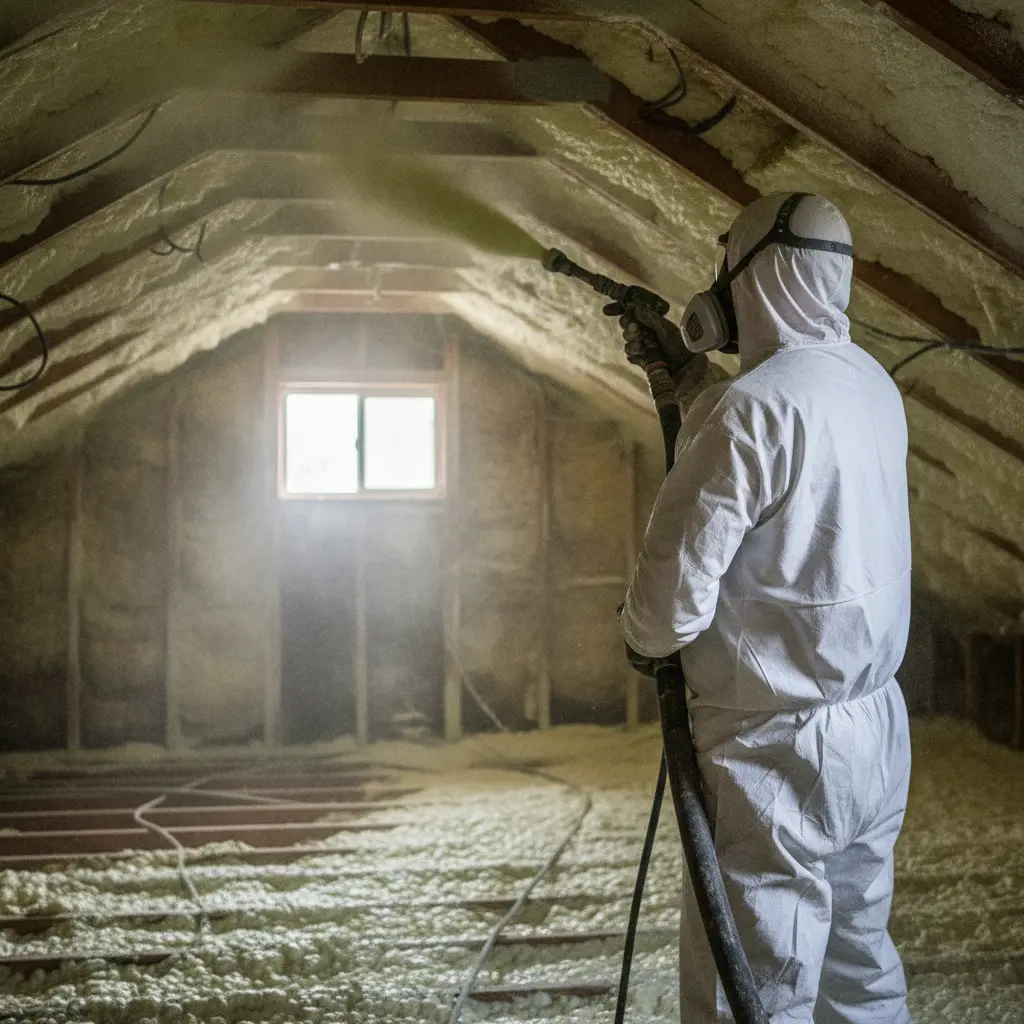
Our team in action — insulation professionals serving Simi Valley
Floor Insulation Methods and Approaches
Fiberglass Batt Insulation
Fiberglass batts remain the most common floor insulation solution for Simi Valley homes with standard 16-inch or 24-inch on-center floor joist framing and accessible crawl spaces. Batts sized to R-19 or R-25 are fitted between joists and retained using wire supports or insulation hangers. This method is cost-effective and performs well in Simi Valley’s relatively low-humidity crawl space environments. It is best suited for homes where moisture levels test below 70% relative humidity in the crawl space.
Spray Foam Insulation
Closed-cell spray foam applied to the underside of the subfloor provides superior air sealing and moisture resistance, achieving R-6 to R-7 per inch of thickness. This method is particularly effective in Simi Valley homes near drainage corridors or hillside lots where moisture intrusion is more likely. Spray foam also adds structural rigidity to the floor system. Explore our spray foam insulation services
Blown-In Loose-Fill Insulation
In floors with irregular joist spacing, limited access points, or unusual framing configurations common in custom hillside homes in Simi Valley’s Bridle Path and Wood Ranch areas, blown-in cellulose or fiberglass loose-fill provides complete coverage that batts cannot achieve. This method is injected through small access ports with minimal disruption to finished surfaces. Learn about our blow-in insulation solutions
Rigid Foam Board Insulation
Rigid foam panels are used in slab-on-grade applications, particularly for insulating perimeter edges of concrete slabs or in below-grade applications. Simi Valley homes with partial slab areas adjacent to crawl spaces sometimes benefit from a hybrid approach combining rigid foam at transitions with batt or spray foam in the crawl space sections.
Ready for Floor Insulation? Get Your Free Estimate Today.
Next Level Insulation of Simi Valley serves Simi Valley and the surrounding area — we’ll be on-site within 24 hours.
📞 Call (805) 774-1832Floor Insulation Cost in Simi Valley, CA
Understanding the cost of floor insulation in Simi Valley helps homeowners budget appropriately and evaluate quotes accurately. Pricing varies based on insulation type, square footage, crawl space accessibility, and whether existing insulation removal is required.
Typical Price Ranges
- Fiberglass Batt Floor Insulation: $1.50 to $3.00 per square foot installed, including materials and labor. A typical 1,500 sq ft Simi Valley ranch home crawl space floor runs approximately $2,250 to $4,500.
- Spray Foam Floor Insulation: $3.50 to $7.00 per square foot installed for closed-cell spray foam at 2-inch thickness. The same 1,500 sq ft area may cost $5,250 to $10,500 depending on thickness specified.
- Blown-In Loose-Fill Floor Insulation: $2.00 to $4.00 per square foot installed, typically $3,000 to $6,000 for a mid-size Simi Valley home floor.
- Insulation Removal (if required): $1.00 to $2.50 per square foot as a separate line item before new installation.
Simi Valley-Specific Cost Factors
Crawl space access difficulty — particularly in homes on hillside lots in communities like Wood Ranch or Oakridge Estates — can add 10% to 20% to labor costs due to restricted access and maneuvering requirements. Homes requiring crawl space moisture remediation or encapsulation before insulation will have additional costs of $3,000 to $8,000 for vapor barrier installation.
California utility rebates through SoCalGas and the Energy Upgrade California program may offset a portion of eligible floor insulation project costs. Ask our team about current incentive availability when you call (805) 774-1832.
Simi Valley Neighborhoods We Serve
Wood Ranch
Developed primarily between 1984 and 1998 along the southeastern slopes above Simi Valley, Wood Ranch homes frequently feature raised wood-frame foundations with ventilated crawl spaces that have experienced decades of thermal cycling. Many Wood Ranch properties have original fiberglass batts that have compressed or fallen from joist cavities and require full replacement to achieve modern R-19 standards.
Bridle Path
This equestrian-oriented community in the eastern Simi Valley hills includes custom and semi-custom homes on larger lots with varying foundation types. Hillside construction often means uneven crawl space depths and wind exposure from the Tierra Rejada Valley, making thorough air sealing alongside floor insulation particularly valuable here.
Central Simi Valley (Tapo Canyon Corridor)
Tract homes built through the 1960s and 1970s along the Tapo Canyon Road corridor represent some of the oldest residential stock in Simi Valley. Many of these homes have never had professional floor insulation upgrades and frequently sit above ground-level crawl spaces subject to moisture intrusion during the Arroyo Simi’s seasonal flow periods.
Oakridge Estates and Knolls Area
Newer construction in the northern Simi Valley hillsides includes homes built from the early 2000s onward, which generally meet current code minimums but may benefit from performance upgrades to achieve greater energy efficiency as utility rates rise across Ventura County.
Floor Insulation Maintenance Tips for Simi Valley Homeowners
- Inspect your crawl space annually: Schedule a visual inspection each fall before Simi Valley’s rainy season begins (typically November) to check for moisture, pest activity, and batt displacement.
- Monitor crawl space humidity: Install a low-cost hygrometer in your crawl space and check readings monthly. Target below 60% relative humidity to prevent condensation on floor joists.
- Maintain crawl space vents properly: Ensure foundation vents are clear of debris after Santa Ana wind events, which can deposit leaves and particulates that block airflow and trap moisture.
- Check for rodent intrusion: Simi Valley’s interface with open hillside habitat means rodent pressure is ongoing. Inspect for gnawed insulation or nesting material in crawl spaces after summer months.
- Clear gutters and direct downspouts away from foundation: After winter rain events, ensure drainage moves away from your foundation to prevent moisture from entering the crawl space below your floor insulation.
- Verify vapor barrier integrity: If you have a ground cover vapor barrier in your crawl space, inspect for tears or displaced sections annually, especially after any plumbing or utility work is performed under the home.
- Re-evaluate after major weather events: Following significant storm events — like the 2023 atmospheric river series — have your crawl space and floor insulation professionally inspected for moisture damage before problems escalate.
Why Choose Next Level Insulation of Simi Valley
Next Level Insulation of Simi Valley is a locally based insulation contractor with deep familiarity with Simi Valley’s housing stock, climate zone characteristics, and the specific challenges faced by homeowners across Ventura County and the greater San Fernando Valley region. We don’t apply one-size-fits-all solutions — every floor insulation project begins with a thorough site assessment that accounts for your home’s specific foundation type, crawl space conditions, and the micro-climate factors that affect your neighborhood.
Our team is trained in the full range of floor insulation methods, from traditional fiberglass batt installation to advanced spray foam systems and blown-in applications. We serve homeowners not only in Simi Valley but throughout our service area including Thousand Oaks, Moorpark, Camarillo, Calabasas, Woodland Hills, and Santa Clarita — meaning we understand the regional building patterns and climate dynamics of the entire greater valley region.
We provide transparent, itemized quotes before any work begins, and our technicians walk every customer through results upon project completion. When you’re ready to stop losing comfort and energy dollars through an under-insulated floor, we’re ready to help. Call us at (805) 774-1832 for your free assessment today. Also explore our attic insulation services
Frequently Asked Questions: Floor Insulation in Simi Valley, CA
How much does floor insulation cost in Simi Valley?
Floor insulation costs in Simi Valley typically range from $1.50 to $7.00 per square foot installed, depending on the insulation type selected. A fiberglass batt installation for a 1,500 sq ft crawl space floor generally runs $2,250 to $4,500, while spray foam applications for the same area may cost $5,250 to $10,500. Removal of old insulation, crawl space access difficulty, and any required moisture remediation are additional cost factors specific to your home.
How long does floor insulation installation take in a typical Simi Valley home?
Most floor insulation projects in Simi Valley are completed within one to two days. A standard 1,200 to 1,800 sq ft crawl space floor with accessible conditions can typically be insulated in a single full workday. Larger homes, difficult crawl space access in hillside communities like Bridle Path, or projects requiring prior insulation removal may require a second day.
What R-value do I need for floor insulation in Simi Valley?
Simi Valley falls within California Energy Commission Climate Zone 9. Current California Title 24 standards recommend a minimum of R-19 for floors over unconditioned crawl spaces, though many energy efficiency professionals recommend R-25 or higher for maximum performance given Simi Valley’s significant day-night temperature swings of 25°F to 35°F. Our team will assess your specific conditions and recommend the most cost-effective R-value target for your home.
Can I insulate my floor if my crawl space has moisture problems?
Moisture issues must be addressed before new floor insulation is installed. Installing insulation in a wet crawl space will trap moisture against wood framing, accelerating rot and mold growth. Our team can assess crawl space moisture levels and recommend appropriate solutions — including vapor barriers, drainage improvements, or full crawl space encapsulation — before proceeding with floor insulation. Learn more about crawl space encapsulation
Is floor insulation worth it in Simi Valley’s climate?
Yes. Despite Simi Valley’s reputation as a warm climate, the valley’s significant nighttime cooling — with winter lows regularly reaching the low to mid-40s°F — means uninsulated floors create measurable comfort and energy efficiency problems. Homeowners in Simi Valley who upgrade floor insulation from R-0 to R-19 or R-25 typically report HVAC runtime reductions and improved floor comfort within the first heating and cooling season.
Do I need a permit for floor insulation in Simi Valley?
In most cases, adding insulation to an existing crawl space floor does not require a permit in the City of Simi Valley. However, if your project involves structural modifications, changes to crawl space ventilation design, or full encapsulation of a previously ventilated crawl space, a permit may be required. Our team will advise you on permit requirements based on your specific project scope.
How do I know if my existing floor insulation needs to be replaced?
Key indicators include visible sagging or fallen batts in the crawl space, pest nesting material embedded in insulation, a musty odor rising through floors, or an energy audit showing below-code R-values. Homes in Simi Valley built before 1985 that have never had insulation upgrades are very likely operating with severely degraded floor insulation. A free professional assessment from Next Level Insulation of Simi Valley will give you a clear picture of your current conditions.
Do you serve areas outside of Simi Valley?
Yes. While Simi Valley is our home base, we serve customers throughout the region including Thousand Oaks, Moorpark, Camarillo, Calabasas, Woodland Hills, Santa Clarita, Chatsworth, Agoura Hills, Westlake Village, North Hollywood, Oak Park, Beverly Hills, San Fernando, Malibu, Fillmore, Oxnard, Port Hueneme, and Santa Paula.
Get Your Free Floor Insulation Estimate in Simi Valley Today
Don’t let an under-insulated floor cost you comfort and money through another Simi Valley summer heat season or winter night. Next Level Insulation of Simi Valley is ready to assess your home, recommend the right floor insulation solution for your specific foundation type and crawl space conditions, and deliver professional installation you can feel from the first day.
Call us now at (805) 774-1832 to schedule your free, no-obligation floor insulation assessment. Our team serves Simi Valley and surrounding communities throughout Ventura County and the San Fernando Valley. Let’s take your home’s comfort and efficiency to the next level — starting from the ground up.
Schedule your free assessment online