

Roof Insulation in Simi Valley, CA
Expert Roof Insulation in Simi Valley, CA — Storm-Tested, Warranty-Backed
Need roof insulation in Simi Valley, CA? Next Level Insulation offers expert attic & roof insulation services in Simi Valley. Call (805) 774-1832 for a free estimate.
- Licensed & Insured
- Locally Owned & Operated
- Free Inspection & Estimate
Request Your
Free EstimateRoof insulation is the thermal and moisture barrier installed between your living space and the outdoor elements, reducing heat transfer through your roof assembly and keeping your home comfortable year-round. In Simi Valley, CA, where summer temperatures routinely climb above 100°F in neighborhoods like Wood Ranch and Bridle Path, and where the infamous Santa Ana wind events accelerate moisture fluctuations, a properly insulated roof is not a luxury — it is a necessity.
At Next Level Insulation of Simi Valley, we specialize in diagnosing and installing roof insulation solutions tailored to the specific climate, building stock, and energy code requirements of Simi Valley and the surrounding Ventura County communities. Whether you own a 1970s tract home near Erringer Road or a newer construction in the Crossroads community, our team delivers insulation performance that translates directly into lower utility bills, improved indoor air quality, and long-term structural protection. Call us today at (805) 774-1832 to schedule your free assessment.
Understanding Roof Insulation in Simi Valley, CA
Roof insulation encompasses any thermally resistive material installed at or near the roofline of a structure — including the attic floor, the roof deck, or between rafters — designed to limit conductive, convective, and radiant heat flow. The concept of insulating building envelopes dates to ancient civilizations that used thatch and clay, but modern performance-rated insulation products emerged in the mid-20th century alongside the mass residential construction boom that would eventually define communities like Simi Valley.
Simi Valley itself was largely developed between the late 1950s and the early 1990s, with the bulk of single-family residential construction occurring between 1965 and 1985. Homes built during this window were constructed under California energy codes that predate the rigorous Title 24 standards enacted in 1978 and significantly strengthened in subsequent revisions through 2022. This means a large percentage of Simi Valley’s approximately 41,000 housing units were originally insulated to R-11 or R-19 standards in the attic — far below today’s recommended R-38 to R-60 range for Climate Zone 9, which covers the Simi Valley area.
Roof insulation works in tandem with your HVAC system. When the thermal boundary at your roofline is compromised or undersized, your air conditioner must work harder to compensate for radiant heat gain through the ceiling assembly. Studies by the Department of Energy indicate that a properly insulated attic can reduce cooling loads by 10 to 50 percent, depending on baseline conditions. In a climate like Simi Valley’s, where air conditioning season can stretch from April through October, those savings are substantial.
Common roof insulation types include fiberglass batt, blown-in cellulose, blown-in fiberglass, open-cell spray foam, and closed-cell spray foam. Each has distinct R-value per inch ratings, moisture resistance profiles, and ideal installation contexts. Understanding which material best suits Simi Valley’s Mediterranean-influenced inland climate — characterized by hot, dry summers and cool, occasionally wet winters — is the foundation of every project we undertake.
Beyond residential homes, Simi Valley’s commercial corridor along Tapo Canyon Road and the light industrial zones near the Simi Valley Freeway (SR-118) also benefit significantly from updated roof insulation, particularly in buildings with metal or low-slope roofing systems that are highly susceptible to radiant heat gain.
Why Roof Insulation Is Needed in Simi Valley, CA
Extreme Heat Events and the Simi Valley Heat Island Effect
Simi Valley sits in an inland valley surrounded by the Santa Susana Mountains to the south and the Simi Hills to the east. This bowl-like topography traps heat during summer months, producing temperatures that frequently exceed those recorded at coastal Los Angeles monitoring stations by 10 to 15°F. The National Weather Service recorded temperatures at Ronald Reagan Presidential Library weather stations exceeding 109°F during the heat dome event of September 2022. Without adequate roof insulation, attic spaces in single-story homes can reach 150°F or higher on such days, turning ceiling drywall into a radiant heat panel that raises indoor temperatures even when air conditioning is running.
Santa Ana Wind Events and Rapid Thermal Cycling
Simi Valley is one of the first inland communities to experience Santa Ana wind conditions as air masses descend through the Santa Susana Pass and the Simi Valley-San Fernando Valley corridor. These events — which occur most intensely between October and February — can drop relative humidity below 5 percent and raise temperatures 20 to 30°F within hours, as observed during the Easy Fire of October 2019, which forced mandatory evacuations across the Madera neighborhood and areas along Alamo Street. Rapid thermal cycling caused by Santa Ana events accelerates the compression and degradation of older fiberglass batt insulation, reducing its effective R-value by 20 to 40 percent over time.
Aging Housing Stock in Core Neighborhoods
Neighborhoods like Sycamore Park, Mountain Gate, and the tracts near Katherine Road contain homes predominantly built between 1965 and 1980. Many of these structures have never had their original insulation assessed or replaced. Original R-11 batts in attic floors — common in this era — have settled and compressed to effective values as low as R-6 to R-8 after 40-plus years. California’s current Title 24 Energy Code requires a minimum of R-38 for attic assemblies in Climate Zone 9, meaning these homes are operating at less than one-quarter of code-required performance.
Wildfire Ash and Particulate Contamination
The Simi Valley community experienced significant wildfire activity during the Woolsey Fire of November 2018, which burned more than 96,000 acres across Ventura and Los Angeles counties and deposited ash throughout Simi Valley neighborhoods north of the 118 Freeway. Ash and wildfire particulate infiltrate attic spaces through soffit vents and ridge vents, contaminating existing insulation with toxic residue including heavy metals and combustion byproducts. Contaminated insulation cannot simply be sanitized — it must be fully removed and replaced, a service we provide as part of our insulation removal process.
Energy Cost Pressures from Southern California Edison Rate Increases
Simi Valley residents served by Southern California Edison have experienced cumulative rate increases exceeding 35 percent between 2019 and 2024. With average summer electric bills in poorly insulated Simi Valley homes reaching $350 to $500 per month, the return on investment for upgraded roof insulation has shortened dramatically. Most homeowners recover the cost of a full attic insulation upgrade within 3 to 5 years through utility savings alone.
Signs You Need Roof Insulation in Simi Valley
Energy and Comfort Indicators
- Monthly cooling bills exceeding $250 during July and August despite a functioning HVAC system
- Rooms on the top floor or directly beneath the roofline that are consistently 5°F or more warmer than the rest of the home
- Your air conditioner runs continuously during afternoon heat peaks without reaching the thermostat setpoint
- Noticeable temperature difference between morning and evening that your system cannot compensate for
Physical and Structural Symptoms
- Visible gaps, voids, or missing sections of insulation when viewed through attic access hatch
- Insulation material that appears yellow-brown, flattened, or dusty rather than fluffy and lofted
- Water staining on insulation batts or on the attic floor sheathing, indicating past or current moisture intrusion
- Presence of ash, soot, or strong odor in attic space following a nearby wildfire event
Urgency Indicators
- HVAC equipment that is less than 5 years old but failing to maintain comfort — a sign that the building envelope is the problem, not the equipment
- Planning a roof replacement within the next 12 months — the optimal time to address insulation is before new roofing is installed
- Recent pest or rodent activity in the attic, which can shred and displace insulation materials rapidly
Our Roof Insulation Process in Simi Valley
Free On-Site Assessment (1–2 Hours)
Our technician visits your Simi Valley property and performs a visual attic inspection, measuring existing insulation depth with a calibrated probe, identifying moisture damage, air sealing deficiencies, and ventilation conditions. We document current R-value and compare it against Title 24 Climate Zone 9 requirements. We note Simi Valley-specific factors including proximity to wildfire debris paths and attic ventilation ratios relative to your roof pitch and square footage.
Insulation Removal (If Required) (Half Day to Full Day)
If existing insulation is contaminated, pest-damaged, or moisture-compromised, we perform a complete insulation removal using HEPA-filtered negative air machines to prevent particulate migration into living spaces. All removed material is bagged and disposed of in compliance with Ventura County waste management regulations.
Air Sealing (2–4 Hours)
Before any new insulation is installed, we seal all attic bypasses — top plates, recessed light cans, plumbing and electrical penetrations, and HVAC chase openings — using low-expansion spray foam and fire-rated caulk. Air sealing is the single highest-return improvement in any insulation upgrade and is frequently skipped by less experienced contractors.
Ventilation Verification (1 Hour)
Simi Valley’s combination of hot summers and Santa Ana-driven low-humidity winters requires balanced attic ventilation. We verify that your soffit-to-ridge ventilation ratio meets the 1:150 standard required by California Building Code and install ventilation baffles at eave locations to preserve airflow pathways after blow-in installation.
Insulation Installation (Half Day to Full Day)
We install the selected insulation product — blown-in fiberglass, blown-in cellulose, or spray foam — to achieve a minimum R-38 attic floor value, or R-49 to R-60 for homeowners seeking maximum performance. Attic insulation depth is verified with rulers affixed to the attic floor at multiple measurement points.
Final Inspection and Documentation (1 Hour)
We photograph the completed installation, document achieved R-values, and provide you with a written report suitable for submission to Southern California Edison’s energy efficiency rebate programs, which currently offer up to $200 for qualifying insulation upgrades in Simi Valley zip codes 93063 and 93065.
Post-Installation Follow-Up (30 Days)
We follow up 30 days after installation to confirm comfort improvements and address any questions regarding maintenance or future upgrades.
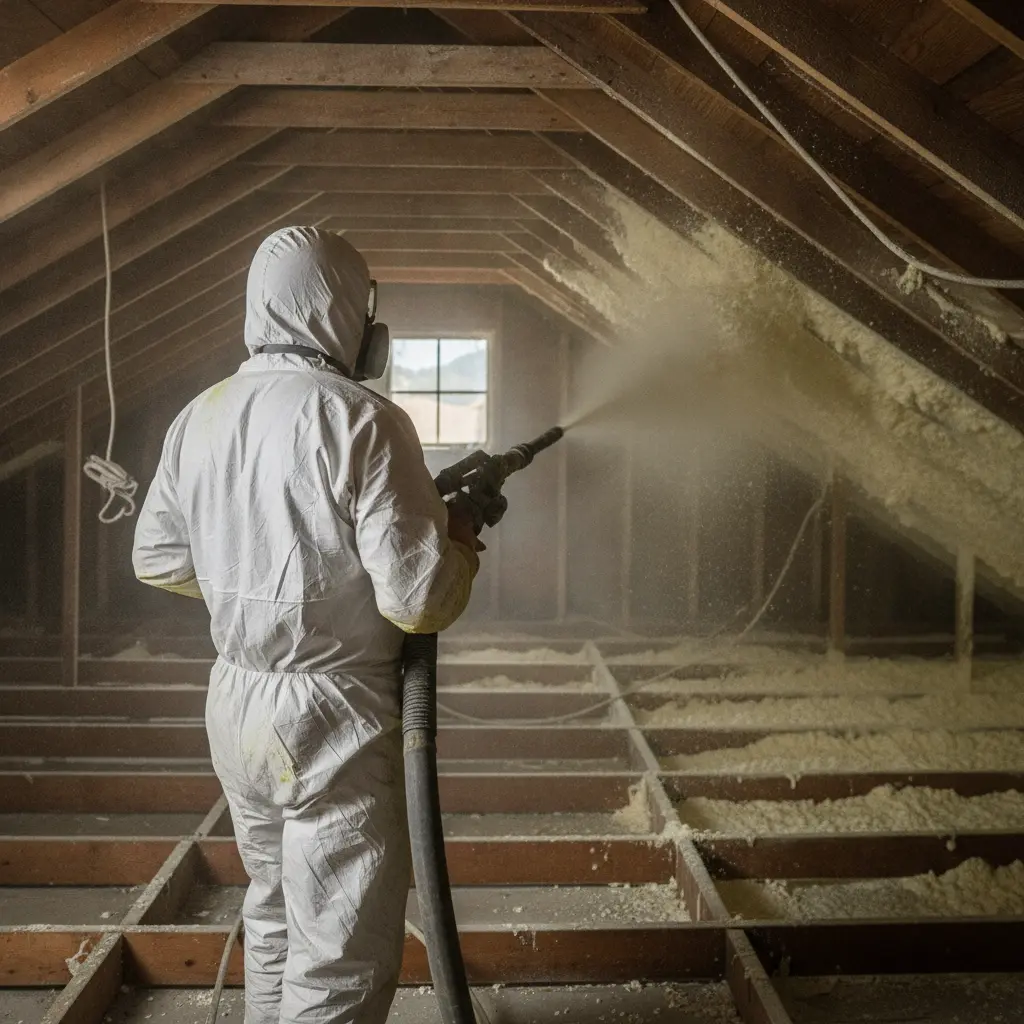
Our team in action — insulation professionals serving Simi Valley
Roof Insulation Methods and Approaches
Blown-In Fiberglass Insulation
Blown-in fiberglass is the most commonly specified product for Simi Valley attic upgrades. It achieves R-2.2 to R-2.7 per inch, resists moisture, and does not settle significantly over time. It is ideal for open attic floors with standard joist spacing and is particularly well-suited to Simi Valley’s low-humidity environment, where cellulose’s moisture absorption characteristics may be less advantageous. Blow-in insulation using fiberglass is our default recommendation for most Wood Ranch and Bridle Path area homes.
Blown-In Cellulose Insulation
Cellulose, manufactured from recycled paper treated with borate fire retardants, achieves R-3.2 to R-3.8 per inch and offers superior air infiltration resistance in dense-pack applications. We recommend cellulose for cathedral ceiling assemblies and wall cavities where dense-pack installation through small drill holes avoids interior finish disruption.
Open-Cell Spray Foam Insulation
Spray foam insulation in open-cell form is ideal for unvented attic assemblies where the insulation is applied directly to the underside of the roof deck rather than the attic floor. This creates a conditioned attic space that eliminates duct energy loss — a significant advantage in Simi Valley homes where HVAC ductwork runs through the attic and is exposed to extreme heat.
Closed-Cell Spray Foam Insulation
Closed-cell spray foam achieves R-6.0 to R-7.0 per inch and provides a complete vapor and air barrier in a single material. It is specified for low-slope commercial roofs along Tapo Canyon Road, for crawl space encapsulation projects, and for any application requiring structural reinforcement alongside thermal performance.
Fiberglass Batt Insulation
Insulation installation using pre-cut fiberglass batts remains appropriate for new construction with accessible joist bays and for supplementing existing installations where access and geometry permit precise placement without voids or compression.
Ready for Roof Insulation? Get Your Free Estimate Today.
Next Level Insulation of Simi Valley serves Simi Valley and the surrounding area — we’ll be on-site within 24 hours.
📞 Call (805) 774-1832Roof Insulation Cost in Simi Valley, CA
Understanding the cost of roof insulation in Simi Valley helps homeowners budget accurately and evaluate contractor proposals. Pricing varies based on material choice, current attic conditions, square footage, and accessibility.
Typical Price Ranges
- Blown-in fiberglass to R-38: $1.50 to $2.50 per square foot installed. A 1,500 sq ft attic typically costs $2,250 to $3,750.
- Blown-in cellulose to R-38: $1.40 to $2.20 per square foot installed. A 1,500 sq ft attic typically costs $2,100 to $3,300.
- Open-cell spray foam at roof deck (unvented attic): $1.75 to $3.00 per square foot at 3.5 inches. Larger coverage for a 1,500 sq ft roof deck runs $2,600 to $4,500.
- Closed-cell spray foam: $4.00 to $7.00 per square foot installed due to material cost and specialized equipment requirements.
- Insulation removal prior to reinstallation: $1.00 to $2.00 per square foot, depending on material type and contamination level.
Simi Valley-Specific Cost Factors
Homes in Simi Valley with limited attic access hatches — common in 1970s construction near Stearns Street and Cochran Street corridors — may require access modification, adding $150 to $400 to project costs. Post-wildfire contamination remediation requiring HEPA equipment adds $300 to $600. Southern California Edison rebates of up to $200 for qualifying projects in zip codes 93063 and 93065 can offset a portion of upgrade costs.
Request a written itemized quote from Next Level Insulation of Simi Valley by calling (805) 774-1832. We provide transparent, line-item proposals with no hidden fees.
Neighborhoods We Serve in Simi Valley
Wood Ranch
Wood Ranch is a master-planned community in eastern Simi Valley developed primarily between 1985 and 2005. Homes here feature tile roofs over vaulted ceiling assemblies, which create challenging insulation geometries. We frequently encounter undersized batt insulation compressed between rafters, reducing effective R-value significantly. Our dense-pack cellulose approach addresses these cathedral ceiling conditions without requiring drywall removal.
Sycamore Park and Mountain Gate
These central Simi Valley neighborhoods contain a high concentration of 1960s and 1970s tract homes with original fiberglass batts that have never been replaced. Attic access is often limited to a single 22-by-30-inch hatch. We routinely perform full removal and blow-in replacement projects in this area, restoring homes from R-6 effective values to R-49.
Bridle Path and Oakridge Estates
This upscale hillside corridor features larger custom homes built between 1990 and 2010, often with complex rooflines and multiple attic zones. Energy bills in this area frequently exceed $500 monthly in summer. We provide zoned attic assessments to address each section of these complex roof assemblies independently.
We also serve homeowners and businesses throughout Thousand Oaks, Moorpark, Camarillo, and Chatsworth with the same Simi Valley-calibrated expertise.
Roof Insulation Maintenance Tips for Simi Valley Homeowners
- Inspect your attic every October before Santa Ana wind season begins. Look for insulation displacement, moisture staining, or pest activity that may have occurred over the summer.
- After any nearby wildfire event, have your attic inspected for ash and particulate infiltration, particularly if your home is in the Madera, Knolls, or Wood Ranch neighborhoods near open hillside terrain.
- Keep soffit vents clear of debris. Simi Valley’s dry landscape produces significant windblown dust that can clog soffit screens, reducing attic ventilation and raising attic temperatures.
- Do not store items directly on attic insulation. Compressing blow-in insulation by even two inches can reduce its R-value by 15 to 25 percent.
- Seal attic access hatches with weatherstripping and an insulated cover rated to at least R-10 to prevent conditioned air from escaping into the attic through this commonly overlooked bypass.
- Check for roof leaks after winter rains. Simi Valley’s occasional El Niño-driven rain events can introduce moisture into attic spaces, which degrades fiberglass batts and can cause cellulose to compact.
- Schedule a professional insulation assessment every 10 years to verify R-value performance and confirm compliance with current Title 24 standards if you plan to sell or refinance.
Why Choose Next Level Insulation of Simi Valley
Next Level Insulation of Simi Valley is a locally based insulation contractor with deep roots in the communities we serve. Our technicians understand Simi Valley’s specific climate challenges — the extreme attic temperatures driven by the Santa Susana basin topography, the wildfire ash contamination risks that affect attic insulation integrity, and the aging housing stock in neighborhoods like Sycamore Park and Mountain Gate that require careful, experienced handling.
We offer the full spectrum of insulation services under one roof: attic insulation, spray foam insulation, blow-in insulation, crawl space insulation, crawl space encapsulation, and insulation removal and replacement. This means you work with a single trusted contractor from initial assessment through completed installation.
Our pricing is transparent and our proposals are itemized. We help you identify applicable Southern California Edison rebate programs and guide you through the documentation process. When you call Next Level Insulation of Simi Valley at (805) 774-1832, you speak directly with a local expert who knows your neighborhood and your climate.
Frequently Asked Questions About Roof Insulation in Simi Valley
How much does roof insulation cost in Simi Valley, CA?
Most Simi Valley homeowners invest between $1,500 and $5,000 for a full attic insulation upgrade, depending on square footage, material choice, and whether existing insulation must be removed first. Blown-in fiberglass to R-38 in a 1,200 to 1,500 square foot attic typically falls between $1,800 and $3,500. Spray foam applications at the roof deck run higher. Call (805) 774-1832 for a free on-site estimate.
What R-value do I need for roof insulation in Simi Valley?
Simi Valley falls within California Energy Commission Climate Zone 9. The current Title 24 standard requires a minimum of R-38 for attic insulation in this zone. We recommend R-49 to R-60 for homes in the hottest microclimates, including hillside properties in Bridle Path and Oakridge Estates that experience prolonged afternoon sun exposure.
How long does a roof insulation installation take in Simi Valley?
A standard attic blow-in insulation installation on a 1,200 to 1,800 square foot Simi Valley home takes 4 to 8 hours, including air sealing. Projects requiring prior insulation removal add a half to full day. Spray foam applications at the roof deck may require 2 days due to off-gassing and cure time requirements.
Is my Simi Valley home’s attic insulation contaminated after the nearby wildfires?
If your home is located in the Madera neighborhood, near Alamo Street, or in hillside areas north of the 118 Freeway, there is a meaningful risk that wildfire ash from events including the Easy Fire (2019) or Woolsey Fire (2018) entered your attic through soffit and ridge vents. We perform visual and, when indicated, laboratory-tested attic inspections to assess contamination and recommend remediation through our insulation removal service.
What is the difference between attic floor insulation and roof deck spray foam in Simi Valley?
Attic floor insulation (blown-in or batt) creates a thermal barrier between the living space and a vented attic. Spray foam applied at the roof deck creates an unvented, conditioned attic. In Simi Valley homes where HVAC ductwork runs through the attic, converting to a conditioned attic with roof deck spray foam can dramatically reduce duct energy losses and is often the higher-performance solution despite its higher upfront cost.
Can I get rebates for insulation upgrades in Simi Valley?
Yes. Southern California Edison customers in Simi Valley zip codes 93063 and 93065 may qualify for rebates of up to $200 for qualifying attic insulation upgrades. SoCal Gas customers may qualify for additional rebates on related weatherization measures. We provide all required documentation at project completion.
How do I find roof insulation service near me in Simi Valley?
Next Level Insulation of Simi Valley is locally based and serves all Simi Valley neighborhoods, including Wood Ranch, Sycamore Park, Mountain Gate, Bridle Path, and the Knolls. We also serve surrounding communities including Moorpark, Thousand Oaks, Chatsworth, and Camarillo. Call (805) 774-1832 to schedule a free in-home assessment.
What happens if I ignore deteriorating roof insulation in Simi Valley?
Neglecting failing roof insulation in Simi Valley’s climate leads to escalating cooling costs — often $100 to $200 per month in unnecessary electricity charges — accelerated HVAC equipment wear, reduced indoor comfort, and potential moisture-related structural damage during El Niño rain seasons. Early intervention is consistently less expensive than reactive replacement after damage compounds.
Get Your Free Roof Insulation Assessment in Simi Valley Today
Stop overpaying on your Southern California Edison bill every summer. If your Simi Valley home was built before 1990, there is a strong likelihood your roof insulation is performing well below California’s current Title 24 energy code standards — and well below what your comfort and wallet deserve.
Next Level Insulation of Simi Valley serves all neighborhoods across Simi Valley, Moorpark, Thousand Oaks, Chatsworth, Camarillo, and the surrounding region. Our free, no-obligation assessment gives you a clear picture of your current insulation performance and a transparent, itemized proposal for bringing your home up to optimal standards.
Call us now at (805) 774-1832 to schedule your free roof insulation assessment. Our local Simi Valley team is ready to help you take your home comfort to the next level.