

Cellulose Insulation in Santa Clarita, CA
Energy-Saving Cellulose Insulation for Santa Clarita, CA Homes — Licensed & Insured
Need cellulose insulation in Santa Clarita, CA? Next Level Insulation offers expert blow-in & dense-pack cellulose for attics & walls. Call (661) 582-0187 today.
- Licensed & Insured
- Locally Owned & Operated
- Free Inspection & Estimate
Request Your
Free EstimateCellulose insulation is one of the most effective, eco-friendly insulation materials available today — and for homeowners and business owners throughout Santa Clarita, CA, it offers a compelling combination of thermal performance, fire resistance, and sustainability. Made from up to 85% recycled paper fiber treated with borate compounds, cellulose is dense-packed or loose-fill blown into walls, attics, and floors to create an airtight thermal envelope.
Santa Clarita’s unique climate — characterized by scorching summers that regularly push past 100°F in neighborhoods like Canyon Country and Stevenson Ranch, combined with cool, dry winters and the ever-present threat of Santa Ana wind events — makes choosing the right insulation critical. Inadequate or aging insulation forces HVAC systems to work overtime, driving up energy bills and shortening equipment lifespan.
At Next Level Insulation of Santa Clarita, our team brings deep knowledge of local building stock, climate conditions, and code requirements to every cellulose insulation project. Call us today at (661) 582-0187 to schedule your free assessment.
Understanding Cellulose Insulation
Cellulose insulation has a longer history than most homeowners realize. The material was first developed in the early 20th century and saw a significant surge in popularity during the energy crisis of the 1970s, when American households were desperate to reduce heating and cooling costs. Since then, manufacturing standards have improved dramatically. Modern cellulose is treated with borate compounds — typically boric acid and borax — that render it resistant to fire, mold, pests, and settling.
There are two primary forms of cellulose insulation used in residential and light commercial applications:
- Loose-fill (blown-in) cellulose: Delivered via a blowing machine through a hose, this form is ideal for open attic floors and hard-to-reach cavities. It conforms to irregular shapes and fills around obstructions like pipes, joists, and electrical boxes more effectively than batt insulation.
- Dense-pack cellulose: Blown into closed wall cavities at higher pressures to achieve densities of 3.5 to 4 lbs per cubic foot, dense-pack cellulose resists settling and dramatically reduces air infiltration. This method is particularly valuable for retrofitting older homes that were never properly insulated.
Cellulose achieves an R-value of approximately R-3.2 to R-3.8 per inch, which is comparable to fiberglass batts. However, its superior air-sealing qualities mean it typically outperforms fiberglass in real-world energy savings by reducing convective heat loss — a significant advantage in Santa Clarita’s extreme temperature swings.
In Santa Clarita, the housing stock is heavily weighted toward single-family detached homes built between the mid-1970s and early 2000s — a period when insulation standards were improving but still far below current California Title 24 Energy Code requirements. Many of these homes in master-planned communities like Stevenson Ranch, Valencia, and Saugus were built with minimum-code fiberglass batts that have since compressed, settled, or been disturbed by pest activity. Cellulose insulation retrofits represent one of the most cost-effective ways for these homeowners to bring their homes up to modern energy performance standards.
Multi-family housing, commercial strip centers, and the school facilities that serve Santa Clarita’s growing population also benefit substantially from cellulose insulation’s sound-dampening qualities — an R-value bonus that fiberglass alone cannot match.
Why Cellulose Insulation Is Needed in Santa Clarita, CA
Extreme Heat Events
Santa Clarita regularly records summer temperatures in excess of 100°F. During the September 2022 heat dome that gripped Southern California, portions of Canyon Country and Saugus recorded surface temperatures above 112°F. The California Energy Commission’s Climate Zone 9 and Zone 16 designations — both of which overlap with Santa Clarita — acknowledge this thermal extremity and mandate higher insulation R-values than coastal zones. Homes without properly installed attic insulation can experience attic temperatures of 150°F to 160°F during peak summer days, with that radiant heat transferring directly into living spaces. Cellulose insulation installed to the current recommended depth of R-38 to R-60 in attics creates an effective barrier against this radiant transfer.
Santa Ana Wind Conditions
The Santa Ana winds that tear through the Santa Clarita Valley multiple times each year — most intensely between October and March — create negative pressure events inside homes that dramatically increase air infiltration through wall cavities, attic bypasses, and unsealed penetrations. Dense-pack cellulose’s superior air-sealing characteristics make it uniquely suited to homes in this region. During the Tick Fire of October 2019, which burned more than 4,200 acres in Canyon Country and forced evacuations across portions of Santa Clarita, the combination of extreme wind and radiant heat from the nearby fire line underscored just how critical airtight building envelopes are in this community.
Aging Housing Stock in Key Neighborhoods
Newhall and Old Town Santa Clarita are home to residential properties dating back to the 1950s and 1960s — homes that were originally constructed with little to no wall insulation and rudimentary attic coverage. Even homes built in the 1980s development boom in Saugus and Valencia were installed with fiberglass batts at R-11 to R-19 in walls and R-19 in attics — figures that are dramatically below California’s current Title 24 minimums. Decades of thermal cycling, pest intrusion, and moisture events have further degraded that original insulation’s performance.
Fire-Resistant Building Needs
Santa Clarita is partially designated within a Very High Fire Hazard Severity Zone (VHFHSZ) by Cal Fire, particularly in foothill areas. Cellulose insulation’s borate treatment gives it a Class I fire rating, and its density reduces the air pockets that can accelerate flame spread within wall cavities — a meaningful consideration for homeowners in wildland-urban interface neighborhoods like Placerita Canyon and Sand Canyon.
Water Efficiency and Moisture Management
Despite Santa Clarita’s semi-arid climate, the valley does experience winter rain events and occasional fog intrusion that can introduce moisture into attic and crawl space environments. Cellulose’s borate treatment inhibits mold growth even when the material absorbs modest amounts of moisture, provided it can dry out — a quality that fiberglass does not share.
Signs You Need Cellulose Insulation in Santa Clarita
Energy Bill Red Flags
- Monthly cooling bills exceeding $250–$350 during Santa Clarita’s June–September peak season in a home under 2,000 square feet
- Consistent year-over-year increases in utility costs without corresponding changes in usage habits
- HVAC system running continuously during triple-digit heat events without reaching the thermostat set point
Comfort and Air Quality Issues
- Rooms that feel noticeably hotter or colder than adjacent spaces — a classic sign of missing or compressed wall insulation
- Drafts near electrical outlets, window frames, or baseboards, especially during Santa Ana wind events
- Visible dust infiltration around ceiling light fixtures, which indicates attic air bypasses
- Musty or dusty odors in rooms adjacent to uninsulated walls or attic spaces
Physical Inspection Indicators
- Attic insulation depth below 10 inches (indicating R-values well below the R-38 California minimum)
- Visible compressed or yellowed fiberglass batts in attic spaces
- Rodent or pest activity in the attic or walls that has disturbed existing insulation
- Water staining on attic insulation following winter rain events
Urgency Indicators
If your home is in a VHFHSZ-designated area and your existing insulation is fiberglass (which carries no inherent fire resistance), upgrading to cellulose becomes a safety consideration, not merely a comfort one. Similarly, if you’ve recently had insulation removal performed after pest infestation, delaying reinstallation through another Santa Clarita summer is costly and uncomfortable.
Our Cellulose Insulation Installation Process
Next Level Insulation of Santa Clarita follows a structured, transparent process on every project — from a modest attic top-up in Newhall to a whole-home dense-pack retrofit in Stevenson Ranch.
- Step 1 — Free On-Site Assessment (1–2 hours): Our technician visits your property, inspects accessible attic spaces, crawl areas, and wall cavities, and documents existing insulation depth, R-values, air sealing deficiencies, and any moisture or pest damage. We note Santa Clarita-specific factors including proximity to fire hazard zones, prevailing wind exposure, and local Title 24 compliance requirements.
- Step 2 — Insulation Removal if Required (Half-day to full day): If existing insulation is damaged, contaminated, or so degraded that it impedes proper cellulose installation, we perform professional insulation removal before proceeding. Our team uses HEPA-equipped vacuum systems to safely extract old material without contaminating living spaces.
- Step 3 — Air Sealing and Preparation (2–4 hours): Before any cellulose is installed, we seal attic bypasses — gaps around plumbing chases, electrical penetrations, recessed lighting, and top plates — with spray foam or caulk. In Santa Clarita homes, this step is especially critical because of the high air infiltration rates caused by seasonal wind pressure differentials.
- Step 4 — Cellulose Installation (2–6 hours depending on scope): Using professional-grade blowing machines, we install cellulose to the specified depth and density. For attic loose-fill applications, we use depth gauges to verify consistent R-38 to R-60 coverage. For dense-pack wall applications, we drill small fill holes through exterior siding or interior drywall, fill cavities to 3.5–4.0 lbs/ft³, and patch all holes.
- Step 5 — Quality Verification (30–60 minutes): Our technician uses a density probe and depth rods to verify installation quality. We photograph completed work for your records and confirm compliance with California Title 24 requirements applicable to your climate zone.
- Step 6 — Cleanup and Walkthrough (30 minutes): All work areas are cleaned, access panels are replaced, and we walk you through the completed installation, explaining what was installed, where, and at what R-value.
- Step 7 — Post-Installation Guidance: We provide written documentation of the installation and guidance on maintaining your new insulation system, including tips specific to Santa Clarita’s fire season and Santa Ana wind periods.
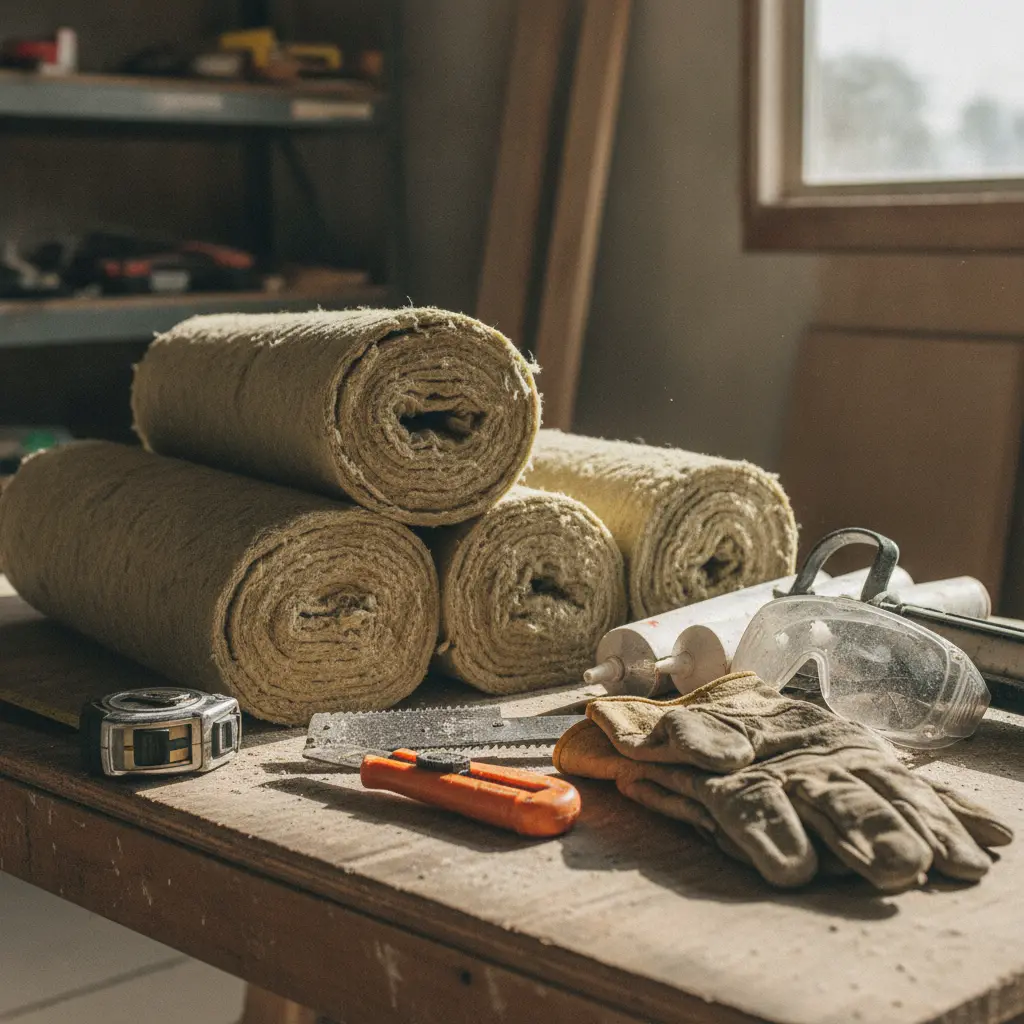
Our team in action — insulation professionals serving Santa Clarita
Cellulose Insulation Methods and Approaches
Attic Loose-Fill Cellulose
The most common cellulose application in Santa Clarita homes, loose-fill is blown across the attic floor to depths of 10–17 inches depending on target R-value. This method is fast, cost-effective, and ideal for the predominant trussed roof construction found throughout Valencia, Saugus, and Stevenson Ranch. It excels at filling around the complex geometry of truss systems that batt insulation cannot fully cover. Learn more about our attic insulation services.
Dense-Pack Cellulose for Wall Cavities
Dense-packing is the preferred method for insulating existing wall cavities without opening walls for full renovation. Our technicians drill 2-inch holes at regular intervals into either the exterior or interior face of the wall, insert a fill tube, and pack cellulose to target density. This is particularly valuable for older Newhall and Canyon Country homes with uninsulated 2×4 stud walls. Explore our blow-in insulation options.
Spray-Applied Stabilized Cellulose
For open cathedral ceilings, vaulted rafters, and new construction wall applications, spray-applied wet-spray cellulose is mixed with a small amount of water and adhesive and applied directly to surfaces before drywall installation. This method creates an extremely tight, conforming layer that adheres to framing members and eliminates voids.
Combined Cellulose and Spray Foam Systems
In homes within Santa Clarita’s VHFHSZ areas or those with significant air sealing challenges, we often recommend a hybrid approach: closed-cell spray foam is applied at 1–2 inches along the attic roof deck or wall perimeter to establish an air and vapor barrier, with cellulose then blown over or into the remaining cavity space to achieve target R-values economically.
Ready for Cellulose Insulation? Get Your Free Estimate Today.
Next Level Insulation of Santa Clarita serves Santa Clarita and the surrounding area — we’ll be on-site within 24 hours.
📞 Call (661) 582-0187Cellulose Insulation Cost in Santa Clarita, CA
Understanding what cellulose insulation costs in Santa Clarita helps homeowners budget accurately and evaluate proposals. Prices vary based on application type, scope, and site-specific conditions.
Typical Price Ranges
- Attic loose-fill cellulose (air sealing included): $1.20 to $2.50 per square foot. A typical 1,500 sq ft Santa Clarita ranch home attic runs $1,800 to $3,750 installed.
- Dense-pack wall cellulose (retrofit): $2.50 to $4.50 per square foot of wall area, including drilling and patching. Full exterior wall treatment on a 2,000 sq ft home typically ranges from $3,500 to $6,500.
- Crawl space insulation with cellulose: $1.50 to $3.00 per square foot. View our crawl space insulation services.
- Combined insulation removal and cellulose reinstallation: Add $1.00 to $2.00 per square foot for insulation removal and disposal.
Factors Affecting Cost in Santa Clarita
- Attic access difficulty: Many Stevenson Ranch and Porter Ranch homes have low-pitch rooflines with limited attic clearance, increasing labor time.
- Existing insulation condition: Heavy rodent contamination (common in foothills adjacent to open space preserves) requires complete removal before reinstallation.
- California Title 24 compliance upgrades: Older homes may require higher final R-values than originally installed, increasing material volume.
- Utility rebates: Southern California Edison and SoCalGas both offer rebates for qualifying insulation upgrades, which can offset project costs by $200 to $800 depending on scope.
Contact Next Level Insulation of Santa Clarita at (661) 582-0187 for a detailed, written estimate specific to your property.
Santa Clarita Neighborhoods We Serve
Canyon Country
Canyon Country’s housing stock ranges from 1960s and 1970s tract homes with minimal original insulation to newer developments built closer to current code. Foothills proximity means elevated wildfire risk and rodent activity — making insulation removal and cellulose replacement a common service need here.
Newhall and Old Town Santa Clarita
Some of Santa Clarita’s oldest residential buildings are found in Newhall, with properties dating to the 1940s and 1950s. These homes frequently have uninsulated wood-frame walls and shallow attics, making dense-pack cellulose retrofits both technically challenging and highly impactful for energy performance.
Stevenson Ranch and Valencia
These master-planned communities feature predominantly 1990s–2000s single-family homes that were built with code-minimum insulation now 20–30 years old. Attic top-ups and air sealing packages are the most common service in these neighborhoods.
Castaic and Northridge
Properties in Castaic sit at higher elevations with wider daily temperature swings, while Northridge homes — particularly post-1994 Northridge Earthquake rebuilds — often have accessible wall and attic cavities ideal for cellulose upgrades. Learn about insulation replacement options.
We also serve Canoga Park, Chatsworth, Mission Hills, Sylmar, Granada Hills, North Hills, Porter Ranch, San Fernando, Simi Valley, and all surrounding communities.
Cellulose Insulation Maintenance Tips for Santa Clarita Homeowners
- Inspect attic depth annually: Use a ruler to check cellulose depth near your attic access hatch each fall — before Santa Clarita’s winter rain season. Settling of more than 1–2 inches may warrant a top-up.
- Check for pest activity after wildfire seasons: Rodents displaced by fire events in adjacent open space areas frequently shelter in attics. Address intrusions immediately to prevent insulation contamination.
- Keep attic vents clear: Santa Clarita’s dry, windy conditions deposit significant debris in soffit and ridge vents. Clogged vents reduce attic ventilation and can drive up moisture levels in cellulose insulation.
- Seal new penetrations promptly: After any plumbing, electrical, or HVAC work that creates new attic penetrations, seal gaps with spray foam before air sealing performance is compromised.
- Monitor for moisture after rain events: Canyon Country and Castaic hillside properties can experience wind-driven rain intrusion through roof vents. Wet cellulose should be inspected and dried or replaced promptly.
- Avoid compressing attic cellulose: Do not store heavy items directly on attic floor insulation — compression dramatically reduces R-value.
- Schedule a professional inspection every 5–7 years: A professional assessment catches gradual settling, air sealing failures, and pest damage before they become costly problems.
Why Choose Next Level Insulation of Santa Clarita
Next Level Insulation of Santa Clarita is a locally focused insulation contractor with deep familiarity with the specific building types, climate conditions, and code requirements of the Santa Clarita Valley and surrounding communities. We don’t apply a one-size-fits-all approach — we assess each property individually, factoring in your home’s age, construction type, fire risk zone designation, and energy goals.
Our team is trained in California Title 24 compliance requirements and stays current with Southern California Edison and SoCalGas utility rebate programs that can reduce your out-of-pocket project cost. We work in Canyon Country and Castaic hillside homes as readily as we work in Valencia and Stevenson Ranch tract homes — every property receives the same careful attention to air sealing, proper density verification, and post-installation documentation.
Beyond cellulose, we offer the full range of insulation services Santa Clarita homeowners need: spray foam insulation, attic insulation, blow-in insulation, crawl space encapsulation, crawl space insulation, insulation removal, and insulation replacement.
Call us at (661) 582-0187 to experience the Next Level difference.
Frequently Asked Questions About Cellulose Insulation in Santa Clarita
How much does cellulose insulation cost in Santa Clarita?
Attic loose-fill cellulose in Santa Clarita typically runs $1.20 to $2.50 per square foot installed, including air sealing preparation. A full attic treatment for a 1,500 sq ft home generally costs between $1,800 and $3,750. Dense-pack wall insulation runs higher — $2.50 to $4.50 per square foot — due to the labor involved in drilling, filling, and patching wall cavities. Southern California Edison rebates may offset a portion of your cost.
How long does cellulose insulation installation take?
Most attic cellulose installations in Santa Clarita are completed in a single day. A standard 1,500–2,000 sq ft attic, including air sealing, typically takes 4–6 hours. Dense-pack wall insulation for a full home exterior takes 1–2 days depending on the number of walls and access conditions.
Is cellulose insulation a good choice for Santa Clarita’s fire-prone areas?
Yes. Cellulose insulation treated with borate compounds carries a Class I fire rating. Its density means there are fewer air pockets within wall cavities to accelerate flame spread. For homes in Cal Fire-designated Very High Fire Hazard Severity Zones — including portions of Canyon Country and Castaic — cellulose’s fire resistance is a meaningful advantage over untreated fiberglass batts.
Will cellulose insulation settle over time?
Loose-fill cellulose does experience some initial settling — typically 10–20% within the first year. Reputable contractors account for this by installing to a greater initial depth than the target R-value requires. Dense-pack cellulose, installed at 3.5–4.0 lbs/ft³ in wall cavities, experiences negligible settling due to its high density.
Can cellulose insulation get wet? What happens if it does?
Cellulose can absorb moisture and will lose R-value when wet, but it does not immediately fail the way fiberglass does. Its borate treatment inhibits mold growth during brief moisture exposure. In Santa Clarita’s climate, prolonged wetting (from roof leaks or wind-driven rain intrusion) requires prompt attention — wet cellulose should be dried or replaced to maintain performance and prevent mold issues.
How much R-value do I need in my Santa Clarita attic?
California’s Title 24 Energy Code requires a minimum of R-38 for attic insulation in the climate zones covering most of Santa Clarita (Climate Zones 9 and 16). Energy efficiency programs and utilities often recommend R-49 to R-60 for maximum energy savings, particularly in Canyon Country and Castaic where temperature extremes are most pronounced.
Do I need to remove old insulation before adding cellulose?
Not always. If existing insulation is clean, undamaged, and free of pest contamination, cellulose can often be blown directly on top to achieve target depth. However, if existing material is contaminated by rodents, water-damaged, or heavily settled and degraded, full removal is recommended before reinstallation to ensure maximum performance.
Does Next Level Insulation of Santa Clarita serve areas outside Santa Clarita proper?
Yes. We serve the entire northern Los Angeles and southern Ventura County region, including Canoga Park, Chatsworth, Mission Hills, Sylmar, Granada Hills, North Hills, Castaic, Porter Ranch, Stevenson Ranch, Newhall, Canyon Country, Northridge, Simi Valley, and San Fernando.
Get Your Free Cellulose Insulation Estimate in Santa Clarita Today
Don’t let another brutal Santa Clarita summer drain your energy budget or another Santa Ana wind season compromise your home’s comfort. Next Level Insulation of Santa Clarita is ready to assess your home, recommend the right cellulose insulation solution, and complete the work with precision and professionalism.
Whether you’re in Canyon Country, Stevenson Ranch, Newhall, or anywhere across the Santa Clarita Valley, our team brings local expertise and quality materials to every project.
Call us now at (661) 582-0187 to schedule your free, no-obligation on-site assessment. You can also reach us through our website’s contact form. We look forward to helping you achieve a more comfortable, energy-efficient home — at the Next Level.