

Insulation Installation in Burbank, CA
Expert Insulation Installation in Burbank, CA for Burbank, CA Homes & Businesses
Need insulation installation in Burbank, CA? Next Level Insulation offers 20+ years of expert attic, spray foam & rodent-proof insulation. Free estimate—call (818) 514-7541.
- Licensed & Insured
- Locally Owned & Operated
- Free Inspection & Estimate
Request Your
Free EstimateInsulation installation is the process of placing thermal and acoustic barrier materials within walls, attics, floors, and ceilings to regulate interior temperatures, reduce energy consumption, and improve comfort. In Burbank, CA — a city nestled in the eastern San Fernando Valley between the Verdugo Mountains and the Los Angeles River basin — extreme summer heat regularly exceeds 100°F, while cool desert nights and occasional freezing temperatures in winter create year-round thermal stress on buildings.
Next Level Insulation of Burbank brings over 20 years of hands-on experience delivering high-performance insulation solutions to homeowners and businesses throughout Burbank and the greater San Fernando Valley. Whether you own a classic 1940s California bungalow near downtown Burbank or a modern commercial facility off the Empire Center corridor, our team designs insulation systems built for this specific climate, this specific geography, and these specific building types. Call us today at (818) 514-7541 for your free estimate.
Understanding Insulation Installation in Burbank, CA
Insulation installation is one of the most impactful building science interventions available to property owners. At its core, it involves selecting the right insulating material — whether blown-in fiberglass, spray polyurethane foam, rigid mineral wool board, or cellulose — and placing it precisely within the thermal envelope of a structure to resist heat transfer. The measurement used to quantify resistance to heat flow is the R-value: the higher the R-value, the more effective the insulation.
Historically, Burbank’s residential building stock was developed rapidly during two major growth periods. The first followed World War II, when Lockheed Aircraft (now part of the Northrop Grumman operations formerly at the Burbank-Glendale-Pasadena Airport site) attracted tens of thousands of workers who needed housing fast. Builders in that era used minimal insulation — often just kraft-faced fiberglass batts with R-values as low as R-7 — because energy was cheap and codes were permissive. The second growth wave came in the 1970s through the 1990s as the entertainment industry expanded around Warner Bros. Studios and NBC Studios (now Burbank Studios), drawing more residents and prompting dense apartment construction along corridors like San Fernando Boulevard and Glenoaks Boulevard. Many of these structures were also built to minimum code, leaving an enormous stock of under-insulated properties today.
Modern California Building Energy Efficiency Standards (Title 24) now require attic insulation at a minimum of R-38 for residential projects in Burbank’s Climate Zone 9, with wall cavity insulation at R-13 to R-21 depending on framing type. Yet the vast majority of pre-1978 homes in Burbank’s Magnolia Park neighborhood, the Rancho neighborhood east of Buena Vista Street, and properties along Olive Avenue predate these requirements entirely.
Insulation installation today encompasses a spectrum of specialized services: attic insulation, house insulation, roof insulation, spray foam insulation, ceiling insulation, sound insulation, fiberglass insulation, and rodent-proof insulation. Each addresses a distinct thermal or acoustic challenge. In a city where sound from Bob Hope Airport flight paths and the nearby 5 and 134 freeways penetrates older single-pane construction daily, acoustic insulation carries additional value beyond energy performance alone.
Why Insulation Installation Is Needed in Burbank, CA
Burbank’s Extreme Thermal Climate
Burbank sits in the eastern San Fernando Valley, a basin geography that amplifies heat island effects significantly. NOAA weather data for the Burbank Bob Hope Airport station consistently records summer afternoon highs between 95°F and 108°F from June through September, with recorded extremes such as the September 6, 2020 heat event when Burbank reached 113°F — among the highest temperatures ever recorded in Los Angeles County during that catastrophic regional heat wave. Overnight lows in January routinely fall to the low 40s°F and occasionally dip below 35°F. This approximately 70°F seasonal swing is substantially larger than coastal Los Angeles (which experiences a roughly 30°F swing), placing enormous and constant demand on HVAC systems inside under-insulated buildings.
The Urban Heat Island Effect and Freeway Proximity
Burbank’s land use pattern — dense industrial corridors near the former Lockheed site along Empire Avenue, high-traffic commercial zones on San Fernando Road, and heavy freeway infrastructure including the I-5, SR-134, and SR-170 — creates an intensified urban heat island effect. Studies by the University of Southern California’s Spatial Sciences Institute have quantified San Fernando Valley heat islands as generating 4°F to 8°F of additional ambient temperature compared to nearby mountainous areas. Properties within half a mile of the I-5 and SR-134 interchange in northern Burbank experience both elevated ambient temperatures and elevated particulate infiltration — both problems that are meaningfully addressed through proper building insulation and air sealing.
Aging Building Stock and Wildfire Smoke Infiltration
Approximately 60% of Burbank’s residential housing was constructed before 1970 according to Los Angeles County assessor records. Homes in the Hillside area along Sunset Canyon Drive, properties in the Chandler Estates neighborhood, and older bungalows near downtown Burbank on streets like Magnolia Boulevard and Harvard Street commonly have attic insulation tested at R-7 to R-11 — less than one-third of current Title 24 requirements. During wildfire events such as the November 2018 Woolsey Fire and the January 2025 Eaton Fire (which burned in nearby Altadena and threatened areas within 8 miles of Burbank), smoke infiltration into poorly sealed attic spaces was a documented public health issue for San Fernando Valley residents.
Hard Water and Moisture Dynamics
Although Burbank is a semi-arid climate, its occasional winter rainstorms — particularly during La Niña and El Niño cycles — introduce moisture into attic spaces through inadequate ventilation or compromised roofing on older structures. When existing fiberglass batt insulation absorbs moisture, it loses up to 40% of its rated R-value, compounding energy efficiency problems. Burbank’s hard tap water (rated at approximately 300 parts per million total dissolved solids by the Burbank Water and Power utility) also contributes to condensation issues in metal ductwork that runs through attic spaces, accelerating degradation of adjacent insulation materials.
Signs You Need Insulation Installation in Burbank
Energy and Comfort Indicators
- Monthly Burbank Water and Power electricity bills exceeding $200–$350 in summer despite moderate thermostat settings
- Rooms on the top floor or beneath the roof staying 8°F or more warmer than downstairs rooms
- HVAC system running continuously during heat waves without reaching the set temperature
- Cold drafts near exterior walls or ceilings during winter nights
Visual and Physical Symptoms
- Attic insulation that appears flat, dirty, or compressed to less than 3–4 inches in depth (indicating R-11 or below)
- Visible daylight through attic eave vents or around recessed light fixtures
- Moisture staining or dark streaks on attic insulation, indicating water or rodent activity
- Insulation material that crumbles, flakes, or emits a musty odor when disturbed
Urgency Indicators
- Evidence of rodent nesting or droppings embedded in existing insulation — a health hazard requiring immediate rodent-proof insulation replacement
- Ice damming or significant condensation on interior window sills during winter months
- Recent roof replacement that exposed or displaced existing insulation
Our Insulation Installation Process in Burbank
Free On-Site Assessment (1–2 Hours)
Our certified technician visits your Burbank property and performs a comprehensive evaluation: attic depth measurements, existing R-value estimation, thermal bridging identification, air sealing gap mapping, and HVAC duct condition review. For homes in Burbank’s hillside zones along Olive Avenue or Country Club Drive, we also assess slope-related insulation challenges specific to cathedral ceiling and knee-wall configurations common in that area.
Customized Insulation Plan and Free Estimate (Same Day)
Based on the assessment, we design an insulation scope that meets or exceeds California Title 24 Climate Zone 9 requirements. We present specific R-value targets, material options, and cost ranges in writing before any work begins.
Site Preparation and Safety Setup (2–4 Hours)
Our crew installs protective floor coverings, seals interior access points, and sets up HEPA-filtered ventilation equipment. In Burbank’s older craftsman and ranch-style homes, this step includes careful protection of original hardwood floors and plaster ceilings during attic access.
Air Sealing (2–4 Hours)
Before any insulation is placed, we seal all penetrations, gaps around recessed lights, top plates, plumbing chases, and HVAC boot connections using fire-rated caulk and two-component spray foam. This step alone can reduce HVAC energy consumption by 15–25% in Burbank’s climate.
Insulation Installation (4–8 Hours Depending on Scope)
We install the approved insulation material to the specified R-value using calibrated blowing machines or hand-placement methods depending on material type. All work complies with ASTM standards and California Energy Commission specifications for Climate Zone 9.
Quality Inspection and Documentation (1 Hour)
We perform depth measurements at minimum 1 measurement per 300 square feet of attic space, photograph all completed work, and provide a written completion certificate with achieved R-values for your records — useful for Burbank Water and Power rebate applications.
Cleanup and Post-Installation Walkthrough (30–60 Minutes)
Our crew removes all equipment and debris, restores the property to pre-work condition, and walks you through the completed installation, maintenance expectations, and rebate paperwork.
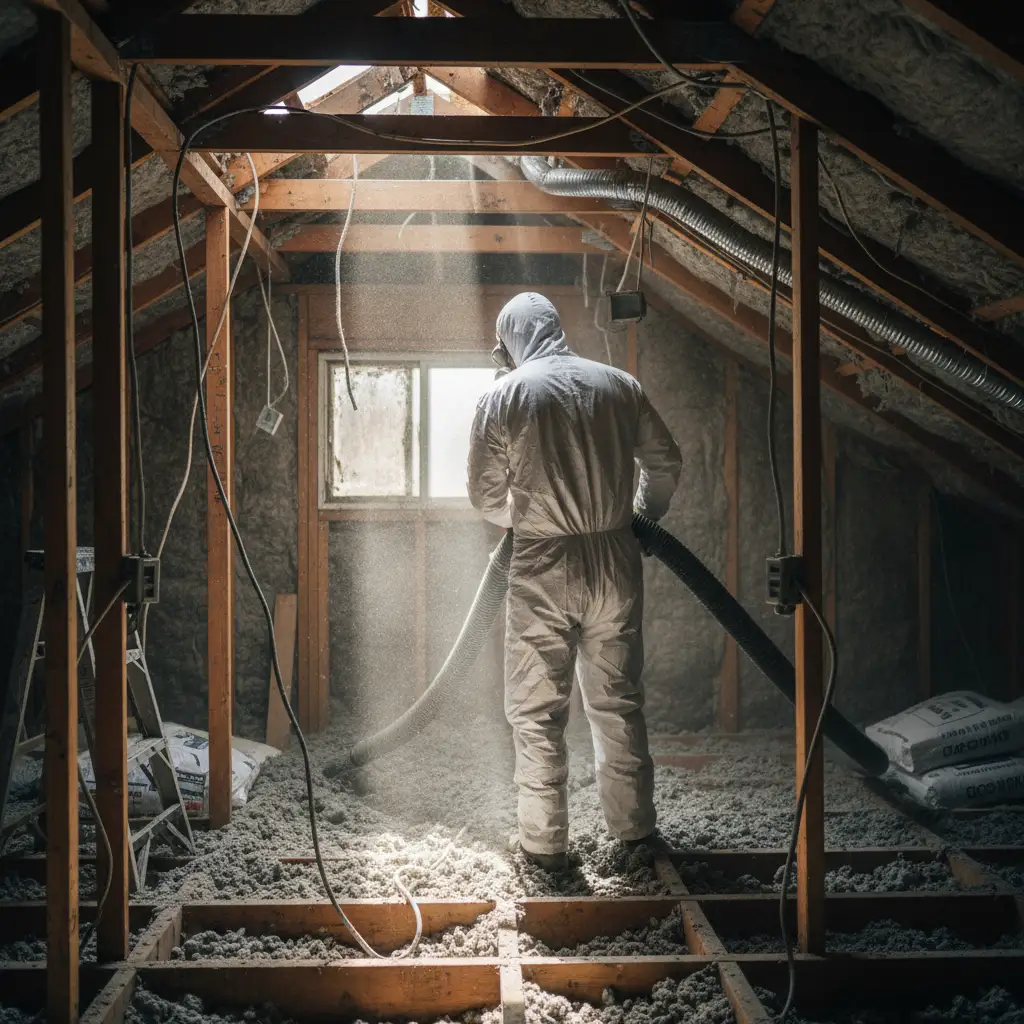
Our team in action — insulation professionals serving Burbank
Insulation Methods and Approaches We Use in Burbank
Blown-In Fiberglass and Cellulose Insulation
Blown-in insulation is the most common method for upgrading attic insulation in Burbank’s large stock of 1940s–1970s single-story ranch homes. Loose-fill materials conform to irregular framing, cover obstructions, and achieve R-38 to R-60 without structural modification. Cellulose (made from recycled paper treated with borate fire retardant) is particularly effective in homes near the Verdugo Woodlands where wildfire risk adds relevance to fire-resistant material choices.
Spray Polyurethane Foam (SPF)
Open-cell and closed-cell spray foam insulation is used where both air sealing and thermal resistance must be achieved simultaneously. Closed-cell SPF at R-6.5 per inch is ideal for Burbank’s flat commercial rooftops, crawl spaces, and rim joist applications in the industrial districts near Empire Avenue. Open-cell foam is preferred for interior wall cavities in sound-sensitive applications near the 134 Freeway corridor.
Fiberglass Batt Insulation
Pre-cut fiberglass batts rated R-13 to R-21 are used in new construction wall cavities and in wall retrofit scenarios during remodeling projects across Burbank. They are the standard solution for 2×4 and 2×6 framed walls in residential and commercial construction throughout neighborhoods like Magnolia Park and Rancho.
Rodent-Proof Insulation
Burbank’s proximity to the Los Angeles River and its mature tree canopy in neighborhoods like Toluca Lake and Chandler Estates creates favorable conditions for roof rats and Norway rats. We remove contaminated insulation, sanitize affected areas, seal all rodent entry points, and replace with TAP (Thermal Acoustical Pest Control) insulation — a borate-treated cellulose product that is pest-resistant by design.
Rigid Board Insulation
Rigid polyiso or EPS foam board insulation is applied to exterior walls and under-slab applications in commercial retrofits and additions throughout Burbank’s Media District and downtown commercial zones.
Ready for Insulation Installation? Get Your Free Estimate Today.
Next Level Insulation of Burbank serves Burbank and the surrounding area — we’ll be on-site within 24 hours.
📞 Call (818) 514-7541Insulation Installation Cost in Burbank, CA
Understanding insulation installation costs helps Burbank homeowners and business owners plan and budget accurately. Pricing varies based on material type, project scope, attic or wall accessibility, and whether old insulation removal is required.
Typical Price Ranges in Burbank
- Attic blown-in insulation (upgrade to R-38): $1,200–$2,800 for a typical 1,200–1,800 sq ft Burbank single-story home
- Attic blown-in insulation (upgrade to R-60): $1,800–$3,800 for the same home footprint
- Old insulation removal and disposal: $800–$1,800 depending on depth and contamination level
- Spray foam insulation (closed-cell, per board foot): $1.00–$2.00 per board foot installed
- Wall cavity fiberglass batt insulation (per sq ft of wall area): $1.50–$3.50 installed
- Rodent-proof insulation replacement (full attic): $2,000–$5,500 including remediation
Burbank-Specific Cost Factors
Labor costs in Burbank and Los Angeles County are generally 15–25% higher than national averages due to prevailing wage rates and cost of living. However, Burbank Water and Power (BWP) offers rebates of up to $200–$400 for qualifying residential insulation upgrades, meaningfully offsetting project costs. California’s cap-and-trade program additionally funds HVAC and insulation incentives through the CHEERS and TECH Clean California programs available to Burbank residents. Properties in Burbank’s hillside areas with limited attic access or steeper pitch rooflines may carry an additional $200–$500 accessibility surcharge. We provide itemized written estimates so every line item is transparent. Request Your Free Estimate
Neighborhoods We Serve in and Around Burbank
Magnolia Park, Burbank
One of Burbank’s most iconic residential neighborhoods, Magnolia Park features a high concentration of 1930s–1950s craftsman bungalows and Spanish Colonial revival homes along Magnolia Boulevard and its surrounding streets. These properties typically have original 2×4 wall framing with no wall insulation and attic insulation at R-7 to R-11, making them prime candidates for comprehensive insulation upgrades. Insulation Services in Magnolia Park
Rancho District, Burbank
East of Buena Vista Street, the Rancho neighborhood contains many post-war ranch-style homes built between 1945 and 1965. Shallow attic profiles in these flat-roof and low-slope designs require blown-in insulation techniques and careful vapor management to prevent condensation issues.
Burbank Hills / Sunset Canyon
Homes on the hillside above Glenoaks Boulevard toward Stough Canyon Nature Center face unique insulation challenges: steeper rooflines, cathedral ceilings, and proximity to wildfire risk zones. Spray foam and fire-resistant cellulose are frequently the preferred solutions in this area.
Studio City, Sherman Oaks, and North Hollywood
Our service area extends into neighboring San Fernando Valley communities. Mid-century apartment buildings along Ventura Boulevard in Studio City and Sherman Oaks and post-war duplexes in North Hollywood share many of the same under-insulated construction characteristics as Burbank’s residential stock. Insulation Services in Studio City
Insulation Maintenance Tips for Burbank Property Owners
- Annual attic inspection: Check attic insulation depth and condition every fall before winter and every spring after the rainy season. Look for compressed, wet, or displaced insulation — common in Burbank after El Niño rainfall events.
- Seal attic access hatches: Burbank’s hot attics (which can reach 150°F in summer) lose conditioned air rapidly through unsealed attic hatches; add weatherstripping and rigid foam insulation to hatch covers annually.
- Monitor for rodent activity: Given Burbank’s proximity to the Los Angeles River and urban tree canopy, inspect for rodent droppings or nesting material in the attic at least twice per year.
- Clear attic ventilation pathways: Ensure soffit vents along eaves are not blocked by blown-in insulation; maintain a minimum 1-inch air channel using vent baffles.
- Check insulation around HVAC ducts: Burbank Water and Power auditors frequently cite duct insulation degradation as a top energy waste source; inspect duct wrap annually for tears or separation.
- After any roof repair or replacement: Confirm that roofing contractors have not displaced or compressed existing attic insulation during their work — a common and often unnoticed problem in Burbank’s housing stock.
- Review BWP rebate programs annually: Burbank Water and Power updates its energy efficiency rebate schedule each fiscal year; staying current ensures you capture available incentives for any insulation improvements.
Why Choose Next Level Insulation of Burbank
Next Level Insulation is Burbank’s trusted insulation contractor — not a franchise operation dispatched from across the county, but a team with over 20 years of direct experience working on Burbank’s specific building types, climate conditions, and energy codes. We have installed insulation in craftsman bungalows in Magnolia Park, commercial tilt-up buildings in the Empire Center industrial corridor, hillside homes above Sunset Canyon, and everything in between.
Our expertise spans the full range of insulation services: attic insulation, house insulation, roof insulation, spray foam insulation, ceiling insulation, sound insulation, fiberglass insulation, and rodent-proof insulation. We are deeply familiar with Burbank Water and Power’s rebate requirements and California Title 24 Climate Zone 9 compliance documentation, saving our customers time and money on incentive paperwork.
Every project begins with a no-cost, no-obligation assessment. We provide written, itemized estimates with no hidden fees. Our installations are designed for long-term performance — not just minimum code compliance. We serve Burbank and surrounding communities including Studio City, Sherman Oaks, North Hollywood, Glendale, Pasadena, Hollywood, Beverly Hills, and Toluca Lake. Call (818) 514-7541 to schedule your free estimate today. Learn More About Next Level Insulation
Frequently Asked Questions: Insulation Installation in Burbank, CA
How much does insulation installation cost in Burbank, CA?
In Burbank, attic insulation upgrades typically range from $1,200 to $3,800 depending on home size, target R-value, and whether old insulation removal is needed. Spray foam projects are priced per board foot at $1.00–$2.00 installed. Burbank Water and Power rebates can offset $200–$400 of qualifying project costs. We provide free written estimates for every project.
What R-value do I need for my Burbank home?
Burbank is in California Climate Zone 9. California Title 24 requires a minimum of R-38 in attics for residential projects, though we often recommend R-49 to R-60 given Burbank’s extreme summer heat — especially for homes in heat-exposed neighborhoods like Rancho or properties near the I-5 freeway corridor. Wall cavity requirements are R-13 (2×4 framing) to R-21 (2×6 framing).
How long does insulation installation take in a typical Burbank home?
A standard attic insulation upgrade for a 1,200–1,600 square foot Burbank single-story home typically takes one full day (6–8 hours) including assessment, air sealing, installation, and cleanup. Larger homes, multi-story properties in the Burbank Hills, or projects combining attic and wall insulation may require 1.5 to 2 days.
Does Burbank Water and Power offer rebates for insulation?
Yes. Burbank Water and Power (BWP) offers energy efficiency rebates for qualifying residential insulation upgrades. Rebate amounts and eligibility requirements are updated annually; as of the most recent program year, BWP offers up to $0.10–$0.20 per square foot for attic insulation upgrades meeting minimum R-value thresholds. We assist customers in completing BWP rebate applications as part of our service.
Is rodent-proof insulation necessary in Burbank?
Given Burbank’s proximity to the Los Angeles River, its mature urban tree canopy, and its large stock of older homes with unsealed eave vents and gaps in fascia boards, roof rat activity in attics is common throughout the city — particularly in Magnolia Park, the Rancho district, and homes near Brace Canyon Park. We recommend TAP (Thermal Acoustical Pest Control) borate-treated insulation as a preventive or remedial measure for any home with a history of rodent activity.
Will new insulation reduce noise from the 134 Freeway or Bob Hope Airport?
Yes, significantly. Dense-pack cellulose and open-cell spray foam insulation in wall cavities and attic spaces provide measurable sound transmission class (STC) improvements. Properties within 1–2 miles of the SR-134 Freeway or under the Bob Hope Airport flight path on Burbank’s east side regularly report meaningful noise reduction after comprehensive insulation upgrades that address both attic and wall assemblies.
Can I stay in my home during insulation installation?
In most cases, yes. For standard blown-in attic insulation projects, residents can remain in the home during installation. For spray foam projects that involve significant off-gassing during curing, we recommend vacating the property for 24–48 hours following application. We discuss all site conditions and safety protocols with you before work begins.
Do you serve areas outside of Burbank?
Yes. While Burbank is our home base, we regularly serve Studio City, Sherman Oaks, North Hollywood, Sun Valley, Toluca Lake, Universal City, Valley Village, Monterey Park, Hollywood, Beverly Hills, Glendale, Pasadena, Alhambra, Culver City, East Los Angeles, South Pasadena, La Cañada Flintridge, San Gabriel, and West Hollywood. View All Service Areas
Get Your Free Insulation Estimate in Burbank Today
Don’t let another Burbank summer push your energy bills past $300 a month or another winter let cold air seep through under-insulated walls. Next Level Insulation of Burbank is ready to assess your home or business, explain your options in plain language, and deliver a written estimate at no cost and no obligation.
With over 20 years of experience serving Burbank and the San Fernando Valley, we know this city’s buildings, its climate, and its energy challenges better than anyone. Whether you need attic insulation, spray foam, rodent-proof insulation, or a full-home thermal upgrade, we have the expertise to take your property to the next level.
Call us now at (818) 514-7541 or schedule your free estimate online. Serving Burbank, Glendale, Pasadena, Studio City, Sherman Oaks, and all surrounding communities.