

Insulation Materials & Types in Orange, CA
Energy-Saving Insulation Materials & Types in Orange for Orange, CA Homes — Licensed & Insured
Explore every insulation material type for Orange, CA homes. Compare R-values, costs, and climate fit. Expert guide from Next Level Insulation of Orange.
- Licensed & Insured
- Locally Owned & Operated
- 24/7 Emergency Service
- Financing Available
- Free Inspection & Estimate
Request Your
Free EstimateChoosing the right insulation material for your Orange, CA home is one of the most impactful decisions you can make for long-term comfort and energy efficiency. Orange sits in California Climate Zone 8, where summers regularly push attic temperatures above 150°F, coastal air carries mild humidity, and seasonal temperature swings between morning and afternoon can exceed 30°F. While Orange doesn’t face the extreme humidity of coastal zones farther south, salt air and moisture from nearby marine layers still influence material durability over time. Wildfire risk in surrounding hillside areas also makes fire-resistance ratings an important consideration for many homeowners.
Understanding R-value — the measure of a material’s resistance to heat flow — is essential. The higher the R-value, the better the insulation performs. California’s Title 24 energy code sets minimum R-value requirements based on climate zone, and meeting or exceeding those benchmarks directly reduces cooling and heating costs.
This guide covers every major insulation material available to Orange homeowners, including spray foam, blown-in, fiberglass batts, mineral wool, cellulose, and foam board — so you can make an informed, climate-matched decision.
Understanding Insulation Types for Orange Homes
Orange homeowners have access to a wide range of insulation materials, each engineered with different performance characteristics, installation methods, and ideal use cases. The right choice depends on more than just price — it depends on your home’s construction type, the specific area being insulated, your energy goals, and the local climate demands unique to this part of Southern California.
Orange falls under California Climate Zone 8, which means Title 24 building codes require a minimum of R-38 in attics for new construction and major remodels. Walls typically require R-13 to R-21 depending on framing type. Many of the city’s housing stock was built between the 1950s and 1980s — tract homes with 2×4 framing, vented attics, and in many cases, original fiberglass batts that have settled, degraded, or never met modern performance standards.
Older homes often have gaps in the building envelope that batts alone cannot seal, making air-sealing materials like spray foam increasingly valuable. Conversely, new construction or room additions may allow for a more comprehensive approach with rigid foam board integrated into wall assemblies.
The six primary material categories — spray foam, blown-in loose-fill, fiberglass batts, mineral wool, cellulose, and rigid foam board — each offer distinct advantages. Understanding how each behaves under Orange’s dry summer heat, occasional marine moisture, and Southern California fire risk will help you choose the most effective solution for your specific home and budget.
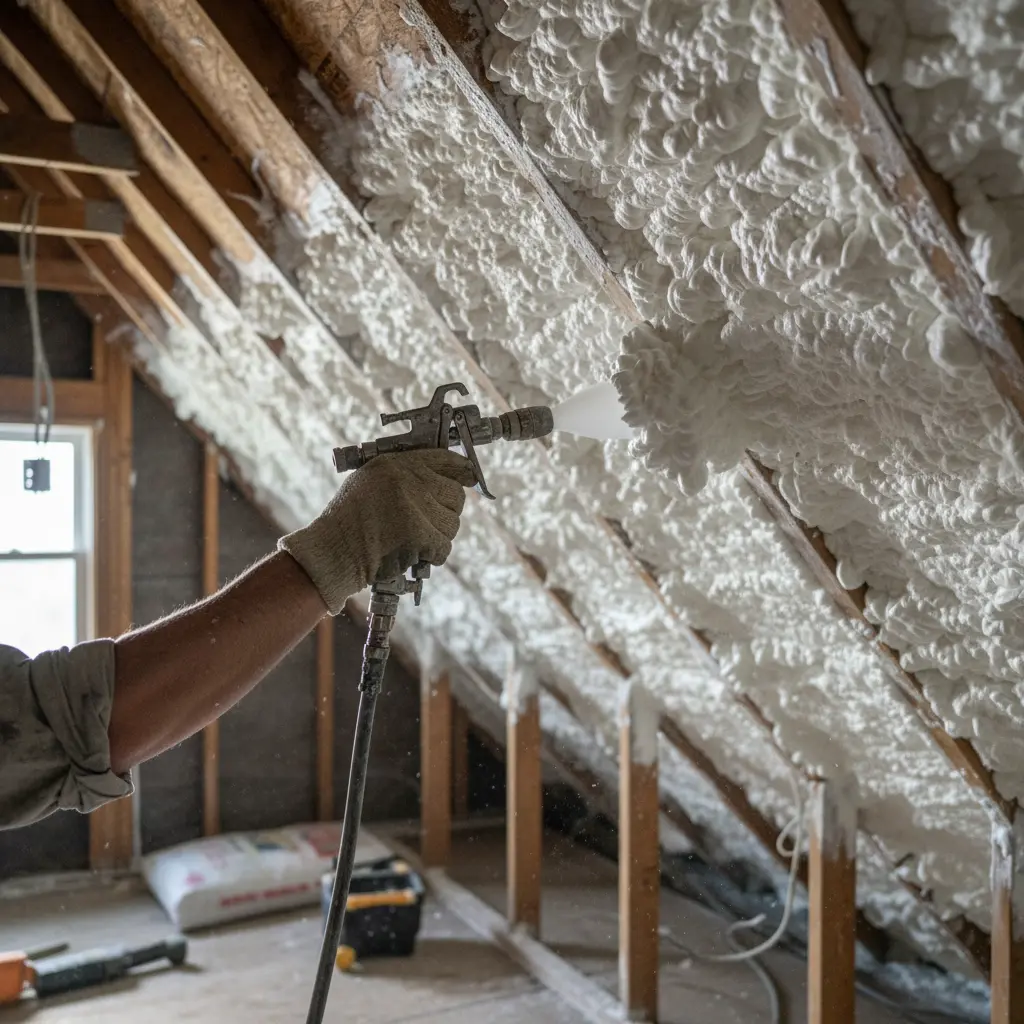
Our team in action — insulation professionals serving Orange
How Orange’s Climate Affects Your Insulation Material Choice
Orange, CA’s climate creates a specific set of insulation demands that differ from inland desert communities and cooler coastal cities. Understanding those demands helps homeowners make smarter, longer-lasting material decisions.
Summer attic heat is the dominant concern. Uninsulated or under-insulated attics in Orange regularly reach 140–160°F during peak summer afternoons, driving up cooling loads significantly. For attics, the priority is high R-value combined with minimal air leakage — making blown-in cellulose or fiberglass the most cost-effective upgrade, while spray foam works best where air sealing is also needed.
Coastal proximity and marine layer moisture affect communities closer to the coast. Homeowners within 10–15 miles of the ocean should prioritize moisture-resistant materials like closed-cell spray foam or mineral wool in crawl spaces and exterior-adjacent assemblies.
Wildfire risk in Orange County’s hillside areas makes fire-resistance ratings relevant. Mineral wool is the clear leader here, with non-combustible properties that provide an added margin of safety.
Housing age matters significantly. Pre-1980 Orange homes typically have inadequate insulation by modern standards. Retrofit solutions like blown-in and spray foam work without major demolition. New construction or room additions allow for comprehensive assemblies incorporating rigid foam board for continuous insulation.
California Title 24 compliance requires meeting minimum R-values by zone and assembly type. Selecting materials that meet or exceed those thresholds also opens the door to utility rebates through Southern California Edison and SoCalGas programs.
Insulation Materials Available in Orange, CA
Spray Foam Insulation
Spray foam insulation is applied as a liquid that expands and cures into either open-cell or closed-cell foam. R-value ranges from R-3.7 per inch (open-cell) to R-6.5 per inch (closed-cell). In Orange’s climate, closed-cell spray foam excels because it simultaneously insulates and creates an air and moisture barrier — critical for sealing older homes against hot, dry summer air infiltration. It adheres to irregular surfaces, fills gaps around pipes and joists, and adds structural rigidity. The primary drawback is cost. Installed cost typically runs $1.50–$4.50 per square foot depending on type and thickness. Best applications include attic rim joists, crawl spaces, and retrofit wall cavities where air sealing is the priority alongside insulation performance.
Blown-In (Loose-Fill) Insulation
Blown-in insulation — typically fiberglass or cellulose — is machine-installed as loose particles that conform to irregular spaces without cutting or seaming. R-values range from R-2.2 to R-3.8 per inch depending on material and settled density. In Orange’s hot-attic environment, blown-in insulation is one of the most popular choices because it can be quickly added over existing material to bring attics up to R-38 or higher. It covers hard-to-reach areas evenly and minimizes installation labor. Moisture resistance varies by material type. Installed cost ranges from $0.80–$2.00 per square foot. Best applications include existing attic floors, enclosed wall cavities (drill-and-fill), and cathedral ceilings where access is limited.
Fiberglass Batt Insulation
Fiberglass batts are pre-cut panels of spun glass fibers designed to fit standard stud and joist spacing. R-values range from R-11 to R-38 depending on thickness. They are the most widely recognized insulation type and remain common in Orange’s residential new construction. Batts are cost-effective and straightforward to install in open wall cavities, but their performance drops significantly if improperly fitted, compressed, or left with gaps — a common issue in older Orange homes. They provide no air sealing on their own. Installed cost typically ranges from $0.50–$1.50 per square foot. Best applications include open wall cavities during construction or remodel, attic floors with standard joist spacing, and floors above unconditioned spaces.
Mineral Wool / Rockwool Insulation
Mineral wool, sold under brands like Rockwool, is manufactured from spun volcanic rock and slag. R-values range from R-3.0 to R-4.2 per inch. It offers a significant advantage in fire resistance — it does not burn and can withstand temperatures above 1,800°F — making it a smart choice for Orange homeowners in or near wildfire-adjacent hillside neighborhoods. It also resists moisture absorption and provides excellent soundproofing. Mineral wool is denser than fiberglass and holds its shape without sagging. The tradeoff is a higher price point. Installed cost typically runs $1.00–$2.50 per square foot. Best applications include walls, attics, and any area where fire resistance or acoustic performance is a priority.
Cellulose Insulation
Cellulose is made from recycled paper fiber treated with fire retardants and is one of the most environmentally friendly insulation materials available. R-values range from R-3.2 to R-3.8 per inch. It performs particularly well in Orange’s climate because its density minimizes air movement within the insulation layer, reducing convective heat transfer during hot summer days. Cellulose is also effective at filling irregular spaces when blown in. One consideration is moisture sensitivity — if exposed to sustained humidity or a roof leak, cellulose can absorb water and lose performance temporarily. Installed cost ranges from $0.70–$1.80 per square foot. Best applications include attic floors, retrofit wall cavities, and homeowners prioritizing sustainable material choices.
Foam Board (Rigid) Insulation
Rigid foam board panels — available in EPS, XPS, and polyisocyanurate (polyiso) — provide continuous insulation without thermal bridging through studs. R-values range from R-3.8 to R-8.0 per inch depending on type, with polyiso performing highest. In Orange’s climate, foam board is often used in exterior wall assemblies, under roof decking, and in garage walls to maximize insulation without sacrificing interior space. It also works well in crawl spaces as a vapor and thermal barrier. Foam board does not air seal on its own without taped seams. Installed cost typically ranges from $0.75–$2.25 per square foot. Best applications include new construction wall assemblies, roof decks, basement and crawl space walls, and garage conversions.
Ready for Insulation Materials & Types? Get Your Free Estimate Today.
Next Level Insulation of Orange serves Orange and the surrounding area — we’ll be on-site within 24 hours.
📞 Call 714-266-2070Why Orange Homeowners Trust Next Level Insulation of Orange for Insulation
Next Level Insulation of Orange brings hands-on expertise and local knowledge that generic contractors simply cannot match. Here is what sets us apart for Orange homeowners:
Insulation Materials FAQ for Orange Homeowners
What is the best insulation type for Orange’s climate?
There is no single best material — it depends on the application and your home’s specific conditions. For attic upgrades in existing homes, blown-in fiberglass or cellulose offers the best balance of performance and value. For air sealing alongside insulation, closed-cell spray foam is unmatched. For fire-prone hillside areas, mineral wool adds an important layer of protection. A professional assessment helps match material to your exact situation.
What R-value does my Orange home need?
California’s Title 24 energy code places Orange in Climate Zone 8, which requires a minimum of R-38 in attics for new construction and significant remodels. Walls typically require R-13 to R-21 depending on framing. Crawl spaces and floors over unconditioned spaces generally need R-19 or higher. Many older Orange homes fall well below these thresholds, making upgrades both a code compliance issue and a major comfort improvement.
How do the costs of different insulation materials compare?
Fiberglass batts are the most affordable at roughly $0.50–$1.50 per square foot installed. Blown-in fiberglass and cellulose typically run $0.80–$2.00. Mineral wool ranges from $1.00–$2.50. Rigid foam board averages $0.75–$2.25. Spray foam is the most expensive at $1.50–$4.50 depending on open-cell versus closed-cell. Higher upfront costs for premium materials are often offset by greater energy savings and longer service life.
Is attic insulation or wall insulation more important for Orange homes?
In Orange’s predominantly hot climate, attic insulation typically delivers the greatest immediate return because attics absorb direct solar heat and transfer it into living spaces. Most energy audits show attic upgrades reduce cooling costs more than wall upgrades alone. However, walls are significant contributors to heat gain as well, especially on west- and south-facing elevations. A comprehensive approach addresses both, prioritizing the attic first if budget is a constraint.
How much can I save on energy bills by upgrading insulation?
Energy savings vary by home size, current insulation condition, and HVAC efficiency, but the U.S. Department of Energy estimates homeowners can save 10–20% on total energy costs with proper insulation upgrades. In Orange’s cooling-dominated climate, homes with severely under-insulated attics often see even larger percentage reductions in summer electricity bills after upgrading to R-38 or above.
Are there rebates or tax credits available for insulation in California?
Yes. Orange homeowners may qualify for rebates through Southern California Edison’s Energy Upgrade California program and SoCalGas rebates for qualifying insulation upgrades. At the federal level, the Inflation Reduction Act’s Energy Efficient Home Improvement Credit (25C) allows homeowners to claim up to 30% of insulation material costs, with a $1,200 annual cap. Eligibility requirements apply, and our team can help you identify which programs your project qualifies for.
Can I add insulation over my existing insulation in the attic?
In most cases, yes. Adding blown-in insulation over existing batts is a common and effective retrofit strategy for Orange attics. The key is to ensure existing insulation is dry, undamaged, and free of pest activity before adding new material. If existing insulation is contaminated, damaged by moisture, or contains older materials like vermiculite, removal and replacement is recommended before adding a new layer.
Does insulation help with soundproofing in Orange homes?
Yes, though the degree of sound reduction varies by material. Mineral wool and open-cell spray foam are the top performers for acoustic applications due to their density and sound-absorbing properties. Cellulose also provides moderate sound attenuation. Standard fiberglass batts offer some noise reduction but less than denser materials. If you live near a busy street, flight path, or commercial area in Orange, specifying a sound-rated material can meaningfully improve interior quiet.
Get a Free Insulation Assessment in Orange
Not sure which insulation material is right for your home? Next Level Insulation of Orange offers a free, no-obligation insulation assessment for homeowners throughout Orange, CA. Our licensed and insured team will evaluate your attic, walls, and crawl space, review your current R-values against California Title 24 requirements, and recommend the best materials for your climate, construction type, and budget.
We work with every major insulation material and never push a one-size-fits-all solution. Our goal is to help you make the most informed decision possible — and to maximize your energy savings and comfort for years to come.
Call us today at 714-266-2070 to schedule your free assessment. Orange homeowners deserve insulation that actually performs — let us help you get there.