

Blown-In Insulation in Burbank, CA
Energy-Saving Blown-In Insulation in Burbank, CA for Burbank, CA Homes — Licensed & Insured
Get expert blown-in insulation in Burbank, CA from Next Level Insulation. 20+ years experience, free estimates, R-38–R-60 attic upgrades. Call (818) 514-7541 today.
- Licensed & Insured
- Locally Owned & Operated
- Free Inspection & Estimate
Request Your
Free EstimateBlown-in insulation is a modern, high-performance insulation method that uses specialized equipment to propel loose-fill material — such as cellulose or fiberglass — into attic spaces, wall cavities, and hard-to-reach areas of your home or commercial building. Unlike traditional batt insulation, blown-in material conforms to irregular surfaces, seals air gaps, and delivers consistent thermal coverage throughout every corner of your structure.
In Burbank, CA, where summer temperatures regularly climb above 100°F in the San Fernando Valley heat corridor and winter nights dip into the 40s, proper insulation is not optional — it is essential. The unique Mediterranean climate, combined with Burbank’s mix of post-war ranch homes, mid-century commercial buildings, and newer construction near the Burbank Media District, creates specific insulation challenges that demand expert solutions.
At Next Level Insulation of Burbank, we bring over 20 years of hands-on experience delivering blown-in insulation solutions that genuinely improve energy efficiency, indoor comfort, and long-term cost savings. Call us today at (818) 514-7541 for your free estimate.
Understanding Blown-In Insulation
Blown-in insulation — also known as loose-fill insulation — has been used in residential and commercial construction across the United States since the mid-twentieth century. The technology gained significant traction during the energy crisis of the 1970s, when federal programs began incentivizing homeowners to retrofit older housing stock with higher R-value insulation. Today, blown-in insulation remains one of the most widely recommended methods by energy auditors and building contractors alike, particularly for attic retrofits and wall cavity upgrades in existing structures.
The process involves using a high-powered blowing machine connected to a flexible hose that forces loose insulation material into target areas. The two most common materials used in the Los Angeles area — and throughout Burbank specifically — are cellulose and fiberglass. Cellulose blown-in insulation is made from approximately 85% recycled paper products treated with fire-retardant chemicals, making it both eco-friendly and effective. Fiberglass blown-in insulation consists of tiny glass fibers and is particularly resistant to moisture absorption, an important quality given Southern California’s occasional periods of elevated humidity.
In Burbank, blown-in insulation is especially prevalent in the city’s large inventory of homes built between 1940 and 1975. During this construction era, many homes were built with minimal attic insulation or with outdated materials such as rock wool and vermiculite that have since degraded significantly. Neighborhoods like Magnolia Park, the Rancho District, and the hillside areas near the Verdugo Mountains contain thousands of homes in this category, all of which can benefit dramatically from modern blown-in insulation upgrades.
Beyond residential applications, blown-in insulation is also widely used in Burbank’s commercial and light industrial buildings, including the studio support facilities around Warner Bros. and Disney that require precise temperature and humidity management for production equipment and archival storage. The versatility of blown-in insulation — suitable for flat roofs, sloped attics, open wall cavities, and enclosed wall systems — makes it an ideal solution across Burbank’s diverse building stock.
Why Blown-In Insulation Is Needed in Burbank, CA
The San Fernando Valley Heat Island Effect
Burbank sits at the eastern edge of the San Fernando Valley, a basin geography that traps heat and produces some of the highest sustained temperatures in the greater Los Angeles region. During the historic September 2022 heat wave, Burbank recorded temperatures exceeding 111°F — one of the hottest readings in the city’s recorded history. Attic temperatures during events like this can reach 150°F or higher, creating enormous thermal stress on roofing materials and allowing heat to radiate into living spaces when insulation is inadequate or improperly installed. Blown-in insulation with a minimum R-38 value — the current California Energy Commission recommendation for Climate Zone 9, which covers Burbank — creates a critical thermal barrier against these extreme heat events.
Aging Housing Stock and Degraded Insulation
According to city records, a substantial portion of Burbank’s residential housing was constructed before 1970, when building codes required little to no attic insulation. Many of these homes in neighborhoods such as the Rancho District near Scott Road and the older sections of Magnolia Park contain original insulation that has settled, compressed, or absorbed moisture over decades of use. Settled cellulose insulation can lose up to 20% of its original R-value within the first few years and continues to degrade over time. Homes that originally had R-11 attic insulation installed in 1955 may now be operating at R-7 or lower — a dramatic reduction in thermal performance.
Seismic Activity and Structural Movement
Burbank lies in close proximity to the Verdugo Fault, a seismically active zone that runs along the northern edge of the city near the Verdugo Mountains. Repeated minor seismic events — including the frequent small tremors associated with the broader Southern California fault network — cause gradual structural movement that creates gaps and settling in traditional batt insulation. Blown-in insulation, by contrast, flows into and fills these gaps, maintaining consistent coverage even as the structure experiences minor movement over time.
Santa Ana Wind Infiltration
Every fall and winter, Burbank experiences the notorious Santa Ana wind events, with gusts regularly exceeding 50 to 60 mph through the Verdugo and San Gabriel mountain passes. These dry, hot winds force air infiltration through every available gap in a building’s envelope, including areas where insulation has pulled away from wall cavities or shifted in attic spaces. Blown-in insulation seals these infiltration points far more effectively than rigid or batt alternatives, reducing the energy penalty during Santa Ana conditions by as much as 15 to 20% according to estimates from California utility energy efficiency programs.
Utility Cost Pressures
Burbank Water and Power, the city’s municipally owned utility, has implemented tiered rate structures that significantly penalize high electricity consumption. Homes without adequate insulation routinely consume 30 to 50% more cooling energy during Burbank’s long summer season, driving utility bills into the $300 to $500 per month range for average-sized homes during peak months. Proper blown-in insulation is one of the highest-return energy efficiency investments available to Burbank homeowners.
Signs You Need Blown-In Insulation in Burbank
Temperature and Comfort Indicators
- Rooms that feel significantly warmer or cooler than your thermostat setting, particularly upper-floor bedrooms during Burbank summers
- Hot spots near exterior walls or ceiling surfaces even when the HVAC system is running continuously
- Drafts or cold air intrusion during Burbank’s winter months or Santa Ana wind events
- Uneven temperatures between rooms on the same floor or between floors in multi-story homes
Energy and Utility Warning Signs
- Burbank Water and Power bills consistently higher than neighbors with similar-sized homes
- HVAC system running continuously without reaching the set temperature during summer heat waves
- Noticeable spikes in energy usage that do not correspond to changes in occupancy or behavior
Physical and Structural Signs
- Visible gaps or thin patches of insulation visible from the attic hatch
- Insulation material that appears flattened, discolored, or damp
- Ice damming or unusual moisture patterns on the roof following rare Burbank cold snaps
- Pest activity in the attic, which often dislodges and contaminates existing insulation
Urgency Indicator: If your home was built before 1978 and has never had insulation upgraded, schedule an inspection immediately — degraded insulation compounds HVAC wear and dramatically increases summer energy costs in Burbank’s climate.
Our Blown-In Insulation Process in Burbank
At Next Level Insulation of Burbank, we follow a systematic, proven installation process refined through two decades of work across Burbank’s diverse residential and commercial building types.
Free In-Home Assessment (1–2 Hours)
Our certified technician visits your Burbank property to evaluate existing insulation levels, measure attic square footage, identify air leakage points, and assess structural conditions. We use thermal imaging where appropriate to identify hidden energy loss areas. We note any Burbank-specific concerns such as proximity to the Verdugo Fault zone or existing rodent evidence common in hillside properties.
Detailed Proposal and R-Value Planning (24–48 Hours)
We provide a written proposal specifying the recommended R-value (typically R-38 to R-60 for Burbank attics per California Title 24 guidelines), material selection, and total cost. We explain California Energy Commission Climate Zone 9 requirements and any applicable Burbank Water and Power rebate programs that may offset your costs.
Site Preparation (1–2 Hours on Installation Day)
Our team covers living areas below the work zone to protect your home from dust. Attic ventilation baffles are inspected and installed where missing to maintain proper airflow — a critical step in Burbank’s hot climate where adequate attic ventilation prevents moisture buildup.
Air Sealing (1–3 Hours)
Before any blown-in material is installed, we seal all identified air leakage points including top plates, recessed light fixtures, plumbing and electrical penetrations, and attic hatch frames. Air sealing is the single most important step for maximizing energy performance in Burbank’s climate.
Blown-In Insulation Installation (2–4 Hours)
Using commercial-grade blowing equipment, we install the specified loose-fill material to the calculated depth required for your target R-value. Depth gauges are placed throughout the attic to ensure consistent coverage. Our team pays particular attention to eave areas and corners where heat gain is highest in Burbank’s sun-exposed rooflines.
Quality Verification and Cleanup (1 Hour)
We conduct a final depth and coverage inspection, photograph completed work, and perform a thorough cleanup of all work areas. All equipment and debris are removed from your property.
Post-Installation Walkthrough and Documentation
We review the completed work with you, provide documentation of installed R-values for Burbank Water and Power rebate applications, and answer any questions about maintaining your new insulation system.
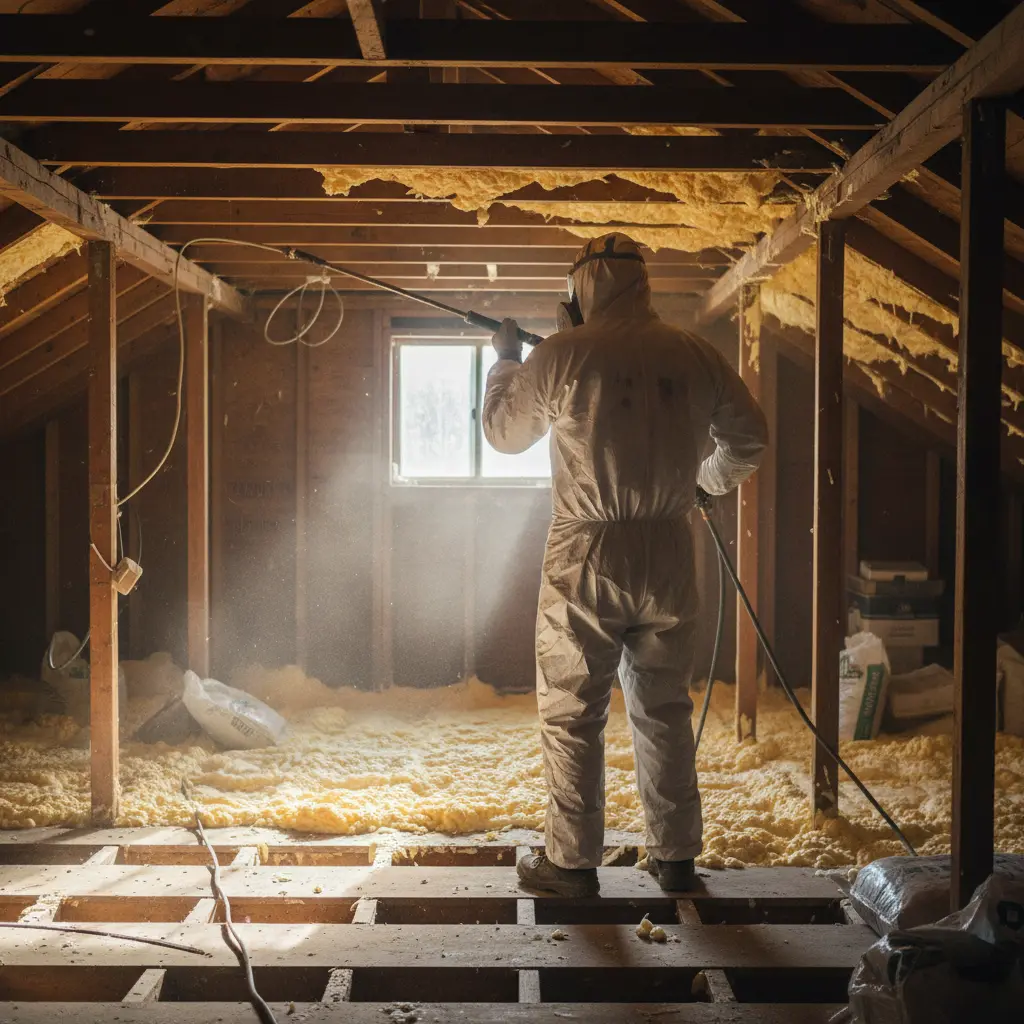
Our team in action — insulation professionals serving Burbank
Blown-In Insulation Methods We Use in Burbank
Cellulose Blown-In Insulation
Our most commonly recommended option for Burbank’s older residential stock, cellulose offers an excellent R-value per inch (approximately R-3.5 per inch), strong air-sealing properties, and superior performance in the deep attic spaces typical of Burbank’s ranch-style homes. Its recycled content also appeals to environmentally conscious Burbank homeowners. Best used for open attic applications and retrofit wall cavity work in homes built before 1980.
Fiberglass Blown-In Insulation
Preferred for applications where moisture exposure is a concern — such as properties near Burbank’s Tujunga Wash flood plain or homes with documented roof leak histories — fiberglass blown-in insulation resists moisture absorption and maintains its R-value even in elevated humidity conditions. Ideal for flat-roof commercial structures around the Burbank Media District.
Dense-Pack Wall Insulation
For Burbank homes with uninsulated wall cavities — particularly common in homes built between 1940 and 1960 in neighborhoods like Magnolia Park — dense-pack blown-in insulation is installed through small holes drilled in the exterior or interior wall surface. The material is packed to a density of 3.5 to 4.0 lbs per cubic foot, creating both thermal and sound insulation benefits.
Stabilized Blown-In for Sloped Ceilings
Many Burbank homes feature vaulted or cathedral ceilings that cannot accommodate traditional loose-fill without settling. We use adhesive-stabilized blown-in products for these applications, ensuring long-term coverage in sloped ceiling cavities common in mid-century Burbank architecture.
Ready for Blown-In Insulation? Get Your Free Estimate Today.
Next Level Insulation of Burbank serves Burbank and the surrounding area — we’ll be on-site within 24 hours.
📞 Call (818) 514-7541Blown-In Insulation Cost in Burbank, CA
Understanding blown-in insulation costs helps Burbank homeowners plan their investment and evaluate proposals accurately. Pricing varies based on several factors specific to both the project and the local market.
Typical Price Ranges in Burbank
- Attic blown-in insulation (cellulose or fiberglass): $1.50 to $3.50 per square foot installed, with most Burbank attic projects falling between $1,800 and $4,500 for a standard 1,200 to 1,800 sq ft home
- Dense-pack wall insulation: $2.00 to $5.00 per square foot, depending on wall access difficulty and material choice
- Crawl space or floor cavity blown-in: $2.50 to $4.50 per square foot in Burbank, where crawl space access varies considerably by construction era
Key Cost Factors in Burbank
- Existing insulation removal: Old insulation removal adds $1.00 to $1.50 per square foot, often necessary in Burbank homes with degraded or pest-contaminated attic insulation
- Air sealing scope: Extensive air sealing in older Burbank homes with many penetrations adds $300 to $800 to total project cost
- Target R-value: Achieving R-60 versus R-38 in a Burbank attic requires approximately 30% more material
- Attic accessibility: Low-clearance attics common in Burbank’s 1950s homes may increase labor costs by 10 to 20%
Available Rebates and Incentives
Burbank Water and Power offers rebates for qualifying insulation upgrades under their energy efficiency programs. Federal tax credits under the Inflation Reduction Act may also cover up to 30% of insulation project costs. We help every Burbank customer identify and apply for applicable incentives. Learn about insulation financing options
Blown-In Insulation Service Areas in Burbank and Surrounding Neighborhoods
Magnolia Park, Burbank
This charming historic district features homes primarily built in the 1930s through 1950s with little to no original insulation. Dense-pack wall insulation and attic blown-in upgrades are among our most requested services in this neighborhood.
Rancho District, Burbank
Burbank’s Rancho District contains a mix of post-war ranch homes and newer construction. Homes here frequently have original attic insulation that has settled to R-10 or below, making blown-in top-ups or full replacements highly cost-effective.
Burbank Hills and Verdugo Area
Properties near the Verdugo Mountains face additional challenges including greater exposure to Santa Ana wind infiltration and higher wildfire risk, which makes fire-retardant cellulose insulation an especially practical choice.
Extended Service Areas
We also proudly serve Studio City, Sherman Oaks, North Hollywood, Sun Valley, Toluca Lake, Universal City, Valley Village, Monterey Park, Hollywood, Beverly Hills, Glendale, Pasadena, Alhambra, Culver City, East Los Angeles, South Pasadena, La Cañada Flintridge, San Gabriel, and West Hollywood. View all service areas
Blown-In Insulation Maintenance Tips for Burbank Homeowners
- Annual attic inspection: Check insulation depth and coverage each spring before Burbank’s summer heat season begins. Look for signs of settling, moisture damage, or pest activity.
- After seismic events: Following any earthquake of 4.0 magnitude or greater near the Verdugo Fault, inspect attic insulation for displacement or shifting.
- Post-Santa Ana wind check: After significant wind events, inspect attic vents and soffits for debris that could block ventilation and trap moisture in insulation.
- Seal new penetrations immediately: Any new wiring, plumbing, or HVAC work that penetrates the attic floor should be re-sealed promptly to maintain air barrier integrity.
- Control attic moisture: Burbank’s rare rain events can introduce moisture through compromised roof sections. Address any roof leaks immediately, as wet blown-in insulation loses R-value and promotes mold growth.
- Pest exclusion: Roof rats and squirrels are common in Burbank’s hillside areas and can displace attic insulation. Maintain proper exclusion screens on all attic vents.
- Avoid compressing insulation: Do not store heavy items directly on blown-in insulation in accessible attic areas, as compression significantly reduces R-value.
- Schedule professional re-inspection every 10 years: Even high-quality blown-in insulation benefits from professional re-evaluation every decade to assess settling and identify opportunities for improvement.
Why Choose Next Level Insulation of Burbank
When you choose Next Level Insulation of Burbank, you’re partnering with a team that has spent over 20 years mastering the specific insulation challenges presented by Burbank’s climate, building stock, and regulatory environment. We are not a national chain that treats every job the same — we are a local Burbank contractor who understands the difference between insulating a Magnolia Park craftsman bungalow and a Burbank Hills mid-century modern.
Our technicians are trained in California Title 24 energy compliance requirements and are familiar with Burbank Water and Power’s rebate program documentation process. We use only premium-grade blown-in materials rated for Southern California’s extreme temperature cycling, and every installation is backed by our workmanship guarantee.
We provide free, no-obligation estimates for every Burbank project, transparent pricing with no hidden fees, and complete post-installation documentation to support utility rebate applications. Our reputation in Burbank is built on referrals from satisfied customers across every neighborhood in the city.
Learn more about our team and credentials
Call us at (818) 514-7541 or request a free estimate online.
Frequently Asked Questions About Blown-In Insulation in Burbank, CA
How much does blown-in insulation cost in Burbank, CA?
Most Burbank homeowners pay between $1,800 and $4,500 for a standard attic blown-in insulation project, depending on home size, target R-value, and whether existing insulation removal is required. Dense-pack wall insulation projects typically range from $2,000 to $6,000. Burbank Water and Power rebates and federal tax credits can meaningfully reduce these costs. Contact us at (818) 514-7541 for a precise quote for your specific property.
What R-value do I need for blown-in insulation in Burbank?
California’s Title 24 energy code places Burbank in Climate Zone 9, which requires a minimum of R-38 for attic insulation in existing homes and R-49 to R-60 for new construction. Given Burbank’s extreme summer heat events — such as the 111°F temperatures recorded in September 2022 — we typically recommend R-49 to R-60 for maximum comfort and energy savings.
How long does a blown-in insulation installation take in Burbank?
A standard Burbank attic project for a 1,200 to 1,800 square foot home typically takes four to six hours from setup to cleanup, including air sealing. Larger homes or projects involving insulation removal may require a full day. Dense-pack wall insulation projects vary based on wall area and access complexity but are usually completed within one to two days.
Will blown-in insulation help with noise from Burbank’s airport and nearby freeways?
Yes. Dense-pack blown-in insulation in wall cavities provides meaningful sound attenuation — particularly relevant for Burbank homes near Hollywood Burbank Airport flight paths or adjacent to the I-5 and SR-134 corridors. Cellulose insulation in particular has excellent sound-dampening properties due to its density and fiber structure. Learn more about sound insulation options
Does blown-in insulation settle over time in Burbank’s climate?
Modern blown-in cellulose and fiberglass products are engineered to resist settling and maintain R-value over time. Cellulose may settle 15 to 20% in the first year, which is accounted for by installing to a greater initial depth. Fiberglass blown-in products settle less. Burbank’s seismic activity and Santa Ana winds are factored into our installation depth calculations to ensure long-term performance.
Can I install blown-in insulation over my existing Burbank attic insulation?
In many cases, yes — we can blow new insulation directly over existing material, provided the existing insulation is dry, free of mold, and not contaminated by pests. For Burbank homes with very old or damaged insulation, we typically recommend removal first to ensure a clean, effective installation. Our free assessment will determine the best approach for your specific attic conditions.
Does Next Level Insulation serve areas outside Burbank?
Absolutely. We serve a wide area across the San Fernando Valley and greater Los Angeles, including Studio City, Sherman Oaks, North Hollywood, Sun Valley, Glendale, Pasadena, Beverly Hills, Hollywood, West Hollywood, Culver City, and many other communities. See our complete service area list
Is blown-in insulation safe for my family and pets in Burbank?
Both cellulose and fiberglass blown-in insulation products meet strict safety standards and are non-toxic once installed. Cellulose is treated with borate-based fire retardants that are safe for occupants and actually discourage pest activity — an added benefit in Burbank’s hillside neighborhoods where rodent pressure can be elevated. Our team takes precautions during installation to minimize dust exposure, and we perform a thorough cleanup after every project.
Get Your Free Blown-In Insulation Estimate in Burbank Today
Don’t let another Burbank summer drain your comfort and your budget. Next Level Insulation of Burbank is ready to assess your home or commercial property and deliver a blown-in insulation solution that delivers real, measurable results — lower energy bills, better indoor comfort, and long-lasting performance designed for Burbank’s demanding climate.
Our free, no-obligation estimates include a full assessment of your current insulation levels, specific R-value recommendations based on California Title 24 requirements for Climate Zone 9, and complete pricing transparency. We will also identify every available Burbank Water and Power rebate and federal tax incentive that applies to your project.
Call us now at (818) 514-7541 or submit your free estimate request online. We serve all Burbank neighborhoods and surrounding communities throughout the greater Los Angeles area. Take your home’s energy efficiency to the next level.