

Blown-In Attic Insulation in Simi Valley, CA
Energy-Saving Blown-In Attic Insulation for Simi Valley, CA Homes — Licensed & Insured
Get expert blown-in attic insulation in Simi Valley, CA. Next Level Insulation offers free assessments, R-38 to R-60 upgrades, and local expertise. Call (805) 774-1832.
- Licensed & Insured
- Locally Owned & Operated
- Free Inspection & Estimate
Request Your
Free EstimateBlown-in attic insulation is a highly effective method of filling your home’s attic space with loose-fill insulating material—typically cellulose or fiberglass—using specialized blowing equipment. The result is a seamless, dense thermal barrier that dramatically reduces heat transfer between your living space and the outdoor environment.
In Simi Valley, CA, where summer temperatures in the Santa Susana Pass area regularly climb above 100°F and cool winter nights can drop into the 30s, proper attic insulation is not a luxury—it is a necessity. The valley’s unique geography, surrounded by the Santa Monica Mountains and the Simi Hills, creates localized heat pockets and wind patterns that accelerate energy loss in under-insulated homes.
At Next Level Insulation of Simi Valley, our team specializes in blown-in attic insulation solutions engineered for the specific climate, construction styles, and building codes of the Simi Valley area. Call us today at (805) 774-1832 to schedule your free attic assessment.
Understanding Blown-In Attic Insulation
Blown-in attic insulation—also called loose-fill insulation—has been a trusted home performance solution since the mid-20th century. The process involves using a high-powered blowing machine to propel small particles of insulating material into an attic cavity, filling gaps, voids, and hard-to-reach corners that traditional batt insulation simply cannot address. The two most common materials used are cellulose (made from recycled paper products treated with fire retardants) and fiberglass (spun glass fibers).
Blown-in insulation is measured by its R-value, which quantifies thermal resistance. The U.S. Department of Energy recommends that homes in Climate Zone 3—which covers most of Southern California, including Simi Valley—maintain attic insulation between R-30 and R-60. Many older Simi Valley homes, particularly those built during the city’s rapid development boom of the 1960s and 1970s, were originally insulated to standards well below today’s recommendations, often as low as R-11 or R-13.
The blown-in method is particularly advantageous for existing homes because it does not require the removal of drywall or structural modifications. Installers access the attic through the existing hatch and use flexible hoses to distribute material evenly across the floor deck. For new construction in Simi Valley’s growing residential developments, blown-in insulation can also be installed in wall cavities using the BIBS (Blown-In Batt System) technique.
Historically, Simi Valley’s housing stock reflects the broader Southern California postwar suburban expansion. Tract homes built by developers like Ryan Homes and various local contractors throughout the 1960s, 1970s, and 1980s dominate neighborhoods like Royal Park Estates and Madera. These homes typically feature wood-framed attic structures with shallow roof pitches that can create compressed insulation issues over time, making the loose-fill blown-in approach the most practical and cost-effective upgrade available today.
For homeowners looking to pair attic upgrades with comprehensive energy improvements, attic insulation services and insulation removal and replacement are natural complements to a blown-in installation project.
Why Blown-In Attic Insulation Is Needed in Simi Valley, CA
Extreme Summer Heat in the Santa Susana Valley
Simi Valley sits in an inland valley surrounded by mountain terrain that traps and amplifies heat. The city has recorded temperatures exceeding 105°F during peak summer heat events, with the National Weather Service noting that the valley floor commonly runs 8–12°F hotter than coastal communities like Camarillo or Oxnard during the same heat events. In July and August, attic temperatures in under-insulated Simi Valley homes routinely reach 140°F to 160°F. Without adequate blown-in insulation, this heat radiates directly into living spaces, forcing air conditioners to work continuously and driving monthly energy costs significantly higher.
The Woolsey Fire and Santa Ana Wind Events
The November 2018 Woolsey Fire, which burned over 96,000 acres across Ventura and Los Angeles counties and came within close proximity to eastern Simi Valley neighborhoods, brought renewed attention to local building resilience. Many homeowners who had fire damage inspections also discovered severely degraded attic insulation—either damaged by heat, smoke infiltration, or disruption from emergency responders accessing attics. The same Santa Ana wind events that fuel wildfires—often gusting 50–70 mph through the Simi Hills and Santa Susana Pass—also create significant pressure differentials on rooflines, accelerating air infiltration in attics with inadequate insulation coverage.
The Northridge Earthquake Legacy
The January 17, 1994 Northridge Earthquake (magnitude 6.7) caused widespread structural damage throughout the greater San Fernando Valley and Simi Valley. Many homes in neighborhoods like Wood Ranch and Berylwood experienced attic structure shifts, dislodged insulation batts, and compromised vapor barriers. Decades later, some of this earthquake-damaged insulation has never been properly replaced. Compressed or displaced batt insulation is significantly less effective—an R-19 batt compressed to half its thickness can perform as poorly as R-10. Blown-in insulation installed over or in place of this legacy material restores full thermal performance.
Aging Housing Stock and Building Code Gaps
A large percentage of Simi Valley’s approximately 41,000 housing units were constructed before 1990, before California’s Title 24 energy efficiency standards reached their current stringency. Homes built in developments like Sinaloa Lake Estates and Country Club Estates in the 1970s and 1980s were built to code at the time but are dramatically under-insulated by today’s standards. The combination of aging insulation materials that have settled and lost R-value, gaps from pest intrusion (Simi Valley has a documented ground squirrel and roof rat population), and decades of thermal cycling means that blown-in insulation upgrades deliver measurable, immediate comfort improvements.
Moisture and Condensation from Marine Layer Influence
While Simi Valley is an inland city, its proximity to the coast—roughly 30 miles from the Pacific—means marine layer moisture occasionally penetrates the valley, particularly in spring and early summer. This moisture, when combined with attic air infiltration, can degrade fiberglass batt insulation and encourage mold growth in poorly sealed attic spaces. Blown-in cellulose insulation with proper air sealing resists this moisture cycling more effectively than loose batt alternatives.
Signs You Need Blown-In Attic Insulation in Simi Valley
Energy and Comfort Warning Signs
- Monthly electricity bills exceeding $250–$350 during Simi Valley’s summer months (June–September) without clear explanation
- Upstairs rooms or rooms directly beneath the roofline that are consistently 5°F or more warmer than the rest of the home
- HVAC system running for extended cycles—more than 20 consecutive minutes—to maintain set temperature during afternoon heat peaks
- Drafts felt near ceiling light fixtures, recessed can lights, or attic access hatches
Visual and Physical Indicators
- Visible attic floor joists when looking into the attic—joists should be buried at least 10–12 inches deep in properly insulated attics meeting R-38 minimums
- Existing insulation that appears flat, compressed, or discolored (yellow or gray batts that have lost their loft)
- Pest activity evidence—rodent tunnels, nesting material, or insect damage within insulation layers
- Water staining on insulation indicating past or current roof leaks or condensation issues
Urgency Indicators
- Home was built before 1985 and has never had insulation upgraded
- Attic was accessed by emergency services or inspectors following the 1994 Northridge Earthquake or local fire events
- HVAC equipment replacement is being planned—new equipment underperforms in under-insulated homes
Our Blown-In Attic Insulation Process in Simi Valley
Comprehensive Attic Inspection (1–2 Hours)
Every project begins with a thorough attic assessment. Our technicians measure existing insulation depth at multiple points, identify air bypasses (gaps around plumbing penetrations, recessed lights, and top plates), check for moisture damage, and document pest activity. In Simi Valley homes, we also inspect for earthquake-related structural shifts that may have compromised existing insulation coverage. We use thermal imaging cameras to identify thermal bridges invisible to the naked eye.
Attic Preparation and Hazard Remediation (2–4 Hours)
Before any new insulation is installed, we address underlying issues. This includes sealing air bypasses with fire-rated caulk and spray foam, installing proper baffles at eave vents to maintain airflow, and—if required—removing and properly disposing of damaged or pest-contaminated existing insulation. professional insulation removal is handled separately if the scope requires full tear-out.
Air Sealing (1–2 Hours)
Air sealing is the most critical yet often skipped step. We seal all attic penetrations, including top plate gaps, recessed light housings, and HVAC duct boots. In Simi Valley homes with whole-house fans—a common feature in homes built in the 1970s and 1980s—we install insulated covers to prevent heat loss and gain through these large openings.
Blown-In Insulation Installation (2–4 Hours)
Using commercial-grade blowing equipment, we install the specified depth of cellulose or fiberglass loose-fill insulation to achieve the target R-value—typically R-38 to R-49 for Simi Valley’s Climate Zone 3 designation. Depth rulers are placed throughout the attic to verify coverage, and multiple passes are made to ensure even distribution around obstacles like HVAC equipment and ductwork.
Verification and Documentation (30–60 Minutes)
We conduct a final depth check at a minimum of 10 sampling points, photograph completed work, and provide the homeowner with a written report documenting achieved R-values and material specifications. This documentation is valuable for California utility rebate applications and future home sale disclosures.
Cleanup and Walkthrough (30 Minutes)
We thoroughly clean the work area, remove all equipment and waste materials, and walk the homeowner through the completed project, explaining what was done and expected performance improvements.
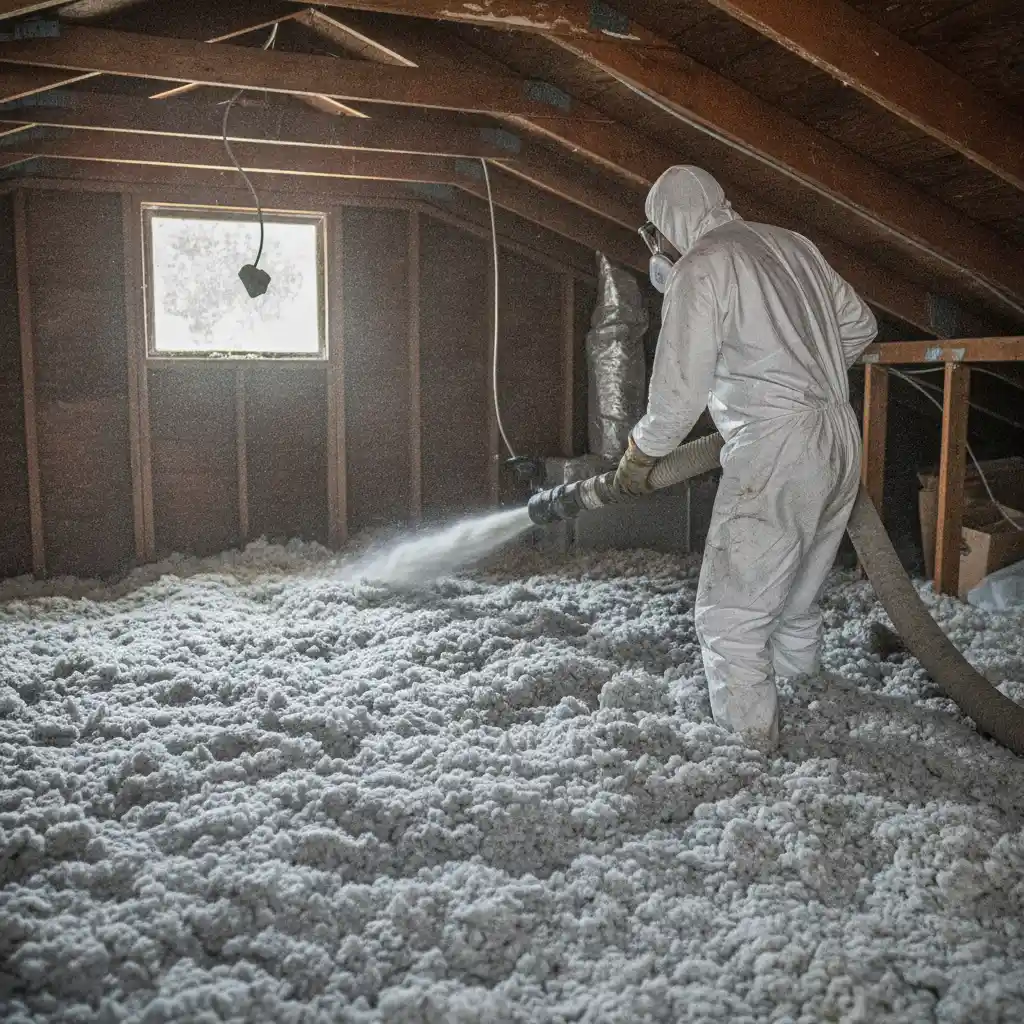
Our team in action — insulation professionals serving Simi Valley
Blown-In Insulation Methods and Approaches
Cellulose Blown-In Insulation
Made from 80–85% recycled paper fiber treated with borate-based fire retardants, cellulose is our most frequently recommended material for existing Simi Valley homes. It achieves an R-value of approximately R-3.7 per inch, conforms to irregular attic spaces, and provides superior air resistance compared to fiberglass. Cellulose is particularly well-suited to the older wood-framed homes in neighborhoods like Madera Estates and Erringer Heights, where irregular framing and decades of settling have created uneven surfaces that batts cannot fully cover.
Fiberglass Blown-In Insulation
Loose-fill fiberglass achieves approximately R-2.5 per inch and is preferred in attics with high moisture exposure risk. For Simi Valley homes near drainage channels or with a history of roof leaks, fiberglass’s inorganic composition means it will not support mold growth even if it becomes wet. It is also lighter weight, making it suitable for older attic floor structures where load capacity is a concern.
Dense-Pack Blown-In for Wall Cavities
For Simi Valley homes where wall insulation is also deficient, we offer dense-pack blown-in insulation installed through small holes drilled in exterior siding or interior drywall. This technique fills wall cavities to 3.5–3.8 lbs/cubic foot density, effectively eliminating convective air movement within the wall. spray foam insulation is recommended for specific air-sealing applications in wall assemblies.
BIBS (Blown-In Batt System) for New Construction
For new residential development projects in Simi Valley’s growing communities, BIBS involves installing netting over open wall framing and then blowing in fiberglass at high density. This achieves R-15 in a standard 2×4 wall and is increasingly required by California Title 24 compliance in new builds.
Ready for Blown-In Attic Insulation? Get Your Free Estimate Today.
Next Level Insulation of Simi Valley serves Simi Valley and the surrounding area — we’ll be on-site within 24 hours.
📞 Call (805) 774-1832Blown-In Attic Insulation Cost in Simi Valley, CA
Understanding the cost of blown-in attic insulation helps Simi Valley homeowners budget appropriately and evaluate quotes accurately. Costs vary based on attic size, existing insulation conditions, material selection, and project complexity.
Typical Cost Ranges
- Small attic (800–1,200 sq ft): $900–$1,800
- Medium attic (1,200–2,000 sq ft): $1,500–$2,800
- Large attic (2,000–3,000+ sq ft): $2,500–$4,500+
- Per square foot average: $1.00–$2.50 depending on target R-value and material
Key Cost Factors in Simi Valley
- Existing insulation removal: If damaged or pest-contaminated insulation must be removed first, add $1.00–$1.50 per square foot for vacuum removal and disposal
- Air sealing scope: Extensive air sealing in older Simi Valley homes with many penetrations can add $300–$800 to project cost
- Access difficulty: Homes with low-pitch rooflines common in 1970s tract construction may require additional labor for difficult access areas
- Material choice: Cellulose is typically 10–15% less expensive than fiberglass for equivalent R-value coverage
California Rebates and Incentives
Southern California Edison and SoCalGas both offer rebates for qualifying insulation upgrades. Simi Valley homeowners may also qualify for federal Inflation Reduction Act tax credits of up to 30% of project cost (up to $1,200) for attic insulation improvements. Our team provides documentation to support rebate applications.
For a precise quote, call us at (805) 774-1832 or request a free attic assessment today.
Simi Valley Neighborhoods We Serve
Wood Ranch
This master-planned community in eastern Simi Valley features many homes built between 1988 and 2000. While newer than other neighborhoods, Wood Ranch homes were built during a period when California Title 24 standards were less stringent than today. Many feature tile roofs over shallow attic decks where insulation has compressed over 25–35 years. Blown-in insulation upgrades here consistently deliver measurable utility cost reductions.
Madera and Royal Park Estates
Developed primarily in the 1960s and 1970s, these central Simi Valley neighborhoods contain the oldest housing stock in the city. Original insulation—often thin fiberglass batts—has settled and degraded significantly. Many homes also have knob-and-tube era electrical wiring in attics that must be accommodated during insulation installation. Our technicians are experienced in working safely around these legacy systems.
Berylwood
Berylwood’s post-Northridge Earthquake rebuild and repair history means some homes have mismatched or incomplete attic insulation from emergency repairs performed in 1994 and 1995. Comprehensive insulation assessments in this neighborhood frequently reveal uneven coverage that blown-in installation corrects efficiently.
Sinaloa Lake and Country Club Estates
These hillside communities present unique challenges including varied roof configurations, steeper pitches, and in some cases, vaulted ceilings that complicate attic access. Our team is equipped to address these architectural complexities with specialized equipment and techniques suited to hillside Simi Valley properties.
Attic Insulation Maintenance Tips for Simi Valley Homeowners
- Annual attic inspections: Check your attic each fall before Simi Valley’s Santa Ana wind season (October–December) for signs of displacement, moisture, or pest intrusion.
- Seal attic hatch covers: Install a pre-made insulated attic hatch cover or weatherstripped lid—an unsealed hatch can be equivalent to leaving a window open.
- Maintain soffit and ridge vents: Ensure attic vents are clear of insulation and debris to prevent moisture buildup, particularly after spring winds deposit dirt and debris.
- Monitor for roof leaks promptly: Simi Valley’s periodic heavy rainfall events, including those associated with atmospheric river systems, can saturate insulation quickly. Address roof leaks before they compromise insulation.
- Address pest intrusion immediately: Ground squirrels and roof rats are common in Simi Valley. Entry points should be sealed before they tunnel through insulation, creating thermal gaps.
- Check insulation depth every 5–7 years: Even blown-in insulation settles slightly over time. A periodic depth check confirms your R-value is maintained.
- Keep HVAC ducts sealed: Leaking attic ducts force conditioned air directly into unconditioned attic space, undermining even excellent insulation. crawl space insulation paired with duct sealing maximizes whole-home efficiency.
Why Choose Next Level Insulation of Simi Valley
Next Level Insulation of Simi Valley is a locally focused insulation contractor serving the communities of the Conejo Valley, Santa Clarita Valley, and Ventura County. Our technicians live and work in this region—they understand the specific demands that Simi Valley’s inland heat, Santa Ana wind events, and aging housing stock place on residential insulation systems.
We offer comprehensive insulation services under one roof: blown-in insulation, spray foam insulation, crawl space encapsulation, and insulation removal and replacement. This means homeowners receive a coordinated whole-home energy performance upgrade rather than piecemeal fixes.
Our process begins with honest, transparent assessment. We will tell you exactly what your attic needs—nothing more and nothing less—and provide written documentation of all work completed. We assist with California utility rebate applications and IRA tax credit documentation to help Simi Valley homeowners maximize the return on their insulation investment.
Ready to take your home’s comfort to the next level? Call (805) 774-1832 today.
Frequently Asked Questions: Blown-In Attic Insulation in Simi Valley, CA
How much does blown-in attic insulation cost in Simi Valley, CA?
For most Simi Valley homes, blown-in attic insulation costs between $1,500 and $3,500 for a complete installation, depending on attic square footage, target R-value, material selection, and whether existing insulation needs removal. Homes in neighborhoods like Wood Ranch with larger attic footprints (2,000+ sq ft) can expect costs toward the higher end of this range. California utility rebates and federal tax credits can offset 20–30% of total project cost.
How long does blown-in attic insulation installation take in Simi Valley?
A standard blown-in insulation installation for a typical Simi Valley home (1,200–2,000 sq ft attic) takes one full day, including inspection, air sealing, installation, and cleanup. Larger projects or those requiring significant insulation removal and remediation may extend to two days. We schedule work to minimize disruption and typically complete projects without requiring homeowners to leave their homes.
What R-value do I need for my Simi Valley attic?
The U.S. Department of Energy recommends R-38 to R-60 for attics in Climate Zone 3, which covers Simi Valley. For most existing homes, we target R-38 to R-49 as the cost-effective sweet spot. Homes with particularly high cooling loads—such as those on south-facing slopes in communities like Sinaloa Lake—may benefit from the full R-60 installation.
Is blown-in insulation or batt insulation better for Simi Valley homes?
For existing Simi Valley homes, blown-in insulation consistently outperforms batt insulation because it fills gaps and irregular spaces that batts cannot cover. The older tract homes in neighborhoods like Madera and Berylwood have decades of settling, pest activity, and structural shifting that create void spaces where batts simply cannot maintain contact. Blown-in insulation conforms to these conditions and provides superior air resistance as well.
Can I install blown-in insulation over my existing insulation in Simi Valley?
In most cases, yes. If existing insulation is dry, free of mold, and not heavily pest-contaminated, blown-in insulation can be installed directly over it to bring total depth to the target R-value. However, if existing insulation shows signs of moisture damage, rodent nesting, or significant compression, we recommend removal first. Our attic assessment identifies which approach is appropriate for your specific home.
Will blown-in insulation help with wildfire smoke infiltration in Simi Valley?
Yes, to a meaningful degree. Proper attic air sealing—performed as part of every blown-in insulation project—reduces the pathways through which wildfire smoke and ash can infiltrate living spaces. While insulation is not a complete smoke barrier, sealed attic penetrations reduce air infiltration significantly. Given Simi Valley’s proximity to fire-prone hillsides in the Santa Monica Mountains and Simi Hills, this is a genuine benefit many local homeowners appreciate.
How do I know if my insulation was damaged by the 1994 Northridge Earthquake?
If your Simi Valley home was built before 1994 and has never had an insulation upgrade, earthquake-related damage is possible even if it was not obvious at the time. Common signs include uneven insulation depth across the attic floor, misaligned batt sections, and gaps near the eaves and ridgeline. Our thermal imaging assessment during the initial inspection will identify these invisible performance gaps.
Do you service areas near Simi Valley?
Yes. Next Level Insulation of Simi Valley serves Thousand Oaks, Moorpark, Camarillo, Chatsworth, Woodland Hills, Calabasas, Agoura Hills, Westlake Village, Santa Clarita, North Hollywood, San Fernando, Fillmore, Santa Paula, Oxnard, Port Hueneme, Oak Park, Malibu, and Beverly Hills. Contact us at (805) 774-1832 to confirm service availability in your specific community.
Get Your Free Blown-In Attic Insulation Assessment in Simi Valley Today
Don’t let another Simi Valley summer drain your budget through an under-insulated attic. Whether your home is a 1970s-era tract house in Royal Park Estates, a hillside property in Sinaloa Lake, or a newer build in Wood Ranch, Next Level Insulation of Simi Valley has the local expertise and professional equipment to bring your attic insulation to the performance level your home deserves.
Call us today at (805) 774-1832 to schedule your no-obligation attic inspection and blown-in insulation quote. Our team will assess your current insulation depth, identify air bypasses, and provide a transparent written proposal—all at no cost to you.
You can also submit a service request online and a member of our Simi Valley team will contact you within one business day. Take your home comfort to the next level—starting in your attic.