

Spray Foam Attic Insulation in Simi Valley, CA
Energy-Saving Spray Foam Attic Insulation for Simi Valley, CA Homes — Licensed & Insured
Get expert spray foam attic insulation in Simi Valley, CA. Next Level Insulation offers free quotes, Title 24-compliant installs & local expertise. Call (805) 774-1832.
- Licensed & Insured
- Locally Owned & Operated
- Free Inspection & Estimate
Request Your
Free EstimateSpray foam attic insulation is a high-performance insulation solution that seals air leaks while delivering superior thermal resistance — creating a tightly conditioned envelope between your living space and Simi Valley’s extreme seasonal temperature swings. Unlike traditional batt or blown-in products, spray polyurethane foam expands on contact to fill every gap, crack, and irregular cavity in your attic structure.
In Simi Valley, where summer attic temperatures routinely climb above 150°F and Santa Ana wind events create intense pressure differentials across building envelopes, spray foam is not simply a comfort upgrade — it is a structural investment. Homes throughout neighborhoods like Wood Ranch, Bridle Path, and the older tract developments near Erringer Road face specific climate and construction challenges that conventional insulation cannot fully address.
Next Level Insulation of Simi Valley brings deep local knowledge, precision installation techniques, and a commitment to energy performance to every attic project we complete across Ventura County and the greater San Fernando Valley. Call us today at (805) 774-1832 to schedule your free assessment.
Understanding Spray Foam Attic Insulation
Spray foam attic insulation is a two-component chemical system — typically composed of isocyanate and polyol resin — that is mixed at the spray tip and expands rapidly upon application. The material adheres directly to roof decking, rafters, joists, and wall sheathing, forming a monolithic air and thermal barrier that performs far beyond what fiberglass batts or cellulose can achieve on their own.
There are two primary categories: open-cell spray foam, which is lighter and more flexible with an R-value of approximately R-3.7 per inch, and closed-cell spray foam, which is denser, moisture-resistant, and achieves R-6 to R-7 per inch. Closed-cell foam also adds meaningful structural rigidity to roof assemblies — an important consideration in older Simi Valley homes built before modern sheathing codes were adopted.
The concept of spray-applied foam insulation dates to the 1940s, when polyurethane chemistry was first developed. Residential applications became widespread in the 1970s and 1980s following the energy crises that reshaped building codes across California. Today, Title 24 of the California Building Standards Code sets rigorous energy efficiency requirements, and spray foam is one of the most reliable ways to meet or exceed those thresholds in both new construction and retrofit applications.
In Simi Valley specifically, the building stock reflects multiple construction eras. The post-war subdivisions developed through the 1950s and 1960s along Tapo Canyon Road and the older sections of the Royal Avenue corridor were built with minimal insulation standards. The master-planned communities constructed in the 1980s and 1990s — including Wood Ranch and Long Canyon — have more modern framing but still suffer from aging insulation that has settled, compressed, or been disturbed by decades of attic access and rodent activity.
Spray foam attic insulation is applicable across single-family homes, townhomes, and light commercial buildings. It is used in both vented and unvented (conditioned) attic configurations, giving installers flexibility to design a system that matches your specific roof geometry and HVAC layout. Learn more about our full attic insulation services
Why Spray Foam Attic Insulation Is Needed in Simi Valley, CA
Simi Valley occupies a semi-arid inland valley at approximately 900 feet of elevation, bounded by the Santa Susana Mountains to the north and the Simi Hills to the south. This geography creates a climate that is significantly more thermally extreme than coastal communities just 20 miles away. The valley’s inland position means it lacks the marine layer buffer that moderates temperatures in Malibu or Oxnard, and its bowl-like topography intensifies heat retention during summer months.
Summer high temperatures in Simi Valley regularly reach 95°F to 105°F from June through September, and attic air temperatures in uninsulated or under-insulated structures can exceed 150°F to 160°F during peak afternoon hours. The California Energy Commission has documented that attic thermal gain in inland Southern California valleys accounts for 25% to 40% of residential cooling load — a direct driver of the high utility bills that many Simi Valley homeowners report during the summer cooling season.
Santa Ana wind events present a second, equally important challenge. These hot, dry offshore winds — which have historically produced gusts exceeding 60 mph through the Santa Susana Pass and adjacent canyons — create substantial pressure differentials across building envelopes. When attic insulation lacks proper air sealing, these pressure events drive conditioned air out of the living space and pull unconditioned attic air in. The October 2003 wind events and the recurring autumn Santa Ana patterns recorded by the Ventura County Air Pollution Control District underscore how consistently and severely Simi Valley is affected.
Wildfire smoke infiltration is a growing concern as well. The Easy Fire of October 2019 burned within miles of residential neighborhoods along Madera Road and the northern portions of the city. Homes with poorly sealed attic assemblies experienced measurable smoke infiltration during that event. Spray foam’s continuous air barrier significantly reduces particulate infiltration during smoke events — a benefit that is directly relevant to Simi Valley’s position within Southern California’s high wildfire risk zone.
Moisture management is another local driver. While Simi Valley averages only about 15 inches of annual rainfall, the January and February rainy season — combined with occasional atmospheric river events — can introduce moisture into attic cavities through roof penetrations, ridge vents, and improperly flashed skylights. Homes in the lower-elevation neighborhoods near the Arroyo Simi floodplain also see higher relative humidity during wet weather periods. Closed-cell spray foam provides a Class II vapor retarder, helping prevent moisture accumulation in roof sheathing and framing members.
Finally, Simi Valley’s aging housing stock presents a structural rationale for spray foam. Many homes built in the 1960s and 1970s along Stearns Street, Cochran Street, and the original Simi Valley tracts have roof sheathing that has experienced decades of thermal cycling without adequate insulation protection. Closed-cell spray foam adds 300 to 400 PSI of racking resistance to roof panels, strengthening the assembly at the same time it improves energy performance. Explore all of our spray foam insulation solutions
Signs You Need Spray Foam Attic Insulation in Simi Valley
Energy Performance Indicators
- Monthly summer cooling bills exceeding $200 to $300 for an average 1,800 to 2,400 square foot Simi Valley home
- HVAC system cycling excessively during afternoon hours in July and August without achieving the thermostat setpoint
- Noticeable temperature differences between second-floor rooms and first-floor rooms of more than 5°F
- Utility bills that increased sharply after a Santa Ana wind event, suggesting air sealing failure
Physical and Structural Symptoms
- Existing blown-in or batt insulation that has settled below R-19 depth (less than approximately 6 inches of fiberglass batts visible in attic)
- Visible gaps around recessed light cans, attic hatch frames, or HVAC duct boots at the attic floor
- Roof sheathing that shows discoloration, soft spots, or staining consistent with past moisture intrusion
- Evidence of rodent nesting or pest activity within existing insulation material
Indoor Comfort and Air Quality Concerns
- Detectable smoke or wildfire particulate odor inside the home during regional fire events near Simi Valley
- Excessive dust accumulation on ceiling-mounted vents and registers
- Rooms that feel stuffy or humid during winter rainy periods despite adequate HVAC operation
Any combination of these symptoms warrants a professional attic evaluation. Contact Next Level Insulation of Simi Valley at (805) 774-1832 to schedule a diagnostic inspection.
Our Spray Foam Attic Insulation Process
Free Attic Assessment and Thermal Analysis (Day 1 — 60 to 90 Minutes)
Our certified technician conducts a thorough inspection of your attic, documenting existing insulation R-values, air leakage pathways, duct conditions, and structural observations. We use thermal imaging where appropriate to identify heat transfer patterns specific to your home’s orientation and construction era. Simi Valley homes with south- or west-facing roof planes are evaluated with particular attention to peak solar gain exposure.
Scope and Material Selection (Day 1 — Included in Assessment)
Based on findings, we recommend either open-cell or closed-cell spray foam — or a hybrid approach — and determine the target R-value aligned with California Title 24 requirements for Climate Zone 9, which encompasses Simi Valley. We provide a detailed written proposal before any work begins.
Pre-Installation Preparation (Day of Installation — 1 to 2 Hours)
Our crew protects attic HVAC equipment, recessed light cans, and any stored materials. Existing damaged or contaminated insulation is removed where required. See our insulation removal service for full details. All ventilation openings are temporarily sealed to prevent foam migration during application.
Air Sealing and Penetration Detailing (Day of Installation — 1 to 2 Hours)
Before full-depth spray foam application, all penetrations — plumbing stacks, electrical conduits, recessed fixture boxes, and attic hatch frames — are sealed with two-component foam or caulk. This step is especially critical in older Simi Valley tract homes where decades of renovation have created numerous unsealed pathways.
Spray Foam Application (Day of Installation — 2 to 5 Hours Depending on Scope)
Our trained applicators install foam to the specified depth and coverage area using calibrated proportioning equipment. Closed-cell applications typically require multiple passes to build thickness without overheating the chemical reaction. We monitor ambient attic temperature — a critical variable during Simi Valley’s hot summer months when substrate temperatures can exceed 100°F — and adjust application timing accordingly.
Quality Inspection and Thickness Verification (Same Day)
Installed foam depth is verified at multiple measurement points across the roof deck and attic floor. We document the installed R-value and provide a post-installation report.
Cleanup and Final Walkthrough (Same Day — 30 to 60 Minutes)
Work areas are cleaned, protective coverings removed, and the homeowner receives a full walkthrough with performance expectations and maintenance guidance.
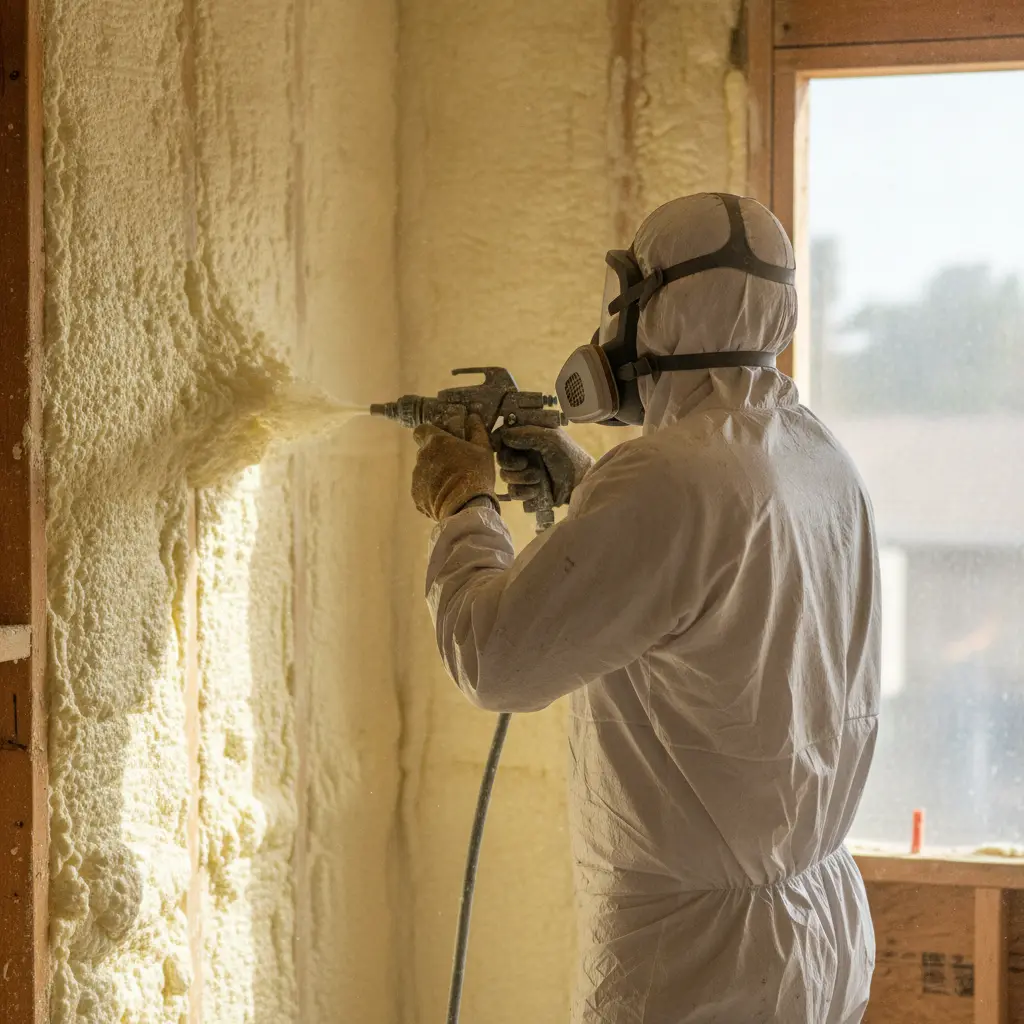
Our team in action — insulation professionals serving Simi Valley
Spray Foam Attic Insulation Methods and Approaches
Closed-Cell Spray Foam (2 lb Density)
The most thermally efficient option at R-6 to R-7 per inch, closed-cell foam is ideal for Simi Valley homes where roof cavity depth is limited, where moisture resistance is a priority, or where structural reinforcement of aging sheathing is desired. It is the preferred choice for unvented conditioned attic assemblies and for homes in the higher-elevation foothill areas where temperature extremes are most severe.
Open-Cell Spray Foam (0.5 lb Density)
Open-cell foam provides excellent air sealing and sound dampening at a lower material cost per square foot. At R-3.7 per inch, it requires greater installed depth to meet Title 24 R-values but is well-suited for large flat or low-slope attic decks in the 1980s and 1990s Wood Ranch and Long Canyon communities where rafter depth allows for thicker applications.
Hybrid Spray Foam and Blown-In System
A hybrid approach applies a 1- to 2-inch layer of closed-cell foam directly to the roof decking for air sealing and moisture resistance, followed by blown-in cellulose or fiberglass attic floor insulation to achieve the target total R-value. This method balances performance and cost effectively for budget-conscious homeowners. Learn more about our blown-in insulation options.
Conditioned Attic (Unvented) Conversion
For homes with HVAC equipment or ductwork located in the attic — common in many Simi Valley single-story tract homes — converting to a fully conditioned, unvented attic by applying closed-cell foam to the underside of the roof deck brings the mechanical systems within the conditioned envelope, dramatically reducing system losses and improving overall energy efficiency.
Ready for Spray Foam Attic Insulation? Get Your Free Estimate Today.
Next Level Insulation of Simi Valley serves Simi Valley and the surrounding area — we’ll be on-site within 24 hours.
📞 Call (805) 774-1832Spray Foam Attic Insulation Cost in Simi Valley, CA
Understanding the investment involved helps homeowners plan accordingly. Spray foam attic insulation costs in Simi Valley generally fall within the following ranges:
- Open-cell spray foam: $1.00 to $1.50 per board foot installed, or approximately $1.50 to $2.50 per square foot at typical residential thicknesses
- Closed-cell spray foam: $1.75 to $3.00 per board foot installed, or approximately $3.50 to $7.00 per square foot at 2-inch to 3-inch thickness
- Full attic conditioned conversion (closed-cell, roof deck application): $4,500 to $10,000+ for a typical 1,500 to 2,500 square foot Simi Valley home, depending on roof geometry and access complexity
- Hybrid system (closed-cell flash coat plus blown-in): $2,500 to $6,000 for average-sized homes
Factors That Affect Your Project Cost
- Existing insulation removal: Contaminated or rodent-damaged insulation removal adds $500 to $2,000 depending on volume and disposal requirements
- Attic access and geometry: Low-pitch roofs, limited access hatches, and complex roof lines common in 1960s Simi Valley ranch homes can increase labor time
- Duct sealing and HVAC coordination: Homes converting to conditioned attics may require HVAC contractor involvement for equipment adjustments
- California utility rebates: Southern California Gas Company and SCE periodically offer insulation rebates — we assist clients in identifying applicable programs
Contact Next Level Insulation of Simi Valley at (805) 774-1832 for a free, no-obligation quote specific to your home’s size and condition.
Simi Valley Neighborhoods We Serve
Wood Ranch
Developed primarily in the late 1980s and 1990s, Wood Ranch homes feature tile roofs and multi-pitch roof geometry that creates complex attic configurations. Many homes in this community have HVAC systems located in the attic and benefit significantly from conditioned attic conversions using closed-cell spray foam.
Long Canyon
This master-planned community includes a mix of single-story and two-story homes built in the early 1990s. Original batt insulation in Long Canyon homes has often settled or been disturbed, and the community’s elevated position near the Simi Hills increases exposure to both heat and Santa Ana wind pressure events.
Bridle Path
An equestrian-oriented community with larger custom and semi-custom homes, Bridle Path properties often have cathedral ceilings and vaulted roof assemblies that require specialized spray foam detailing to achieve compliant R-values without sacrificing interior ceiling height.
Central Simi Valley (Tapo Canyon and Erringer Road Corridors)
The original postwar Simi Valley subdivisions concentrated along Tapo Canyon Road, Sycamore Drive, and Erringer Road include homes built from the 1950s through the 1970s with little to no original insulation. These properties represent the most urgent need for spray foam upgrades and often require full attic remediation including insulation removal prior to foam application. Learn about our insulation replacement services.
Attic Insulation Maintenance Tips for Simi Valley Homeowners
- Inspect attic annually after Santa Ana wind season: Every October through December, check that ridge vents, soffit vents, and attic hatches remain sealed and undamaged after high-wind events common to the Simi Valley area.
- Check for pest intrusion each spring: Roof rats and squirrels active in the Santa Susana Mountain foothills regularly access attics through eave gaps. Inspect for evidence of gnawing or nesting and seal entry points promptly.
- Monitor for roof leaks after atmospheric river rainfall events: January and February storms can drive water through aging flashing and skylights. Address any moisture staining on foam or sheathing immediately to prevent wood rot.
- Keep attic access hatches properly weather-stripped: Attic hatch air leakage is one of the most significant sources of thermal bypass in Simi Valley homes — inspect gaskets annually.
- Do not store materials directly on attic floor insulation: Foot traffic and storage boxes compress insulation and create thermal bridges even in spray foam systems at the attic floor level.
- Schedule a professional re-inspection every 5 to 7 years: While spray foam does not settle or degrade like batt insulation, attic assemblies evolve with roof work, HVAC changes, and structural movement common in Simi Valley’s expansive soil conditions.
- Maintain proper attic ventilation in vented configurations: Ensure soffit and ridge vents remain unobstructed so that vented attic systems perform as designed alongside any supplemental foam air sealing.
Why Choose Next Level Insulation of Simi Valley
Next Level Insulation of Simi Valley is a locally focused insulation contractor serving Simi Valley and the surrounding communities of Thousand Oaks, Moorpark, Camarillo, Calabasas, and Woodland Hills. Our team has direct, hands-on experience with the specific construction types, climate challenges, and regulatory requirements that define insulation work in Ventura County and the greater San Fernando Valley.
We install the full spectrum of insulation systems — including spray foam, blown-in, batt, crawl space encapsulation, and insulation removal — giving us the flexibility to recommend what actually works best for your home rather than a one-size-fits-all solution. Explore our crawl space encapsulation services.
Every project begins with a thorough diagnostic inspection so that our recommendations are grounded in the actual conditions of your specific attic — not assumptions. We provide transparent, itemized written proposals before any work begins, and our installation teams are trained in California Title 24 compliance requirements applicable to Climate Zone 9.
We serve homeowners across all of Simi Valley’s neighborhoods, from the original postwar tracts near Tapo Canyon to the newer master-planned communities in Wood Ranch. Call us at (805) 774-1832 to speak with a local insulation expert today.
Frequently Asked Questions: Spray Foam Attic Insulation in Simi Valley, CA
How much does spray foam attic insulation cost in Simi Valley?
Costs vary based on foam type, attic size, and existing conditions. Open-cell foam typically runs $1.50 to $2.50 per square foot installed, while closed-cell foam ranges from $3.50 to $7.00 per square foot. A full attic project for an average Simi Valley home of 1,500 to 2,500 square feet generally costs between $3,000 and $10,000. We provide free, detailed quotes specific to your home. Contact us at (805) 774-1832.
How long does a spray foam attic insulation installation take?
Most residential attic spray foam projects in Simi Valley are completed in a single day. Larger homes or those requiring prior insulation removal may require two days. Foam is typically fully cured and safe for re-entry within 24 hours of application.
Is spray foam insulation worth it in Simi Valley’s climate?
Yes — Simi Valley’s combination of extreme summer heat, Santa Ana wind events, and wildfire smoke exposure makes spray foam one of the highest-return insulation investments available. Homeowners typically report cooling cost reductions of 20% to 40% after a properly designed spray foam attic upgrade.
What is the difference between open-cell and closed-cell spray foam for Simi Valley attics?
Closed-cell foam is denser (R-6 to R-7 per inch), moisture-resistant, and structurally reinforcing — best suited for unvented conditioned attic conversions and homes with limited rafter depth. Open-cell foam is lighter, more affordable, and better for sound attenuation — suitable for vented attic floor applications where depth is not a constraint.
Can spray foam insulation help during wildfire smoke events near Simi Valley?
Yes. Spray foam’s continuous air barrier significantly reduces smoke and particulate infiltration through attic assemblies during wildfire events. Given Simi Valley’s proximity to high fire hazard severity zones — as experienced during the Easy Fire in October 2019 — this is a meaningful benefit for local homeowners.
Do Simi Valley homes need insulation removal before spray foam is installed?
Not always. In some cases, existing blown-in insulation at the attic floor can remain in place while spray foam is applied to the roof deck above. However, contaminated, rodent-damaged, or wet insulation must be removed prior to any new installation. Our assessment will determine what your specific attic requires. Learn more about professional insulation removal.
Does spray foam attic insulation qualify for rebates in Simi Valley?
California utility programs through Southern California Gas Company and Southern California Edison periodically offer insulation rebates. Federal energy efficiency tax credits under the Inflation Reduction Act may also apply. We help our clients identify and navigate available incentives during the proposal process.
What areas near Simi Valley do you serve?
In addition to all Simi Valley neighborhoods, Next Level Insulation serves Thousand Oaks, Moorpark, Camarillo, Calabasas, Woodland Hills, Chatsworth, Agoura Hills, Westlake Village, Oak Park, Santa Clarita, Malibu, San Fernando, Fillmore, Oxnard, Port Hueneme, Santa Paula, North Hollywood, and Beverly Hills.
Get Your Free Spray Foam Attic Insulation Quote in Simi Valley Today
Stop overpaying for cooling in Simi Valley’s brutal summer heat. Whether your home is a 1960s ranch on Tapo Canyon Road or a newer two-story in Wood Ranch, Next Level Insulation of Simi Valley has the local expertise and the right materials to deliver a properly installed, code-compliant spray foam attic system that performs through every Santa Ana wind event and heat wave Ventura County sends your way.
Our assessments are free, our proposals are detailed and transparent, and our installations are completed by trained local technicians who understand Simi Valley’s climate and construction realities.
Call us now at (805) 774-1832 to schedule your no-obligation attic inspection and quote. You can also reach us through our website to request a callback at a time that works for your schedule. Take the first step toward a more comfortable, energy-efficient home today.