

Basement Insulation in Simi Valley, CA
Energy-Saving Basement Insulation for Simi Valley, CA Homes — Licensed & Insured
Need basement insulation in Simi Valley, CA? Next Level Insulation offers expert installation, spray foam & more. Call (805) 774-1832 for a free estimate today.
- Licensed & Insured
- Locally Owned & Operated
- Free Inspection & Estimate
Request Your
Free EstimateBasement insulation is the process of applying thermal and moisture barriers to below-grade spaces, rim joists, foundation walls, and subfloor assemblies to regulate temperature, prevent moisture intrusion, and improve overall energy efficiency throughout your home. In Simi Valley, CA, where temperatures swing from cool, damp winters to scorching summers exceeding 100°F, an uninsulated or poorly insulated basement becomes a direct liability — driving up energy bills and creating uncomfortable living conditions year-round.
At Next Level Insulation of Simi Valley, we specialize in basement insulation solutions engineered for the unique climatic and structural demands of Simi Valley and the greater Ventura County region. Whether your home sits in the Santa Susana foothills or on the valley floor near the 118 Freeway corridor, our team understands how local soil conditions, marine-influenced humidity, and seasonal temperature extremes impact your basement environment. Call us today at (805) 774-1832 to schedule your free assessment.
Understanding Basement Insulation
Basement insulation refers to the strategic application of insulating materials — including spray foam, rigid foam board, fiberglass batts, and blown-in cellulose — to the walls, ceiling, floor, and rim joist areas of a basement or semi-subterranean space. The primary goal is to create a thermal envelope that separates conditioned living space from the unconditioned ground and exterior environment, reducing heat transfer in both directions depending on the season.
Historically, basement insulation was often overlooked in residential construction, particularly in California where the focus was placed on above-grade energy efficiency. Homes built in Simi Valley during the post-war suburban expansion of the 1950s through the 1970s — many of which still stand in neighborhoods like Royal Avenue Estates and the older tracts near Tapo Canyon Road — were constructed with little to no basement insulation. Building codes at the time did not mandate it, and natural gas was inexpensive enough that homeowners rarely felt the financial pressure to upgrade.
That calculus changed dramatically as energy costs rose and California’s Title 24 Building Energy Efficiency Standards evolved through successive updates in 2013, 2016, 2019, and 2022. Today, any permitted renovation or new construction in Simi Valley must meet minimum R-value requirements for below-grade assemblies, pushing basement insulation from an optional upgrade to a code-required component in many project types.
In Simi Valley specifically, the prevalence of slab-on-grade construction is high, but a meaningful number of homes — particularly those on sloped lots in the Knolls neighborhood and hillside areas near Wood Ranch — feature daylight basements or partial basements that serve as bonus rooms, garages, or utility spaces. These partially below-grade spaces are especially vulnerable to thermal bridging, moisture infiltration, and poor air sealing, making professional basement insulation not just beneficial but essential to home performance and occupant health.
Proper basement insulation also plays a critical role in moisture management. A poorly insulated basement wall allows warm interior air to contact cold concrete surfaces, producing condensation that fuels mold growth, wood rot, and structural deterioration — problems that are particularly acute in Simi Valley during the November through March rainy season when ground saturation is at its peak.
Why Basement Insulation Is Needed in Simi Valley, CA
Extreme Seasonal Temperature Swings
Simi Valley’s inland location within the Transverse Ranges produces a semi-arid climate characterized by significant diurnal and seasonal temperature variation. Summer daytime highs routinely exceed 100°F — during the historic heat dome event of September 2022, Simi Valley recorded temperatures as high as 109°F — while winter nighttime temperatures in hillside areas near Tierra Rejada Road and the Santa Susana Pass can drop into the upper 30s. An uninsulated basement exposed to these swings acts as a thermal sink, absorbing heat in summer and radiating cold into your living space in winter. Properly installed basement insulation with R-values of R-15 to R-21 for walls and R-30 for ceiling assemblies significantly dampens these extremes.
Simi Valley’s Soil Composition and Ground Moisture
The valley floor sits atop a mix of alluvial deposits and expansive clay-rich soils characteristic of the Simi Hills and Santa Susana geological formations. Clay soils retain moisture significantly longer than sandy loam, meaning that even weeks after rainfall, the ground surrounding basement walls remains saturated. The Simi Valley receives an average of 14 to 16 inches of rainfall annually, concentrated primarily between November and March. This prolonged ground saturation creates hydrostatic pressure against foundation walls and drives moisture vapor through concrete — a problem documented extensively in older homes near the Arroyo Simi floodplain and in lower-lying tracts near Erringer Road.
Fire and Rebuilding Context
The Easy Fire of October 2019 burned through portions of northern Simi Valley near the Ronald Reagan Presidential Library on Madera Road, displacing residents and prompting a wave of rebuilding and renovation activity throughout the surrounding neighborhoods. Homeowners undertaking rebuilds or major renovations in these areas are now subject to current Title 24 energy codes, which require properly insulated below-grade assemblies. Next Level Insulation of Simi Valley has experience working within post-fire reconstruction timelines and permit requirements specific to the City of Simi Valley Building and Safety Division.
Santa Ana Wind Events and Pressure Differentials
Simi Valley sits at the intersection of several wind corridors, including the Santa Ana wind patterns that funnel through the Santa Susana Pass and the Simi Hills gaps. These events, which typically occur between October and February, create significant pressure differentials across building envelopes. An un-air-sealed basement allows these pressure events to drive cold exterior air and wildfire smoke particulates into living spaces — a particular concern given Simi Valley’s proximity to recurring fire activity in the surrounding open space preserves.
Energy Cost Pressures
Southern California Gas and Southern California Edison rates have increased substantially over the past decade. Homeowners in Simi Valley with uninsulated basements or crawl spaces can lose 15–25% of their conditioned air energy through the floor system alone, according to Department of Energy estimates. Addressing this with proper basement insulation can reduce annual heating and cooling costs by $300 to $700 for a typical Simi Valley home.
Signs You Need Basement Insulation in Simi Valley
Temperature and Comfort Issues
- Floors above the basement feel noticeably cold during winter months, particularly in rooms above unconditioned spaces
- Rooms directly above the basement or crawl space are consistently 5–10°F cooler or warmer than the rest of the home
- Your HVAC system runs excessively during Simi Valley’s summer heat events despite a programmable thermostat
- Drafts are perceptible along baseboards or near floor registers in above-grade rooms
Moisture and Structural Symptoms
- Visible efflorescence (white chalky deposits) on basement or foundation walls, indicating moisture migration through concrete
- Musty or earthy odors emanating from below-grade spaces, particularly following winter rainfall events
- Visible mold or mildew growth on wall surfaces, wood framing, or stored items
- Condensation forming on basement walls or floor surfaces during warm weather
- Warping, cupping, or buckling of hardwood floors above the basement or crawl space
Energy and Financial Indicators
- Unexplained spikes in gas or electric bills during seasonal transitions in March–April or October–November
- Your home was built before 1980 and has never had basement insulation professionally installed or inspected
- You are planning a renovation and need to meet current Simi Valley and California Title 24 energy compliance requirements
Our Basement Insulation Process in Simi Valley
Next Level Insulation of Simi Valley follows a structured, multi-step process to ensure every basement insulation project meets both performance targets and local code requirements.
Free On-Site Assessment (1–2 Hours)
Our technician visits your Simi Valley home to evaluate the existing basement or below-grade space. We assess current insulation condition, identify moisture entry points, check for existing mold or pest damage, and document R-value deficiencies. We also note any site-specific factors such as proximity to the Arroyo Simi, slope orientation on hillside lots, or prior fire damage that may affect material selection.
Moisture Remediation Planning (If Required)
If our assessment reveals active moisture intrusion — common in Simi Valley properties near drainage corridors or with clay-dominant soils — we develop a remediation plan prior to any insulation installation. Installing insulation over an active moisture problem traps water and accelerates structural damage. This phase may include recommendations for crawl space encapsulation or drainage improvements.
Air Sealing and Rim Joist Preparation (2–4 Hours)
Before insulation is applied, we seal all penetrations, gaps around pipes, wiring chases, and the critical rim joist area using closed-cell spray foam. This step is essential in Simi Valley homes given the Santa Ana wind pressure events that exploit every unsealed gap in the building envelope.
Material Selection and Installation (1–2 Days)
Depending on your basement configuration, existing framing, and R-value targets, we install the appropriate insulation system — spray foam, rigid foam board, fiberglass batts, or a hybrid approach. Installation is performed by trained technicians following manufacturer specifications and California Title 24 requirements.
Vapor Barrier Installation (2–4 Hours)
Where applicable, we install a 6-mil or 10-mil polyethylene vapor barrier on concrete floors and walls to manage the ground moisture common to Simi Valley’s clay-rich soil conditions.
Quality Inspection and Documentation (1–2 Hours)
We conduct a post-installation inspection to verify coverage, R-value consistency, and air sealing integrity. Documentation is provided for permit records and future insurance or resale purposes.
Final Walkthrough and Maintenance Guidance
We walk you through the completed work, explain what to monitor, and provide guidance on seasonal maintenance specific to Simi Valley’s climate cycles.
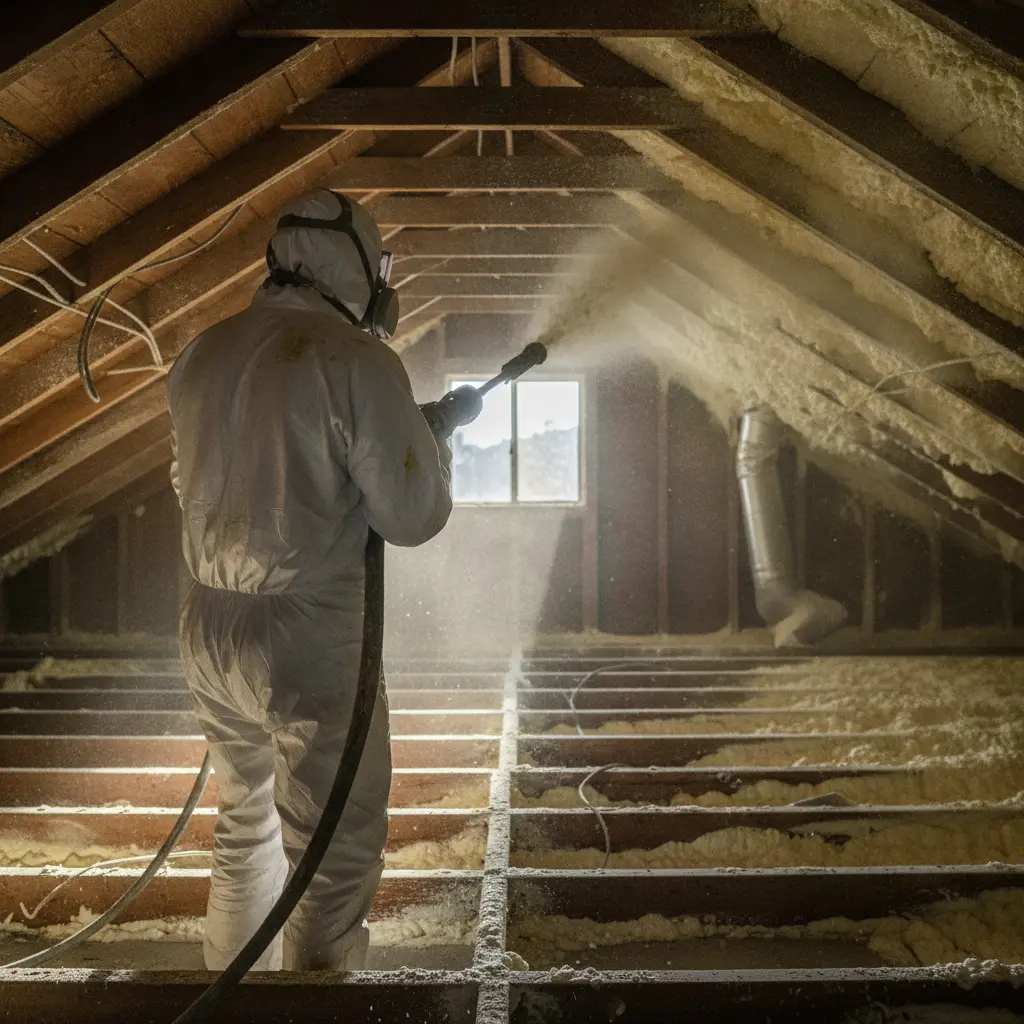
Our team in action — insulation professionals serving Simi Valley
Basement Insulation Methods and Approaches
Closed-Cell Spray Foam Insulation
Closed-cell spray foam is our premium option for Simi Valley basements where both moisture resistance and maximum R-value per inch are required. At approximately R-6.5 per inch, closed-cell foam applied at 2–3 inches to basement walls delivers R-13 to R-19 while also acting as a Class II vapor retarder — ideal for homes near the Arroyo Simi floodplain or on clay-soil lots where ground moisture is a persistent concern. Learn more about our spray foam insulation services.
Open-Cell Spray Foam Insulation
Open-cell spray foam is a cost-effective alternative for rim joist cavities and interior wall applications where vapor drive is less severe. At R-3.7 per inch, it provides excellent air sealing and sound attenuation — a benefit for Simi Valley homeowners near the 118 Freeway or the Metrolink rail corridor.
Rigid Foam Board Insulation
EPS or XPS rigid foam panels are ideal for application against concrete basement walls before framing or as continuous exterior insulation on daylight basement walls. R-values range from R-4 to R-6.5 per inch depending on product type. This method is commonly used in Wood Ranch and Bridle Path area homes with finished or partially finished basement spaces.
Fiberglass Batt Insulation
Fiberglass batts are used in framed basement wall cavities and basement ceiling assemblies where a budget-conscious solution is appropriate and moisture conditions are controlled. R-13 to R-21 batts pair well with a continuous rigid foam layer for a hybrid assembly meeting Title 24 requirements. Explore our full insulation installation options.
Blown-In Cellulose or Fiberglass
For basement ceiling cavities with existing drywall or awkward joist bays, blown-in insulation provides dense-pack coverage without full demolition, making it a practical retrofit choice for Simi Valley’s older housing stock.
Ready for Basement Insulation? Get Your Free Estimate Today.
Next Level Insulation of Simi Valley serves Simi Valley and the surrounding area — we’ll be on-site within 24 hours.
📞 Call (805) 774-1832Basement Insulation Cost in Simi Valley, CA
Understanding the cost of basement insulation in Simi Valley helps homeowners plan their investment and evaluate options appropriately. Pricing varies based on basement size, insulation type, existing conditions, and any required preparatory work.
Typical Cost Ranges
- Fiberglass Batt Installation: $1.50–$3.00 per square foot installed, making a 1,000 sq ft basement approximately $1,500–$3,000
- Blown-In Cellulose or Fiberglass: $1.75–$3.50 per square foot, ideal for retrofit ceiling applications
- Rigid Foam Board: $2.00–$4.50 per square foot installed depending on thickness and product
- Open-Cell Spray Foam: $1.50–$2.50 per board foot applied
- Closed-Cell Spray Foam: $3.00–$5.00 per board foot applied — the premium option for high-moisture Simi Valley conditions
- Rim Joist Air Sealing and Insulation: $500–$1,500 for most Simi Valley homes, depending on perimeter length and access
Cost Factors Specific to Simi Valley
Homes on hillside lots in areas like Wood Ranch or near the Santa Susana Pass may require additional access equipment or staging, adding $200–$500 to project costs. Properties with active moisture conditions — particularly those near the Arroyo Simi drainage basin — may require pre-treatment that adds $300–$800. If existing damaged insulation must be removed, insulation removal costs run $1.00–$2.00 per square foot additionally.
Available Incentives
Simi Valley homeowners may qualify for rebates through Southern California Gas Company’s Energy Upgrade California program or federal residential energy efficiency tax credits under the Inflation Reduction Act, which provides up to 30% of project cost (capped at $1,200 per year for insulation) for qualifying improvements. We can help you identify applicable programs during your assessment.
Call (805) 774-1832 for a detailed, no-obligation cost estimate tailored to your specific basement configuration.
Simi Valley Neighborhoods We Serve
Wood Ranch
Developed primarily from the late 1980s through the early 2000s, Wood Ranch homes frequently feature daylight basements and bonus rooms on sloped lots. These partially below-grade spaces benefit greatly from closed-cell spray foam on exposed foundation walls and rigid board on exterior-facing assemblies. We regularly service this community given its hillside exposure to Santa Ana wind events.
Royal Avenue Estates and Central Simi Valley
Many homes in this area date to the 1960s and 1970s tract-building era. Original insulation — where present at all — is typically degraded fiberglass with no vapor management. Insulation replacement paired with modern air sealing delivers dramatic comfort and energy improvements for these homeowners.
Bridle Path
Bridle Path’s equestrian-zoned properties often include large sub-structures, workshops, and utility spaces that function as de facto basements. These spaces, many built in the 1970s–1990s, require customized insulation strategies given their mixed-use nature and exposure to outdoor humidity from horse facilities.
Knolls and North Simi Valley Foothills
Hillside homes in the northern portion of Simi Valley near the Santa Susana Mountains face elevated wind exposure, cooler nighttime temperatures, and soils with higher clay content. These conditions make premium moisture-resistant insulation solutions — particularly closed-cell spray foam — the appropriate choice for below-grade spaces in this area.
Basement Insulation Maintenance Tips for Simi Valley Homeowners
- Inspect after heavy rain events: Following Simi Valley’s winter rain season (November–March), visually inspect your basement walls and floor for new moisture staining, efflorescence, or dampness that could compromise insulation performance.
- Check for pest activity annually: Ground squirrels, roof rats, and occasional termites active in Simi Valley’s open-space interface zones can damage fiberglass and cellulose insulation. Annual inspections help catch infestations early.
- Monitor humidity levels: Maintain basement relative humidity below 60% using a hygrometer. If readings consistently exceed this threshold, add a dehumidifier or address vapor management with crawl space encapsulation solutions.
- Clear basement vents and air pathways: Ensure foundation vents are not blocked by debris, vegetation, or soil buildup — particularly after Simi Valley’s seasonal wind events deposit debris against foundation walls.
- Re-inspect rim joist sealants every 5–7 years: Spray foam air sealing at rim joists can develop hairline cracks over time due to Simi Valley’s thermal cycling. Professional re-inspection ensures continued air sealing effectiveness.
- Update insulation before major renovations: If you are finishing a basement space, address insulation upgrades before drywall installation to avoid costly teardown later.
- Document insulation specifications: Keep a record of installed R-values, materials, and installation dates. This documentation is valuable for Title 24 compliance verification and future resale disclosures in California.
Why Choose Next Level Insulation of Simi Valley
Next Level Insulation of Simi Valley is a locally focused insulation contractor with deep familiarity with the climatic conditions, soil types, building vintages, and energy code requirements specific to Simi Valley and the surrounding Ventura County communities. We don’t apply one-size-fits-all solutions — every basement insulation project is scoped based on the specific lot, structure, and performance goals of your home.
Our team services the full spectrum of insulation needs, from attic insulation and spray foam to crawl space insulation and insulation removal, giving you a single, accountable contractor for all envelope performance needs. We understand the permit requirements of the City of Simi Valley Building and Safety Division and can assist with documentation for Title 24 compliance.
We serve not only Simi Valley but all surrounding communities including Thousand Oaks, Moorpark, Camarillo, Chatsworth, Woodland Hills, Calabasas, and Santa Clarita. Whether your project is a straightforward rim joist seal or a comprehensive below-grade insulation system, we bring the same attention to detail and local expertise. Call us at (805) 774-1832 to get started.
Frequently Asked Questions: Basement Insulation in Simi Valley, CA
How much does basement insulation cost in Simi Valley, CA?
Basement insulation in Simi Valley typically costs between $1,500 and $8,000 for most residential projects, depending on the square footage, insulation type, and existing conditions. Spray foam projects on the higher end can reach $10,000 or more for large or complex basements. We provide free, detailed estimates specific to your home — call (805) 774-1832 to schedule yours.
Do I need a permit for basement insulation in Simi Valley?
In many cases, insulation-only projects in existing spaces do not require a permit in Simi Valley. However, if the basement is being converted to conditioned living space or if the project is part of a larger renovation, a permit and Title 24 compliance documentation will be required by the City of Simi Valley Building and Safety Division. We help you navigate this process.
What is the best type of insulation for a Simi Valley basement?
For most Simi Valley basements, closed-cell spray foam is the highest-performance option because it simultaneously insulates, air seals, and acts as a vapor retarder — addressing all three of the primary challenges of below-grade spaces in Simi Valley’s clay-soil, high-moisture-season environment. Rigid foam board is an excellent and slightly more budget-friendly alternative for wall assemblies. We recommend the best approach based on your specific conditions during the on-site assessment.
How long does basement insulation installation take?
Most Simi Valley basement insulation projects are completed in one to two days. Larger or more complex projects — particularly those requiring prior moisture remediation or insulation removal — may extend to three to four days. We provide a specific project timeline during your initial assessment.
Can basement insulation help with wildfire smoke infiltration in Simi Valley?
Yes. Proper air sealing combined with basement insulation significantly reduces the pathways through which wildfire smoke particulates enter living spaces during events like the Easy Fire (2019) or future fire incidents in the open space areas surrounding Simi Valley. Closed-cell spray foam at the rim joist and foundation wall penetrations is particularly effective at reducing uncontrolled air infiltration from exterior smoke events.
Is basement insulation near me in Simi Valley worth the investment?
Absolutely. The combination of Simi Valley’s extreme temperature swings, clay-rich moisture-retaining soils, rising energy costs from SoCalGas and SCE, and California’s increasingly stringent Title 24 standards make basement insulation one of the highest-return energy upgrades available. Most homeowners see payback periods of four to eight years through energy savings alone, not counting comfort improvements and potential resale value increases.
Does Next Level Insulation of Simi Valley serve areas outside Simi Valley?
Yes. We serve a wide service area including Thousand Oaks, Moorpark, Camarillo, Oxnard, Santa Clarita, Chatsworth, Woodland Hills, Calabasas, Agoura Hills, Westlake Village, Oak Park, North Hollywood, Beverly Hills, San Fernando, Malibu, Fillmore, Port Hueneme, and Santa Paula. Contact us to confirm service availability for your specific address.
What is the R-value requirement for basement walls in California?
Under California’s current Title 24 2022 standards, below-grade wall assemblies in Climate Zone 6 (which covers Simi Valley) typically require a minimum continuous insulation value or equivalent framed assembly. R-13 to R-21 is the standard range for basement walls, with higher values recommended for maximum energy performance in Simi Valley’s heating-dominated winter months. Our team confirms the applicable requirements for your specific project during the assessment phase.
Get Your Free Basement Insulation Estimate in Simi Valley Today
Don’t let an uninsulated or under-insulated basement drive up your energy bills, compromise indoor air quality, or allow moisture to silently damage your Simi Valley home’s structure. Next Level Insulation of Simi Valley is ready to provide a thorough, no-obligation assessment of your basement insulation needs — tailored to your home’s specific age, construction, and location within the valley.
Whether you’re in Wood Ranch, the Knolls, Royal Avenue Estates, or anywhere across Simi Valley and the greater Ventura County region, our team brings local expertise and high-performance insulation solutions to every project.
Call us now at (805) 774-1832 to schedule your free on-site assessment. Ask us about available rebates through Southern California Gas and federal energy efficiency tax credits that may significantly reduce your out-of-pocket investment.