

Soundproofing Insulation in Simi Valley, CA
Expert Soundproofing Insulation in Simi Valley, CA — Storm-Tested, Warranty-Backed
Expert soundproofing insulation in Simi Valley, CA. Reduce SR-118 freeway noise, shared-wall sound bleed & more. Free estimates. Call (805) 774-1832 today.
- Licensed & Insured
- Locally Owned & Operated
- Free Inspection & Estimate
Request Your
Free EstimateSoundproofing insulation is a specialized form of acoustic treatment that reduces the transmission of unwanted noise between spaces — whether from outside traffic, neighboring units, or mechanical systems within your home. By absorbing sound waves and blocking airborne noise before it penetrates walls, floors, and ceilings, soundproofing insulation creates a measurably quieter, more comfortable indoor environment.
Simi Valley presents unique acoustic challenges. Situated in a valley flanked by the Santa Susana Mountains and the Simi Hills, the region’s terrain can funnel highway noise from the Ronald Reagan Freeway (SR-118) directly into residential neighborhoods. Rapid suburban growth has brought denser housing developments, shared walls, and mixed-use construction — all conditions that amplify sound transfer concerns.
At Next Level Insulation of Simi Valley, our team specializes in diagnosing and resolving noise problems specific to this community. Whether you live in a 1970s tract home near Stearns Park or a newer townhome along Madera Road, we provide expert soundproofing insulation solutions engineered for Simi Valley’s distinct building stock and lifestyle needs. Call us today at (805) 774-1832.
Understanding Soundproofing Insulation
Soundproofing insulation works by interrupting the pathways that sound travels through a building’s structure. Sound moves in two primary forms: airborne sound (voices, music, traffic) and impact sound (footsteps, dropped objects). Effective soundproofing insulation targets both, using materials with high Sound Transmission Class (STC) ratings and Impact Insulation Class (IIC) ratings to quantify performance.
Historically, residential insulation focused almost exclusively on thermal performance. Early California tract developments — many of which make up Simi Valley’s older housing stock built between the late 1960s and early 1990s — were constructed with fiberglass batts sized primarily to meet Title 24 energy codes. Acoustic performance was rarely a design priority. As a result, thousands of Simi Valley homes were built with single-layer drywall assemblies and minimal cavity fill, leaving residents vulnerable to noise intrusion that only worsened as the surrounding area grew busier.
Modern soundproofing insulation integrates several material types:
- Dense-pack cellulose: Recycled paper fiber compacted tightly into wall cavities, achieving STC ratings of 44–52 when properly installed.
- Mineral wool (rock wool/slag wool): An open-cell material with naturally superior acoustic properties, commonly achieving STC ratings between 45 and 55 in standard wall assemblies.
- Spray polyurethane foam (closed-cell): Excellent for sealing air gaps that act as sound conduits, particularly in older Simi Valley homes with penetrations around plumbing and electrical runs.
- Acoustic fiberglass batts: Higher-density versions of conventional batts, designed specifically to improve STC performance in retrofit scenarios.
In Simi Valley, the predominance of single-family homes, condominiums along the SR-118 corridor, and newer multifamily developments in areas like the Wood Ranch community means soundproofing insulation applies to a wide variety of building types — from wood-frame ranch houses to modern stucco-clad townhomes. Understanding which material and assembly combination is appropriate for each building era and type is the cornerstone of effective acoustic insulation work.
For properties that also need thermal upgrades alongside acoustic improvements, our attic insulation services and spray foam insulation solutions can address both goals simultaneously.
Why Soundproofing Insulation Is Needed in Simi Valley, CA
SR-118 Ronald Reagan Freeway Corridor Noise
The SR-118 cuts directly through the heart of Simi Valley, and neighborhoods within a quarter-mile of the freeway — including sections of Erringer Road, Tapo Canyon Road, and Los Angeles Avenue — regularly experience ambient exterior noise levels between 65 and 75 decibels (dB) during peak commute hours. The California Department of Transportation (Caltrans) established a noise abatement goal of 67 dB for residential land uses, meaning many Simi Valley homes along this corridor already exceed federal noise thresholds. Soundproofing insulation combined with air-sealing can reduce interior noise transmission by 10 to 20 dB in these affected homes.
Valley Topography and Acoustic Amplification
Simi Valley’s bowl-shaped topography — bounded by the Santa Susana Mountains to the south and the Simi Hills to the west — creates a natural acoustic chamber effect. Wind patterns, particularly the offshore Diablo wind events that accelerate through mountain passes between October and March, can push noise pollution across the valley floor in unexpected directions. Neighborhoods on the northern slopes near Madera Road and Rocky Peak Road that might otherwise feel insulated from freeway noise can experience significant sound carryover during these wind episodes.
High-Density Housing Developments
Since 2010, Simi Valley has approved multiple high-density residential projects, including townhome complexes along Cochran Street and mixed-use developments near the Simi Valley Town Center. Shared-wall construction inherently creates noise-transmission challenges. Party walls in attached townhomes with standard 2×4 framing and a single layer of 5/8-inch drywall typically achieve STC ratings of only 33–36 — well below the 50 STC commonly recommended for comfortable multi-family living.
Older Housing Stock and Settlement Gaps
A significant portion of Simi Valley’s housing was constructed between 1965 and 1985 during the city’s rapid growth period. Decades of seasonal temperature swings — from summer highs averaging 95°F to winter lows near 38°F — cause wood framing to expand and contract, creating gaps around electrical outlets, plumbing penetrations, and window frames. These gaps, even when small (as little as 1/4 inch), can reduce a wall assembly’s effective STC rating by 10 or more points, essentially negating the acoustic value of existing insulation.
Proximity to Rocketdyne and Industrial Areas
Commercial and light-industrial activity near the former Rocketdyne Santa Susana Field Laboratory site and along industrial parks on Kuehner Drive generates low-frequency mechanical noise that standard insulation does not adequately address. Low-frequency sounds (below 250 Hz) require mass and decoupling strategies, making professional soundproofing assessment critical for residents in the northern Simi Valley areas closest to these zones.
Signs You Need Soundproofing Insulation
Noise from Outside
- You can clearly hear SR-118 freeway traffic inside your home with windows closed.
- Conversations are difficult during Diablo wind events due to ambient outdoor noise penetrating walls.
- You hear aircraft from the Simi Valley area flight path over your neighborhood regularly.
- Lawnmowers, leaf blowers, or neighbor activity is audible throughout your home.
Noise Between Rooms or Units
- Television audio from one room is clearly audible in adjacent bedrooms.
- You can hear conversations through shared walls in a condo or townhome.
- Impact noise — footsteps from upstairs units — is disruptive at all hours.
- Home office productivity suffers due to household noise bleed.
Urgency Indicators
- Sleep disruption occurring three or more nights per week due to noise.
- Noise levels are affecting property rental value or tenant satisfaction.
- A home theater, music studio, or remote work setup is compromised by acoustic bleed.
- You notice sound transmission has worsened after recent construction nearby — a common issue during Simi Valley’s ongoing residential development cycles.
Our Soundproofing Insulation Process
Acoustic Assessment (1–2 Hours)
Our technicians conduct a walk-through of your Simi Valley property, identifying primary noise sources, affected rooms, and existing insulation conditions. We use decibel meters to document current interior noise levels, creating a baseline for measuring post-installation improvement. We note Simi Valley-specific factors such as proximity to SR-118, wall orientation relative to prevailing wind directions, and building era.
Insulation Inspection and Removal Plan (Same Day)
Where existing insulation is degraded, compressed, or pest-damaged — common in Simi Valley homes that experienced damage during the 1994 Northridge earthquake or from rodent activity in attic and crawl space areas — we develop a targeted insulation removal plan before any new material is installed. Introducing soundproofing insulation over compromised existing material significantly reduces effectiveness.
Air-Sealing (Half Day to Full Day)
Because even small gaps devastate acoustic performance, we air-seal all penetrations — electrical boxes, plumbing runs, top plates, and bottom plates — using acoustically rated caulk and spray foam. This step alone can improve effective STC ratings by 8 to 12 points in older Simi Valley homes.
Material Selection and Staging (Same Day)
Based on your specific building construction, noise sources, and budget, we select the optimal soundproofing insulation material — mineral wool, dense-pack cellulose, closed-cell spray foam, or a combination — and stage materials at your property. Simi Valley’s warm, dry climate allows us to work year-round without weather-related material concerns.
Soundproofing Insulation Installation (1–3 Days Depending on Scope)
Our crews install the selected soundproofing insulation in wall cavities, attic floors, and crawl space areas as specified. For retrofit applications in occupied homes, we use minimally invasive blow-in techniques through small-diameter holes that are patched and finished after installation. Blow-in insulation is particularly effective for Simi Valley’s large inventory of closed-cavity wall construction.
Post-Installation Verification (1–2 Hours)
We re-test interior decibel levels against the baseline established in Step 1, documenting measured improvement and confirming that installation met target STC performance goals.
Client Walkthrough and Documentation
We walk every client through the completed work, explain what was installed, and provide written documentation of materials used — important for HOA compliance in Simi Valley’s many planned communities.
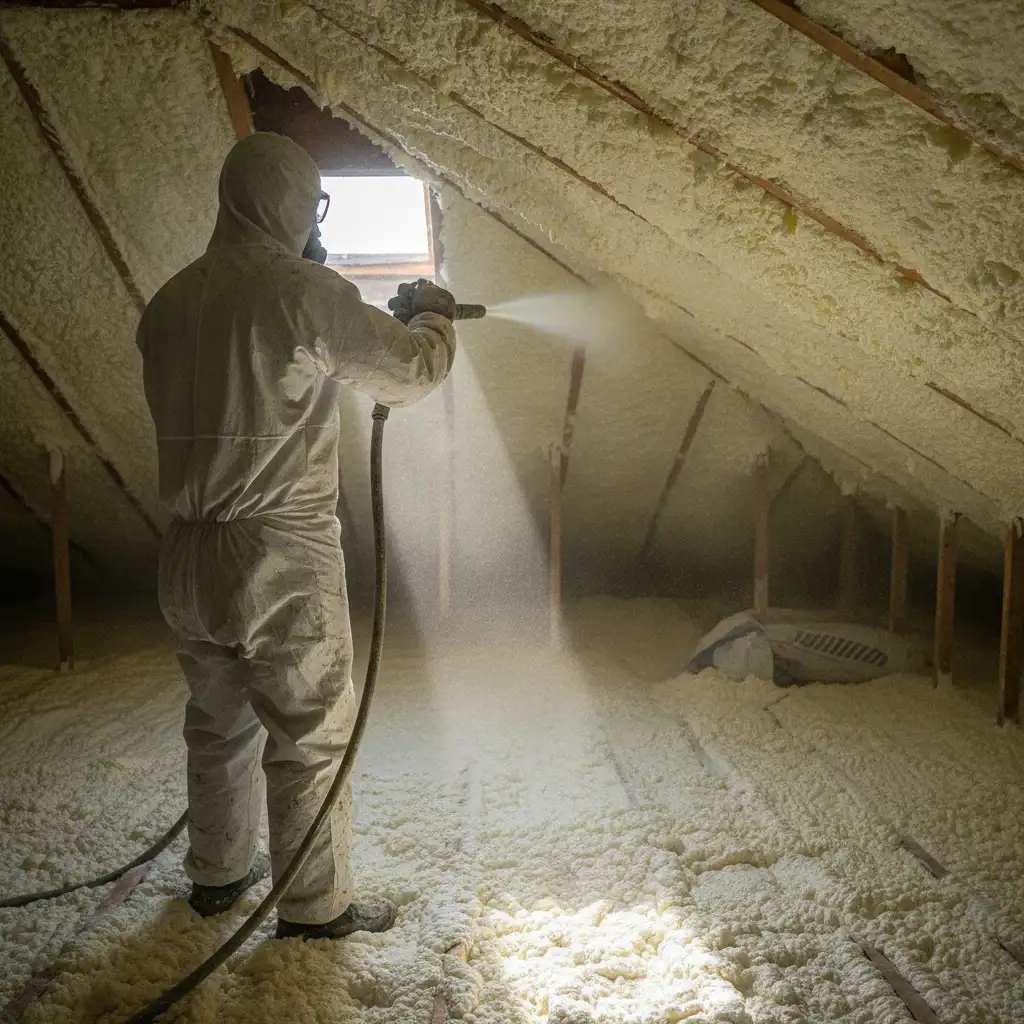
Our team in action — insulation professionals serving Simi Valley
Soundproofing Insulation Methods and Approaches
Mineral Wool Batt Installation
Mineral wool is our most frequently recommended soundproofing solution for open wall cavities during renovation or new construction in Simi Valley. Products like Rockwool Safe’n’Sound achieve STC ratings up to 52 in standard 2×4 wall assemblies. Mineral wool is also naturally fire-resistant — a meaningful advantage in Simi Valley, which falls within a High Fire Hazard Severity Zone per CAL FIRE designation. Best used in: walls adjacent to noisy spaces, home theater rooms, bedrooms, and shared walls during renovation projects.
Dense-Pack Cellulose Blow-In
For Simi Valley’s large inventory of older homes with closed wall cavities, dense-pack cellulose installed at 3.5 lbs per cubic foot fills voids completely and significantly improves STC performance without requiring wall demolition. Best used in: retrofit applications where wall openings are not feasible, older 1970s tract homes, and exterior walls facing SR-118 noise exposure. Learn more about our blow-in insulation services.
Closed-Cell Spray Foam for Gap Sealing
Used in conjunction with acoustic batts to eliminate air gaps that defeat STC performance. Particularly effective around electrical penetrations, plumbing chases, and attic knee walls common in split-level Simi Valley homes. Explore our spray foam insulation options.
Crawl Space Encapsulation with Acoustic Underlayment
For homes with raised foundations — common in older Simi Valley neighborhoods — crawl space encapsulation combined with acoustic underlayment reduces low-frequency impact noise and eliminates the moisture conditions that degrade insulation performance over time.
Ready for Soundproofing Insulation? Get Your Free Estimate Today.
Next Level Insulation of Simi Valley serves Simi Valley and the surrounding area — we’ll be on-site within 24 hours.
📞 Call (805) 774-1832Soundproofing Insulation Cost in Simi Valley, CA
Understanding the cost of soundproofing insulation helps Simi Valley homeowners plan effectively. Pricing varies based on scope, material selection, and the complexity of your specific building construction.
Typical Price Ranges
- Single room wall treatment (mineral wool retrofit): $800 – $2,200 depending on room size and wall assembly complexity.
- Whole-house dense-pack cellulose blow-in (exterior walls): $3,500 – $8,500 for a standard 1,500–2,500 sq ft Simi Valley home.
- Attic soundproofing insulation (floor/ceiling assembly): $1,200 – $4,000 based on attic access conditions and square footage.
- Crawl space insulation with acoustic treatment: $1,800 – $5,500 depending on crawl space dimensions and encapsulation needs.
- Home theater or dedicated acoustic room treatment: $2,500 – $7,000 for comprehensive wall, ceiling, and floor assemblies.
Factors Affecting Cost in Simi Valley
- Building era: Pre-1990 homes often require air-sealing and insulation removal prior to installation, increasing total project cost by 15–30%.
- Wall cavity access: Open-cavity new construction is less expensive than retrofit blow-in applications.
- Material choice: Mineral wool runs approximately 20–30% more per square foot than standard fiberglass batts but delivers significantly superior STC performance.
- HOA requirements: Several Simi Valley planned communities require specific materials or installation documentation, which can affect scheduling and scope.
Call us at (805) 774-1832 for a free, no-obligation estimate tailored to your property.
Neighborhoods We Serve in Simi Valley
Wood Ranch
This master-planned community in eastern Simi Valley features homes built primarily between 1985 and 2005. Wood Ranch properties often include shared walls in attached townhome configurations and are located close enough to the SR-118 extension to experience freeway noise. Dense-pack cellulose and mineral wool upgrades are frequently requested here.
Bridle Path and Horse Haven Estates
Located in northern Simi Valley, these neighborhoods feature larger lot single-family homes from the 1970s and 1980s. While noise from neighbors is less of an issue, proximity to Kuehner Drive industrial activity and low-frequency mechanical noise from nearby facilities makes soundproofing a priority for many residents.
Sycamore Park and Royal Avenue Corridor
Some of Simi Valley’s oldest residential development sits in this central corridor, with homes dating to the mid-1960s. These properties frequently have severely degraded original insulation and virtually no acoustic treatment. Comprehensive insulation replacement combined with soundproofing upgrades is often the most cost-effective approach here.
Madera Estates
This newer-construction neighborhood in west Simi Valley includes homes built in the 1990s to 2010s, many of which are two-story stucco construction. Floor-ceiling assemblies between first and second floors are a primary soundproofing concern, particularly impact noise from upper-level activity.
Soundproofing Insulation Maintenance Tips for Simi Valley Homeowners
- Inspect annually for pest intrusion: Simi Valley’s warm climate supports active rodent populations. Inspect attic and crawl space insulation each fall for signs of nesting, which compresses material and destroys acoustic performance.
- Re-seal penetrations after renovation work: Any plumbing, electrical, or HVAC modification can open gaps in your acoustic envelope. Re-caulk around all new penetrations with acoustically rated sealant.
- Check weatherstripping on windows and doors: Sound enters through the same pathways as air. Simi Valley’s dry climate degrades rubber and foam weatherstripping faster than humid regions — inspect and replace every 2–3 years.
- Monitor crawl space moisture after winter rains: Simi Valley receives the majority of its annual 14–15 inches of rainfall between November and March. Moisture intrusion in crawl spaces degrades insulation and can cause cellulose to settle, reducing its acoustic effectiveness.
- Avoid compressing attic insulation during storage: Many Simi Valley homeowners use attic space for seasonal storage. Compressing blow-in or batt insulation reduces both thermal and acoustic performance significantly.
- Schedule professional re-inspection every 7–10 years: Insulation materials settle and degrade over time. A professional assessment can identify where acoustic performance has declined before noise levels become a quality-of-life issue.
Why Choose Next Level Insulation of Simi Valley
Next Level Insulation of Simi Valley is a locally focused insulation contractor with deep knowledge of the specific building stock, noise challenges, and climate conditions that affect Simi Valley homeowners. Unlike national contractors who apply one-size-fits-all approaches, our team understands the acoustic implications of Simi Valley’s SR-118 corridor, the building eras present in different neighborhoods, and the HOA documentation requirements common in the area’s planned communities.
We offer the full spectrum of insulation services — from initial insulation removal and crawl space insulation to complete acoustic retrofits — meaning you work with one knowledgeable team from assessment through completion. Our technicians are trained in current California Building Code Title 24 requirements and acoustic testing protocols.
We serve homeowners across Simi Valley and the surrounding region, including Thousand Oaks, Moorpark, Camarillo, Chatsworth, and Woodland Hills. Every project begins with a thorough assessment and honest, itemized estimate — no pressure, no surprises.
Ready to experience a quieter home? Call us at (805) 774-1832 to schedule your free evaluation.
Frequently Asked Questions About Soundproofing Insulation in Simi Valley, CA
How much does soundproofing insulation cost in Simi Valley?
Costs vary significantly based on scope. A single-room retrofit using mineral wool batts typically ranges from $800 to $2,200. A whole-house blow-in application for a typical Simi Valley home of 1,800–2,200 square feet runs $4,000 to $7,500. Factors like building age, existing insulation condition, and wall cavity access all influence final pricing. We provide free, no-obligation estimates — call (805) 774-1832.
How long does soundproofing insulation installation take?
Most single-room projects are completed in one day. Whole-house applications — including air-sealing, removal of degraded material, and new installation — typically require two to three days for an average Simi Valley single-family home. We work efficiently to minimize disruption to your household.
Will soundproofing insulation block SR-118 freeway noise?
Yes, significantly. For homes within a quarter-mile of the SR-118 Ronald Reagan Freeway, properly installed soundproofing insulation combined with air-sealing can reduce interior noise levels by 10 to 20 decibels — the difference between a clearly audible freeway and a low background hum. Complete elimination of all exterior noise is not typically achievable without also addressing windows and doors.
Can soundproofing insulation be added to existing walls without tearing them open?
Yes. Our dense-pack cellulose blow-in method allows installation through small 1-inch to 2-inch diameter holes drilled in exterior siding or interior drywall. Holes are patched and finished after installation. This retrofit approach is ideal for Simi Valley’s large stock of older homes where wall demolition is not practical.
What is the best soundproofing insulation for a Simi Valley home theater?
For dedicated home theater applications, we recommend a combination approach: mineral wool batts in wall and ceiling cavities (for maximum STC performance), closed-cell spray foam at all penetrations and top/bottom plates, and acoustic underlayment beneath any flooring above a lower-level theater space. This assembly can achieve STC ratings of 55 or higher, containing most home theater audio within the room.
Does soundproofing insulation also improve energy efficiency?
Absolutely. Many soundproofing insulation materials — particularly mineral wool and dense-pack cellulose — also provide strong thermal resistance. Air-sealing performed as part of a soundproofing installation directly reduces energy loss. Many Simi Valley homeowners report noticeable HVAC savings following a comprehensive soundproofing insulation upgrade, especially in homes along the hot SR-118 corridor where cooling costs are already elevated.
Do Simi Valley HOAs place restrictions on insulation work?
Some planned communities in Simi Valley — particularly in Wood Ranch and newer developments — require advance HOA approval for work affecting shared walls or exterior assemblies. We are familiar with these requirements and can assist with documentation. Always confirm your HOA’s specific rules before scheduling any work affecting party walls or exterior facades.
How do I know if my current insulation is affecting sound transfer?
If you can clearly hear freeway traffic, neighbor conversations, or room-to-room noise with windows and doors closed, your current insulation is likely providing little to no acoustic benefit. Many Simi Valley homes built before 1990 have original fiberglass batts that have compressed to 50–70% of their original thickness, reducing both thermal and acoustic performance significantly. A professional inspection is the most reliable way to assess your current situation.
Get a Free Soundproofing Insulation Estimate in Simi Valley Today
Whether SR-118 freeway noise is keeping you awake, shared walls are disrupting your household, or you’re building the home theater of your dreams, Next Level Insulation of Simi Valley is ready to help. Our team provides honest assessments, detailed estimates, and expert installation tailored specifically to Simi Valley’s homes and neighborhoods.
Don’t let unwanted noise control your comfort. Contact us today to schedule your free, no-obligation evaluation.
- Call or Text: (805) 774-1832
- Service Area: Simi Valley, Thousand Oaks, Moorpark, Camarillo, Chatsworth, Woodland Hills, and surrounding communities
Reach out now and take the first step toward a quieter, more comfortable home.