

Garage Insulation in Simi Valley, CA
Energy-Saving Garage Insulation for Simi Valley, CA Homes — Licensed & Insured
Need garage insulation in Simi Valley, CA? Next Level Insulation offers expert installation, spray foam & more. Call (805) 774-1832 for a free estimate today.
- Licensed & Insured
- Locally Owned & Operated
- Free Inspection & Estimate
Request Your
Free EstimateGarage insulation is the process of installing thermal and acoustic barrier materials within your garage walls, ceiling, and door assemblies to regulate temperature, reduce energy loss, and improve comfort throughout your home. For Simi Valley homeowners, this service is far more than a luxury — it’s a practical necessity driven by the region’s dramatic seasonal temperature swings, hot Santa Ana wind events, and the widespread prevalence of attached garages in the tract-home developments that define much of the city’s housing stock.
At Next Level Insulation of Simi Valley, our team specializes in diagnosing and resolving the specific insulation challenges that affect garages across the Simi Valley area. Whether your garage is an uninsulated shell baking in the summer heat on Erringer Road or a finished space losing energy through poorly sealed walls near the Wood Ranch community, we deliver solutions tailored to your home’s construction era, layout, and local climate demands. Call us today at (805) 774-1832 to schedule your free assessment.
Understanding Garage Insulation
Garage insulation refers to the installation of insulating materials — including fiberglass batts, blown-in cellulose, spray foam, or rigid foam board — within the structural cavities and surfaces of a residential or commercial garage. The goal is to create a thermal envelope that slows heat transfer between the interior of the garage and the outdoor environment, as well as between the garage and the living spaces it adjoins.
Historically, garages were not considered part of the home’s conditioned space and were routinely built without insulation. Through the 1960s, 1970s, and even into the early 1980s — decades when the bulk of Simi Valley’s residential neighborhoods were developed following the city’s incorporation in 1969 — building codes placed minimal requirements on garage thermal performance. The sprawling tracts developed by builders like the Runkle Canyon area and the original Sinaloa Lake communities reflect this era of construction, where garages were essentially open-air structures attached to the home.
Over time, building science evolved significantly. California’s Title 24 energy standards, first adopted in 1978 and updated repeatedly since, have progressively tightened requirements for thermal performance. However, existing homes built before modern code cycles remain largely unaddressed unless homeowners take proactive steps to retrofit insulation.
In Simi Valley specifically, the prevalence of attached two-car garages in single-family homes means that an uninsulated garage wall is often the primary barrier between outdoor conditions and a home’s living room, kitchen, or master bedroom. When that barrier lacks adequate insulation — particularly with an R-value below R-13 in walls or R-30 in ceilings — conditioned air bleeds freely into the unconditioned garage space, driving up utility bills and creating uncomfortable hot or cold zones throughout the home.
Modern garage insulation projects range from simple batt installation in open stud-wall cavities to full spray foam encapsulation of finished garages, garage conversions, and accessory dwelling units (ADUs) — a building type increasingly common in Simi Valley as homeowners adapt older garages to meet the demand for additional living space.
Why Garage Insulation Is Needed in Simi Valley, CA
Extreme Summer Heat
Simi Valley regularly records summer high temperatures between 95°F and 105°F, with the valley’s inland geography amplifying heat compared to coastal communities like Malibu or Oxnard. In neighborhoods such as Bridle Path and the Long Canyon area, east- and south-facing garage doors absorb radiant solar heat throughout the afternoon, pushing interior garage temperatures above 130°F on peak summer days. Without wall and ceiling insulation, this heat radiates directly into adjacent living spaces, forcing air conditioning systems to work significantly harder and increasing cooling costs by an estimated 15–25% compared to properly insulated homes.
Santa Ana Wind Events
Simi Valley sits in one of Southern California’s most active Santa Ana wind corridors. The Simi Hills and Santa Susana Mountains channel offshore desert winds directly into the valley, producing sustained gusts of 40–60 mph and temperatures that can spike 20–30°F in under an hour. The November 2003 Simi Fire and the October 2003 Piru Fire — which together burned tens of thousands of acres in and around Ventura County — underscored the valley’s exposure to these extreme wind events. During Santa Ana conditions, uninsulated garage spaces experience dramatic pressure fluctuations and rapid temperature changes that stress unsealed wall cavities, push conditioned air out of the home, and create ideal conditions for moisture infiltration as humidity swings sharply.
Ronald Reagan Freeway Corridor Dust and Air Quality
Homes situated along the Highway 118 (Ronald Reagan Freeway) corridor — particularly in neighborhoods like Madera tract and the Stonebrook Estates area near the 118/Los Angeles Avenue interchange — face elevated particulate infiltration. Uninsulated garage wall cavities act as collection points for fine dust and combustion particulates, which then migrate into living spaces. Proper insulation with sealed installation significantly reduces this infiltration pathway.
Wildfire History and Defensible Space Requirements
Following the 2003 Simi Fire and subsequent fires in the Santa Susana foothills, Ventura County adopted stricter defensible space regulations. Many older Simi Valley homes in the wildland-urban interface — especially in the Hummingbird Lane and Flanagan Drive areas — have undergone retrofits that included upgraded garage doors rated for ember resistance. Proper insulation paired with air sealing complements these fire-hardening efforts by reducing the number of air gaps through which embers and smoke can infiltrate.
Aging Housing Stock
A significant portion of Simi Valley’s housing was built between 1965 and 1985, primarily in the original planned communities developed by Great Western Savings and similar developers. Homes in this era were built to far lower insulation standards than current code requires. Many garage walls contain only R-11 fiberglass batts — or none at all — while modern best practices call for R-15 to R-21 in 2×4 and 2×6 wall cavities respectively.
Signs You Need Garage Insulation in Simi Valley
Temperature and Comfort Indicators
- Rooms adjacent to the garage are noticeably warmer in summer or cooler in winter than the rest of the house, often by 5°F or more
- Your garage interior exceeds 110°F on hot Simi Valley summer days even with the door closed
- HVAC system runs continuously without reaching the set temperature in rooms sharing a wall with the garage
- You feel drafts near the door between the garage and living space during Santa Ana wind events
Energy and Utility Bill Indicators
- Monthly SCE or SoCalGas bills have increased by 15% or more year-over-year without explanation
- Energy audits show significant heat loss through garage-adjacent walls
- Your home consistently fails to meet Title 24 performance benchmarks
Visual and Physical Indicators
- Visible daylight gaps around garage door frames or between wall panels
- Existing fiberglass batts that are compressed, yellowed, water-stained, or falling from cavities
- Condensation forming on interior garage walls during winter mornings
- Visible mold or mildew growth on garage drywall, particularly in homes near Arroyo Simi creek areas prone to ground moisture
Urgency Indicators
- You are converting your garage to an ADU and need to meet Title 24 compliance
- A home inspection has flagged inadequate garage insulation prior to sale or refinancing
Our Garage Insulation Process in Simi Valley
Initial Assessment and Thermal Inspection (1–2 Hours)
Our technician visits your Simi Valley home for a comprehensive garage assessment. Using thermal imaging cameras, we map heat transfer zones across your garage walls, ceiling, and the shared wall with the living space. We measure existing R-values, inspect for moisture damage — especially in older homes near the Arroyo Simi flood plain — and document any existing insulation that requires removal before new material is installed.
Custom Insulation Plan and Material Selection (Same Day)
Based on the inspection findings, we develop a site-specific insulation plan. For Simi Valley’s climate, we typically recommend R-15 or R-21 for garage walls (depending on stud depth) and R-30 to R-38 for garage ceilings. We select materials appropriate to your garage’s use case — spray foam for ADU conversions, blown-in for finished ceilings, or batts for open-stud applications.
Preparation and Air Sealing (2–4 Hours)
Before insulation is installed, our crew seals all penetrations, gaps around conduit, plumbing, and the garage-to-house door frame using fire-rated caulk and spray foam. This step is critical in Simi Valley homes, where Santa Ana wind pressure differentials can drive significant air exchange through even small openings.
Insulation Installation (4–8 Hours Depending on Scope)
Our installers place, spray, or blow insulation material into all designated cavities. For spray foam applications, we allow full cure time (typically 24 hours) before trimming and finishing. Batt installations are stapled and faced per manufacturer specifications to ensure proper vapor control appropriate for Simi Valley’s dry climate.
Garage Door Insulation (1–2 Hours)
We assess and, where needed, install insulation panels within existing garage door sections, significantly reducing radiant heat gain through the door — a critical factor given Simi Valley’s intense afternoon sun exposure on south- and west-facing garages.
Post-Installation Thermal Verification (1 Hour)
We conduct a follow-up thermal scan to confirm even insulation coverage and identify any missed areas before we leave the site.
Client Walkthrough and Documentation
We walk you through the completed work, provide material data sheets, and explain expected performance improvements you should observe within the first full billing cycle.
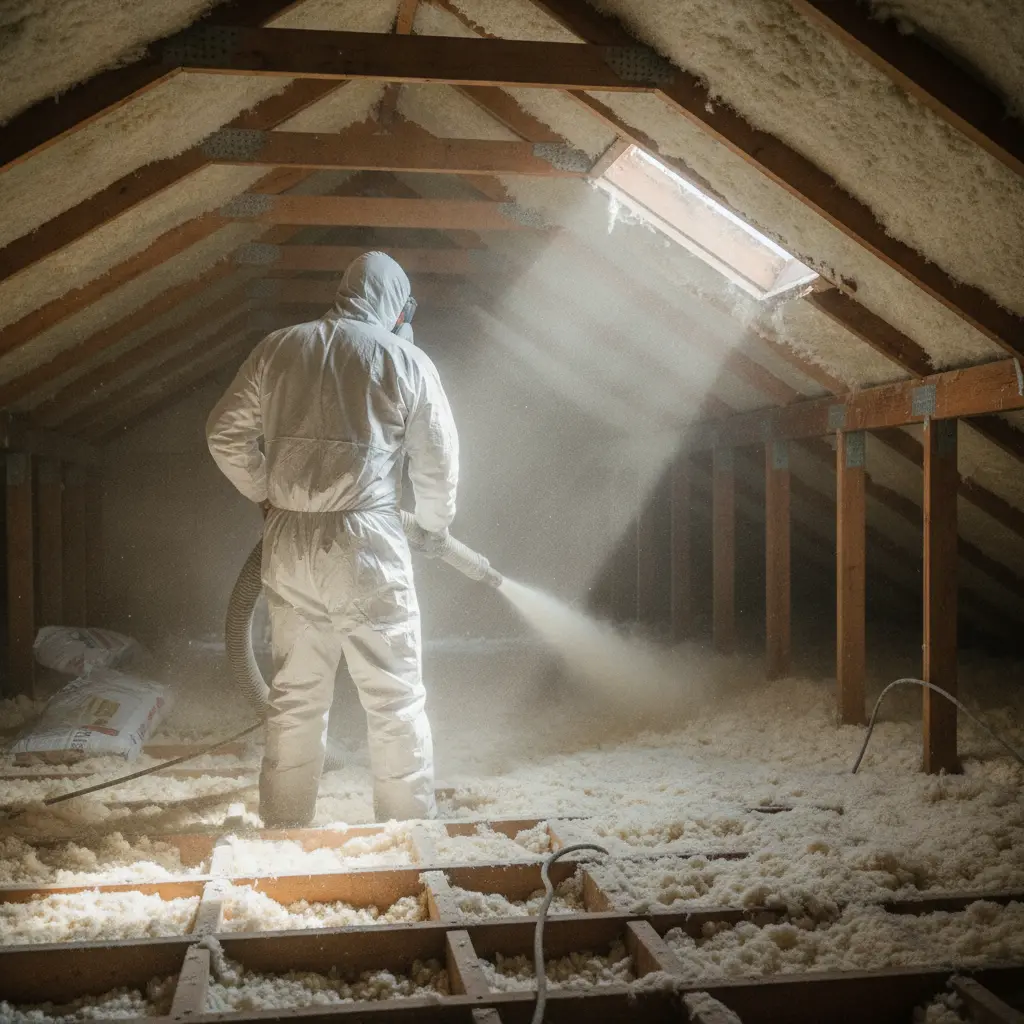
Our team in action — insulation professionals serving Simi Valley
Garage Insulation Methods and Approaches
Fiberglass Batt Insulation
The most cost-effective solution for open-stud garage walls in homes built between the 1960s and 1990s — exactly the era that defines most of Simi Valley’s Wood Ranch, Bridle Path, and Madera neighborhoods. Batts are available in R-13, R-15, and R-21 configurations and can be installed quickly in a single day. Learn more about our insulation installation services
Spray Foam Insulation
Closed-cell spray foam provides the highest R-value per inch (approximately R-6.5 per inch) and creates an impermeable air and moisture barrier — ideal for Simi Valley garages being converted to ADUs or conditioned workshops, and for homes in the wildland-urban interface where air sealing against ember intrusion is a priority. Explore our spray foam insulation options
Blown-In Insulation
Blown-in cellulose or fiberglass is the preferred method for insulating finished garage ceilings where cavity access is limited. It’s particularly effective in older Simi Valley homes where ceiling framing was not designed for batt installation. Learn about our blow-in insulation services
Rigid Foam Board
Rigid foam panels are applied to the interior face of concrete or masonry garage walls — common in hillside homes in the Long Canyon and Yosemite Avenue areas — providing continuous thermal resistance without requiring cavity framing.
Insulation Removal and Replacement
Many Simi Valley homes have degraded original insulation that must be removed before new material is installed. Our team handles full removal, disposal, and replacement as a single-service package. Find out about our insulation removal services
Ready for Garage Insulation? Get Your Free Estimate Today.
Next Level Insulation of Simi Valley serves Simi Valley and the surrounding area — we’ll be on-site within 24 hours.
📞 Call (805) 774-1832Garage Insulation Cost in Simi Valley, CA
The cost of garage insulation in Simi Valley varies based on garage size, insulation method, existing conditions, and scope of air sealing required. Below are typical price ranges for Simi Valley homeowners based on current material and labor costs in the Ventura County market.
Typical Cost Ranges
- Single-car garage (fiberglass batts, walls only): $400–$800
- Two-car garage (fiberglass batts, walls and ceiling): $900–$1,800
- Two-car garage (spray foam, full encapsulation): $2,500–$5,000
- Blown-in ceiling insulation only (two-car garage): $600–$1,200
- Garage door insulation panel kit installation: $200–$500
- Insulation removal and replacement (two-car garage): $1,200–$2,800
Factors Affecting Garage Insulation Cost in Simi Valley
- Garage size: Standard Simi Valley two-car garages average 400–500 sq ft; three-car garages in Wood Ranch estates can exceed 700 sq ft
- Existing insulation removal: Removal of old fiberglass or degraded blown-in adds $300–$700 to project cost
- Air sealing scope: Extensive air sealing required in older 1970s-era homes adds $150–$400
- ADU or conditioned space conversion: Title 24 compliance requirements add material and documentation costs
- Access difficulty: Homes with finished garage ceilings or complex framing require additional labor
For an accurate estimate specific to your Simi Valley home, contact Next Level Insulation of Simi Valley at (805) 774-1832. We provide free, no-obligation on-site assessments throughout the Simi Valley area.
Simi Valley Neighborhoods We Serve
Wood Ranch
This master-planned community in eastern Simi Valley features homes built primarily between 1985 and 2005. Many Wood Ranch garages were built with minimal wall insulation despite the neighborhood’s exposure to afternoon heat radiating off the Santa Susana foothills. Three-car garages are common here and benefit significantly from full wall and ceiling insulation packages.
Sinaloa Lake and Bridle Path
These older, semi-rural neighborhoods feature homes built in the late 1960s and 1970s, many with uninsulated single-skin drywall garage walls. The larger lot sizes and horse-property configurations mean garages often serve as workshops — making thermal comfort a functional priority, not just an energy concern.
Madera Tract and Stonebrook
Centrally located neighborhoods with dense concentrations of 1970s and 1980s tract homes, most featuring attached two-car garages with minimal or deteriorated original insulation. These homes are excellent candidates for batt insulation upgrades or blown-in ceiling applications.
Long Canyon and Royal Avenue Corridor
Homes in this area frequently back up to open hillside terrain, increasing wildfire interface concerns and wind exposure. Spray foam insulation with integrated air sealing is frequently the recommended approach for garages in this zone.
Garage Insulation Maintenance Tips for Simi Valley Homeowners
- Annual visual inspection: Check garage walls and ceiling for signs of water staining, settling, or pest intrusion — particularly after Simi Valley’s winter rain season (November–March)
- Check weatherstripping seasonally: Inspect and replace door-bottom weatherstripping before each summer and winter season to maintain air sealing performance during Santa Ana wind events
- Inspect garage door panels: Look for cracked or missing insulation panels in sectional garage doors, especially after high-wind events that can dislodge foam inserts
- Monitor for pest activity: Simi Valley’s semi-rural areas attract rodents that can damage fiberglass batts; inspect accessible cavities annually and seal any entry points
- Keep vents clear: Ensure attic vents above the garage are not obstructed, particularly after windblown debris events common in the Simi Hills area
- Address moisture promptly: If you observe condensation or water intrusion following winter storms, contact an insulation professional before mold develops within wall cavities
- Re-inspect after seismic events: Simi Valley sits near the Santa Susana Fault; significant seismic activity can shift wall cavities and compress or displace batt insulation
Why Choose Next Level Insulation of Simi Valley
Next Level Insulation of Simi Valley is a locally focused insulation contractor serving homeowners throughout Simi Valley and the surrounding Ventura County and Los Angeles County communities. Our team has hands-on familiarity with the specific construction eras, housing types, and climate challenges that define garage insulation work in this region — from the post-war tract homes of the Madera neighborhood to the newer estate homes of Wood Ranch.
We bring expertise across the full spectrum of insulation services, including spray foam, blown-in, batt installation, crawl space encapsulation, attic insulation, and complete insulation removal and replacement. This breadth of capability means we recommend the right solution for your specific garage — not just the most convenient one for us to install.
We serve homeowners not only in Simi Valley but across our full service area, including Thousand Oaks, Moorpark, Camarillo, Santa Clarita, Woodland Hills, Calabasas, and beyond. When you call us at (805) 774-1832, you speak directly with a local insulation expert who understands your neighborhood’s specific needs. Learn more about our company
Frequently Asked Questions: Garage Insulation in Simi Valley, CA
How much does garage insulation cost in Simi Valley?
In Simi Valley, garage insulation typically costs between $400 and $5,000 depending on garage size, insulation method, and project complexity. A standard two-car garage with fiberglass batt installation runs $900–$1,800, while a full spray foam encapsulation for a garage ADU conversion can reach $2,500–$5,000. Contact us at (805) 774-1832 for a free site-specific estimate.
How long does garage insulation installation take in Simi Valley?
Most standard two-car garage insulation projects in Simi Valley are completed within a single day — typically 4–8 hours for installation, plus 1–2 hours for prep and air sealing. Spray foam projects require an additional 24-hour cure period before the space can be finished or occupied.
Do I need a permit to insulate my garage in Simi Valley?
Most standard insulation retrofits in existing Simi Valley garages do not require a permit. However, if you are converting your garage to an ADU or conditioned living space, a building permit is required, and the insulation must meet current California Title 24 standards. We can advise you on permit requirements based on your specific project scope.
What R-value do I need for garage walls in Simi Valley?
For Simi Valley’s climate zone (Climate Zone 10), we typically recommend R-15 for 2×4 stud walls and R-21 for 2×6 walls in garages. Garage ceilings benefit from R-30 to R-38 to address the intense radiant heat that builds up in attic spaces over garages during Simi Valley’s hot summers.
Is spray foam worth the extra cost for a Simi Valley garage?
For certain applications, yes. Spray foam’s superior air sealing properties make it particularly valuable in Simi Valley homes located in the wildland-urban interface — such as the Long Canyon and Royal Avenue corridor — where ember intrusion during Santa Ana wind fire events is a concern. It’s also the best choice for garage-to-ADU conversions that must meet Title 24 performance requirements.
Can you insulate a garage with finished drywall walls?
Yes. We use blown-in insulation techniques that allow us to fill wall cavities through small access holes without removing existing drywall. This is a common requirement in Simi Valley’s 1980s-era finished garages throughout neighborhoods like Stonebrook and Bridle Path.
Does garage insulation really reduce energy bills in Simi Valley?
Absolutely. Because most Simi Valley homes feature attached garages that share one or more walls with living spaces, an uninsulated garage is a major energy leak. Homeowners typically report a 10–25% reduction in cooling and heating costs after proper garage insulation, with the largest gains seen in summer months when valley temperatures routinely exceed 100°F.
Do you offer garage insulation services near me in Simi Valley?
Yes. Next Level Insulation of Simi Valley serves all areas of Simi Valley, including Wood Ranch, Madera, Sinaloa Lake, Bridle Path, Long Canyon, and the Ronald Reagan Freeway corridor neighborhoods. We also serve surrounding communities including Moorpark, Thousand Oaks, Santa Clarita, and Woodland Hills. Call (805) 774-1832 to schedule service at your location.
Get Your Free Garage Insulation Estimate in Simi Valley Today
Don’t let another Simi Valley summer drive your energy bills through the roof or your indoor comfort to its limits. Whether your garage is an aging 1970s shell in Madera, a finished space in Wood Ranch losing heat through an uninsulated ceiling, or a garage you’re converting to an ADU that must meet Title 24 code, Next Level Insulation of Simi Valley has the expertise and the right materials to get the job done correctly.
Call us today at (805) 774-1832 to schedule your free, no-obligation on-site garage insulation assessment. Our local Simi Valley team is ready to help you achieve a more comfortable, energy-efficient home — starting with your garage. Contact us online to request your free estimate