

Batt Insulation in Simi Valley, CA
Energy-Saving Batt Insulation for Simi Valley, CA Homes — Licensed & Insured
Need batt insulation in Simi Valley, CA? Next Level Insulation offers expert installation, free assessments & Title 24 compliance. Call (805) 774-1832 today.
- Licensed & Insured
- Locally Owned & Operated
- Free Inspection & Estimate
Request Your
Free EstimateBatt insulation is one of the most widely used and cost-effective methods for insulating residential and commercial properties, and it remains a top choice for homeowners throughout Simi Valley, California. This pre-cut, blanket-style insulation material — available in fiberglass, mineral wool, and cotton — fits precisely between wall studs, floor joists, and ceiling rafters to create a reliable thermal and acoustic barrier.
In Simi Valley, where summer temperatures regularly climb past 100°F and the Santa Ana winds create dramatic seasonal temperature swings, proper insulation is not optional — it is essential. The unique semi-arid climate of the Simi Valley corridor, combined with a housing stock that spans from 1960s tract homes to modern custom builds, creates specific insulation demands that require local knowledge and hands-on expertise.
At Next Level Insulation of Simi Valley, we specialize in batt insulation installation tailored to the exact conditions of this community. From older homes in the Knolls neighborhood to newer construction near the Wood Ranch area, our team delivers precision installation that lowers energy bills, improves indoor comfort, and meets California building codes. Call us today at (805) 774-1832.
Understanding Batt Insulation
Batt insulation — sometimes called blanket insulation — consists of flexible panels of fibrous material manufactured to fit standard building dimensions. The most common variety is fiberglass batt insulation, which has been used in American residential construction since the 1930s. Mineral wool (also called rock wool or slag wool) batts emerged as a popular alternative due to superior fire resistance and sound dampening. More recently, recycled cotton batts have gained traction among environmentally conscious homeowners.
Each batt is assigned an R-value — a measure of thermal resistance. Higher R-values indicate better insulating performance. In Simi Valley and throughout Ventura County, California’s Title 24 Building Energy Efficiency Standards require specific minimum R-values depending on the climate zone. Simi Valley falls within Climate Zone 9, which mandates a minimum of R-38 for attic insulation in most residential applications, R-13 to R-21 for exterior walls, and R-19 for floors over unconditioned spaces.
Batt insulation is particularly well-suited for new construction framing and open-wall renovations because it can be installed quickly between standard 16-inch or 24-inch on-center stud bays. When installed correctly — without gaps, compressions, or voids — batts perform remarkably well in both thermal and acoustic control.
Simi Valley’s housing landscape is dominated by single-family detached homes built primarily between 1965 and 2000, many of which were originally insulated with early-generation fiberglass batts that have since degraded, settled, or become contaminated. This aging housing stock represents a substantial opportunity for insulation upgrades that can dramatically reduce heating and cooling costs. Newer developments such as those in the Sinaloa Lake area and subdivisions along Cochran Street also benefit from high-performance batt installation during initial construction phases.
Beyond thermal performance, batt insulation in Simi Valley plays an important role in noise reduction — critical for homes near the Ronald Reagan Freeway (SR-118) corridor, where traffic noise can penetrate insufficiently insulated walls.
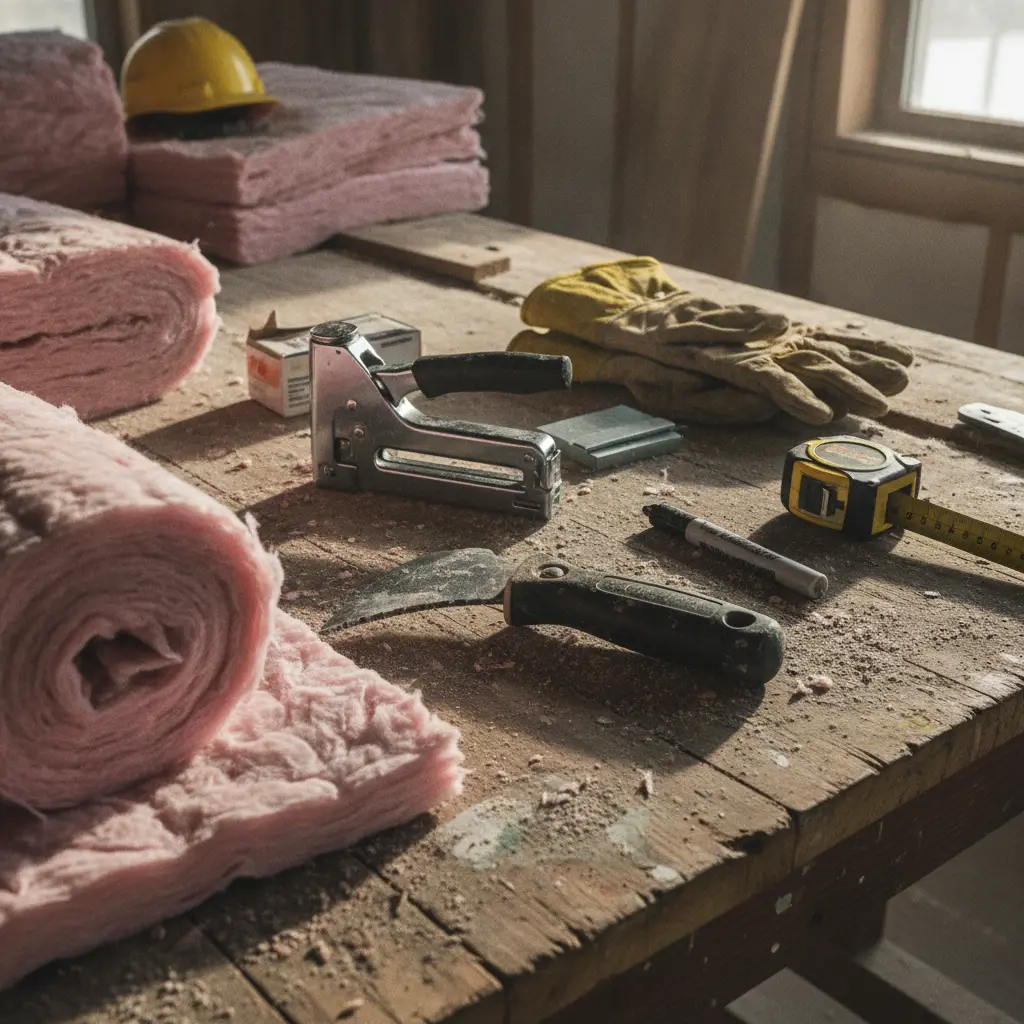
Our team in action — insulation professionals serving Simi Valley
Why Batt Insulation Is Needed in Simi Valley
Extreme Seasonal Temperature Swings
Simi Valley experiences some of the most dramatic temperature fluctuations in the greater Los Angeles region. During summer months, temperatures in the valley floor — particularly in neighborhoods like Oakridge, Yosemite, and areas east of Tapo Canyon Road — routinely reach 105°F to 110°F. In contrast, winter nights can dip to the mid-30s°F, particularly in elevated neighborhoods near the Rocketdyne hills and the Blind Canyon area. This 70°F+ daily and seasonal swing creates enormous pressure on home HVAC systems and makes quality insulation a direct financial necessity.
The Santa Ana Wind Effect
Simi Valley is positioned at the eastern end of a wind corridor that channels powerful Santa Ana winds from the Simi Hills and Santa Susana Pass. During major Santa Ana events — like the Easy Fire of October 2019 that swept through areas north of Tapo Canyon Road — temperatures spike while relative humidity drops below 10%. These conditions don’t just create fire danger; they cause extreme thermal stress on building envelopes. Poorly insulated walls allow conditioned air to escape rapidly, forcing HVAC systems to work at full capacity around the clock. Batt insulation acts as a buffer that stabilizes interior temperatures during these extreme events.
Aging Housing Stock and Degraded Original Insulation
The majority of Simi Valley’s residential neighborhoods — including the Knolls, Simi Valley Estates, and the areas surrounding Sycamore Drive — were developed between 1965 and 1985. Homes of this era were typically insulated with R-11 fiberglass batts in walls and R-19 in attics, well below today’s Title 24 requirements. After 40 to 50 years, these original batts have experienced significant settling, moisture absorption, and fiber deterioration, reducing their effective R-value by as much as 30 to 40 percent. Many homeowners in the Knolls and Crestview areas are unknowingly living with insulation that performs at R-7 or lower.
High Cooling Costs Specific to Simi Valley
Southern California Edison rate structures, which affect Simi Valley residents, have seen consistent increases in recent years. Inadequately insulated homes in the Simi Valley area average $280 to $420 per month in summer electricity costs for a 1,800-square-foot home running central air conditioning. Proper batt insulation upgrades can reduce cooling costs by 20 to 35 percent annually, representing savings of $800 to $1,500 per year for a typical Simi Valley household.
Wildfire Ember and Smoke Infiltration
Following the Las Virgenes and Simi Hills fires, building scientists identified insulation gaps as a pathway for ember-carried smoke to infiltrate attic and crawl spaces. Replacing degraded batt insulation in attic knee walls and floor assemblies reduces this infiltration risk while restoring thermal performance.
Signs You Need Batt Insulation in Simi Valley
Energy and Comfort Indicators
- Monthly electricity bills exceeding $350 during Simi Valley’s June–September peak cooling season for a home under 2,000 square feet
- Rooms that feel noticeably hotter or cooler than others, especially south-facing rooms along the Simi Valley sun path
- HVAC system running continuously during afternoon hours without reaching the set thermostat temperature
- Cold floors in winter, particularly in homes with crawl spaces common in the older Knolls and Alamo Street neighborhoods
Visual and Physical Warning Signs
- Visible gaps, voids, or compressed batts when inspecting your attic — batts should be fluffy and uniform, not matted or discolored
- Dark or dusty staining on existing batt surfaces, indicating air movement through the insulation
- Moisture staining, mold growth, or musty odors in attic or wall cavities
- Insulation that crumbles or breaks apart when touched, indicating advanced fiber degradation
Urgency Indicators
- Home was built before 1980 and has never had insulation upgraded — immediate evaluation recommended
- Recent water intrusion event (roof leak, plumbing failure) that may have saturated existing batts
- Evidence of rodent activity in attic, which is common in Simi Valley’s brushland-adjacent neighborhoods, as nesting destroys batt integrity
Batt Insulation Methods and Approaches
Standard Fiberglass Batt Installation
The most cost-effective option for Simi Valley homes, fiberglass batts are available in R-13, R-15, R-19, R-21, R-25, and R-38 configurations. We use faced batts (with kraft paper or foil vapor barrier) in exterior wall assemblies and unfaced batts in interior partition walls and between attic floor joists. This is the default solution for most new construction and gut-renovation projects throughout Simi Valley’s Wood Ranch and Bridle Path neighborhoods.
Mineral Wool (Rockwool) Batt Installation
For homes near the SR-118 freeway or properties where fire resistance and sound control are priorities, mineral wool batts are our recommended solution. Mineral wool is naturally fire-resistant to temperatures exceeding 1,200°F — a meaningful benefit in Simi Valley’s high fire risk zone designations — and provides superior sound transmission reduction compared to standard fiberglass. Explore our attic insulation options including mineral wool
High-Density Batt Installation
High-density batts achieve higher R-values within the same cavity depth — for example, R-21 in a standard 2×4 wall cavity rather than R-13. This approach is ideal for Simi Valley homes where wall cavity depth cannot be increased but maximum thermal performance is desired.
Hybrid Batt and Blow-In Systems
In attic applications, we often combine a base layer of batt insulation with a top layer of blown-in cellulose or fiberglass to achieve required R-38 or R-49 values efficiently. Learn more about our blow-in insulation services
Crawl Space Batt Insulation
For Simi Valley homes with vented crawl spaces, we install faced fiberglass batts between floor joists with kraft paper facing toward the conditioned space above. Explore our complete crawl space insulation solutions
Ready for Batt Insulation? Get Your Free Estimate Today.
Next Level Insulation of Simi Valley serves Simi Valley and the surrounding area — we’ll be on-site within 24 hours.
📞 Call (805) 774-1832Batt Insulation Cost in Simi Valley
Understanding the cost of batt insulation in Simi Valley helps homeowners budget accurately and evaluate contractor proposals. Pricing varies based on insulation type, R-value, installation location, and existing conditions.
Typical Cost Ranges for Simi Valley Homeowners
- Attic Batt Insulation (R-38): $1.50 to $2.50 per square foot installed. For a typical 1,500-square-foot Simi Valley ranch home attic, expect $2,250 to $3,750 total.
- Exterior Wall Batt Insulation (R-13 to R-21): $1.00 to $2.00 per square foot installed during open-wall renovation, totaling $2,000 to $5,000 for a full home depending on square footage.
- Crawl Space Floor Batt (R-19): $1.25 to $2.25 per square foot, or $1,500 to $3,000 for an average Simi Valley crawl space.
- Mineral Wool (Rockwool) Upgrade: Add 20 to 30 percent to fiberglass pricing for superior performance and fire resistance.
Factors Affecting Your Simi Valley Batt Insulation Cost
- Insulation removal required before installation adds $0.50 to $1.25 per square foot
- Rodent damage cleanup and sanitation in brushland-adjacent neighborhoods can add $300 to $800
- Air sealing work prior to batt installation ranges from $500 to $1,500 depending on home size and condition
- Permit fees through City of Simi Valley Building and Safety, when required, typically range from $75 to $200
Available Rebates
Southern California Edison offers rebates of up to $0.25 per square foot for qualifying insulation upgrades in Simi Valley. Contact us for current program details and assistance with rebate applications. These incentives can reduce your net project cost by $300 to $600 on a typical home.
Simi Valley Neighborhoods We Serve
The Knolls
One of Simi Valley’s oldest established neighborhoods, the Knolls features homes built primarily between 1965 and 1978. These properties almost universally carry original R-11 fiberglass batts that have degraded significantly. Attic access in Knolls homes often involves low-pitch roof lines that require compact installation techniques our team has mastered.
Wood Ranch
Homes in the Wood Ranch planned community, developed through the 1990s and early 2000s, generally feature better original insulation but often have bypassed wall and attic top plates that allow significant air leakage. We specialize in the combination air-seal-and-batt-upgrade approach this neighborhood requires.
Sinaloa Lake Area
Properties near Sinaloa Lake sit at higher elevation with increased wind exposure. Many feature custom construction with non-standard framing bays that require custom-cut batt installation — a precision service our team provides routinely.
Oakridge and Royal Avenue Corridor
The Oakridge area along the Royal Avenue corridor includes a mix of 1970s construction and 1990s infill development. Crawl space configurations here frequently require both batt floor insulation and crawl space encapsulation to fully address moisture and thermal performance.
Batt Insulation Maintenance Tips for Simi Valley Homeowners
- Inspect your attic annually in October — before Simi Valley’s Santa Ana season — to check for displaced or compressed batts caused by wind pressure differentials.
- Check for rodent intrusion every spring and fall. Simi Valley’s proximity to open brushland makes attic rodent activity more common than in denser urban areas. Rodents nest in and destroy batt insulation rapidly.
- After any roof repair or leak event, have attic batts inspected for moisture absorption. Wet batts lose R-value and can foster mold growth within 24 to 48 hours in Simi Valley’s warm temperatures.
- Keep attic ventilation pathways clear. Batts should never block soffit vents — improper installation that covers vents is a common error that leads to moisture buildup in Simi Valley’s marine-influenced winter months.
- Do not compress batts during storage use of your attic. Stored boxes on top of attic batts reduce R-value permanently in the compressed areas.
- Re-evaluate insulation after any home addition or HVAC replacement to ensure coverage matches your current square footage and system capacity.
- Schedule a thermal imaging inspection every 10 years to identify performance degradation before it significantly impacts your energy bills.
Why Choose Next Level Insulation of Simi Valley
Next Level Insulation of Simi Valley is a locally focused insulation contractor with deep knowledge of Simi Valley’s specific climate conditions, housing stock, and building code requirements. We are not a national franchise dispatching crews unfamiliar with local conditions — we are specialists who understand the difference between insulating a 1969 ranch home in the Knolls and a 2005 custom home in Wood Ranch, and we approach each project accordingly.
Our comprehensive service offering means you work with a single trusted contractor for every insulation need: insulation installation, spray foam insulation, attic insulation, blow-in insulation, crawl space encapsulation, crawl space insulation, insulation removal, and insulation replacement.
We use California Title 24 Climate Zone 9 compliance as a baseline — not a ceiling — for every project. Our goal is to deliver insulation performance that exceeds code minimums and delivers real, measurable energy savings for Simi Valley homeowners. Contact us at (805) 774-1832 to schedule your free assessment.
Frequently Asked Questions About Batt Insulation in Simi Valley
How much does batt insulation cost in Simi Valley?
Batt insulation in Simi Valley typically costs $1.00 to $2.50 per square foot installed, depending on the R-value, insulation type, and location within your home. A full attic upgrade for a typical 1,500-square-foot Simi Valley home ranges from $2,250 to $3,750. Mineral wool batts cost 20 to 30 percent more than standard fiberglass but offer fire resistance benefits particularly relevant in Simi Valley’s high fire hazard severity zones.
How long does batt insulation installation take in Simi Valley?
Most residential batt insulation projects in Simi Valley are completed in one to two days. A standard attic insulation upgrade on a 1,500 to 2,000-square-foot home typically requires four to six hours of installation time. Full home wall insulation during a renovation may take two full days. We schedule jobs to avoid peak heat hours in summer, typically starting at 7:00 a.m. to complete attic work before afternoon temperatures exceed safe working conditions in Simi Valley’s hot summers.
What R-value do I need for batt insulation in Simi Valley?
Simi Valley falls within California Climate Zone 9. California Title 24 requires a minimum of R-38 for attic insulation, R-13 to R-21 for exterior walls (depending on framing type), and R-19 for floors over unconditioned spaces such as garages or crawl spaces. We recommend targeting R-49 for attics when budget allows, as the additional investment pays back within three to five years given Simi Valley’s high cooling season energy costs.
Should I remove old insulation before adding new batt insulation?
It depends on the condition of the existing insulation. In Simi Valley homes built before 1985, we almost always recommend removal because original batts have degraded to the point that layering over them reduces the effectiveness of the new installation. Homes with evidence of rodent activity, moisture damage, or mold must have existing insulation removed and the space sanitized before new batts are installed. We provide honest assessments — if your existing insulation is in acceptable condition, we will tell you and recommend a targeted upgrade rather than full replacement.
Is batt insulation or spray foam better for Simi Valley homes?
Both products serve different functions. Batt insulation provides bulk thermal resistance in wall and attic cavities. Spray foam is superior for sealing air leaks at penetrations, top plates, and rim joists. The most effective approach for most Simi Valley homes is a combination: air seal critical points with spray foam, then fill cavities with high-performance batt insulation. Learn more about our spray foam insulation services
Do Simi Valley homes near the SR-118 freeway need special insulation?
Yes. Homes within approximately a quarter mile of the Ronald Reagan Freeway (SR-118) benefit significantly from mineral wool batt insulation in exterior walls and ceiling assemblies. Mineral wool provides a Sound Transmission Class (STC) rating 3 to 5 points higher than comparable fiberglass batts, which translates to noticeably reduced traffic and road noise penetration.
Does batt insulation help during Simi Valley’s Santa Ana wind events?
Absolutely. While batt insulation alone does not air-seal a home, properly installed batts in combination with air sealing at penetrations significantly reduce the rate at which conditioned air escapes during Santa Ana conditions. During the extreme low-humidity, high-temperature days common to Simi Valley’s fall Santa Ana season, well-insulated homes maintain interior temperatures 10 to 15°F more stable than poorly insulated homes, substantially reducing HVAC load.
Are there rebates for batt insulation upgrades in Simi Valley?
Yes. Simi Valley residents served by Southern California Edison may qualify for insulation rebates under the Residential Energy Efficiency Programs. Rebate amounts vary based on the scope of work and current program availability, but typically range from $0.10 to $0.25 per square foot for qualifying attic insulation upgrades. We assist all clients with identifying and applying for available rebates as part of our service.
Get Your Free Batt Insulation Assessment in Simi Valley Today
If your Simi Valley home is uncomfortable, your energy bills are climbing, or you simply haven’t thought about your insulation since you moved in, now is the time to act. Next Level Insulation of Simi Valley provides free, no-obligation on-site assessments for homeowners throughout Simi Valley and surrounding communities including Thousand Oaks, Moorpark, Camarillo, Chatsworth, Woodland Hills, and Calabasas.
Our team will evaluate your current insulation performance, identify gaps and opportunities, and provide a clear written proposal with honest pricing — no pressure, no upselling. We serve all of Simi Valley’s neighborhoods, from Knolls to Wood Ranch to Sinaloa Lake.
Call us now at (805) 774-1832 to schedule your free assessment, or reach out through our website. Comfort, efficiency, and lower energy bills are one call away.