

Blown-In Insulation in Santa Clarita, CA
Energy-Saving Blown-In Insulation in Santa Clarita, CA for Santa Clarita, CA Homes — Licensed & Insured
Need blown-in insulation in Santa Clarita, CA? Next Level Insulation offers expert installation, free estimates & Title 24 compliance. Call (661) 582-0187 today!
- Licensed & Insured
- Locally Owned & Operated
- Free Inspection & Estimate
Request Your
Free EstimateBlown-in insulation is a high-performance insulation method that uses loose-fill material — typically cellulose or fiberglass — pneumatically blown into walls, attics, and enclosed cavities to create a seamless thermal barrier. Unlike traditional batt insulation, blown-in insulation conforms to irregular spaces, filling gaps around joists, beams, pipes, and wiring that other methods often miss.
In Santa Clarita, where summer temperatures regularly exceed 100°F in communities like Canyon Country and Stevenson Ranch, and where older homes in Newhall were built before modern energy codes, the need for effective insulation is critical. The region’s hot, dry desert-adjacent climate demands insulation solutions that perform under extreme thermal stress.
At Next Level Insulation of Santa Clarita, we bring over 20 years of hands-on experience delivering blown-in insulation solutions tailored to the unique building stock and climate conditions of the Santa Clarita Valley. Call us at (661) 582-0187 for a free estimate today.
Understanding Blown-In Insulation
Blown-in insulation, also called loose-fill insulation, has been used in residential and commercial construction since the early 20th century, initially gaining widespread adoption during the energy crisis of the 1970s when the U.S. government mandated stricter energy efficiency standards. Today, it is one of the most commonly installed insulation types in California due to its versatility, effectiveness, and ability to retrofit existing homes without major demolition.
The process involves using a specialized blowing machine to force loose-fill material through a flexible hose into the target area. The two primary materials used are:
- Cellulose: Made from recycled paper products treated with fire retardants, cellulose offers an R-value of approximately R-3.2 to R-3.8 per inch. It is an eco-friendly choice and performs well in Santa Clarita’s hot, dry summers.
- Fiberglass Loose-Fill: Made from spun glass fibers, fiberglass blown-in insulation offers an R-value of approximately R-2.2 to R-2.7 per inch. It is moisture-resistant, making it ideal for areas near the Santa Clara River corridor where humidity can fluctuate seasonally.
California’s Title 24 Building Energy Efficiency Standards, updated most recently in 2022, require attic insulation to meet a minimum of R-38 in Climate Zone 9, which covers much of the Santa Clarita Valley. Many older homes in Newhall, Canyon Country, and Castaic fall well short of this requirement, with some properties built in the 1960s and 1970s containing only R-11 or R-13 insulation — roughly one-third of what current codes demand.
Blown-in insulation is particularly well-suited for:
- Existing attics in post-World War II tract homes common throughout Santa Clarita’s older neighborhoods
- Enclosed wall cavities in homes where opening walls is cost-prohibitive
- Irregular attic floor geometries with multiple obstructions
- Additions and remodels where new insulation must blend with existing coverage
The material’s ability to settle into every corner makes it one of the most effective weapons against Santa Clarita’s brutal summer heat radiating through uninsulated attic decks.
Why Blown-In Insulation Is Needed in Santa Clarita, CA
Extreme Heat in the Santa Clarita Valley
Santa Clarita sits within California’s Climate Zone 9, a classification defined by hot, dry summers and mild winters. The city regularly records temperatures above 100°F from June through September, with recorded highs reaching 113°F during the September 2022 heat wave — one of the most severe heat events in the region’s recorded history. Attic temperatures in homes with inadequate insulation can reach 150°F to 160°F under such conditions, transferring massive amounts of heat into living spaces below. Blown-in insulation creates a thick, continuous thermal barrier that dramatically reduces this heat transfer.
The Diablo Wind Effect and the Santa Ana Wind Events
Santa Clarita is situated in a geographical corridor that funnels hot, low-humidity Santa Ana winds from the northeast. During wind events — including the October 2019 Tick Fire, which burned through Canyon Country and forced mass evacuations — homes with poor insulation experienced rapid temperature fluctuations inside. Beyond fire risk, these wind events strip moisture from building materials and highlight gaps in the building envelope where insulation coverage is incomplete.
Aging Housing Stock in Newhall, Canyon Country, and Castaic
A significant portion of Santa Clarita’s housing stock was built between 1955 and 1985, before California’s Title 24 energy standards took effect. Neighborhoods like Old Newhall feature homes originally insulated with R-11 fiberglass batts — a standard that was already considered minimal at the time. Decades of settling have further reduced effective R-values, with some attic measurements showing as little as R-7 in compression-damaged batt insulation. Blown-in insulation can be added directly over existing degraded batts to bring these homes up to or beyond the current R-38 minimum.
Wildfire Smoke Infiltration
The proximity of Santa Clarita to wildland-urban interface zones — particularly the areas bordering Vasquez Rocks, the San Gabriel Mountains, and the Placerita Canyon corridor — means homeowners regularly deal with wildfire smoke infiltration through uninsulated or poorly insulated attic spaces. Gaps in insulation coverage allow smoke particles and toxic air to migrate into living areas. Properly installed blown-in insulation significantly reduces this infiltration pathway.
Energy Cost Pressures
Southern California Edison, the primary utility serving Santa Clarita, increased residential electricity rates by approximately 14% between 2021 and 2023. Homes running central air conditioning without adequate attic insulation can see cooling costs of $350 to $500 per month during peak summer months. Industry data suggests that properly installed blown-in insulation at R-38 or higher can reduce cooling costs by 20% to 30% annually — a meaningful savings for the average Santa Clarita homeowner.
Signs You Need Blown-In Insulation in Santa Clarita
Energy and Comfort Indicators
- Monthly electricity bills exceeding $250 during summer months despite normal thermostat settings
- Rooms on the top floor of your home consistently 5°F to 10°F warmer than lower floors
- Air conditioning running continuously without reaching the set temperature on days above 95°F
- Noticeable hot spots on ceilings, especially in rooms directly below an attic space
Physical and Visual Indicators
- Visible attic insulation that appears thin, compressed, or settled below the top of attic floor joists
- Drafts near electrical outlets, recessed lighting, or wall corners — common in Canyon Country’s 1970s tract homes
- Presence of rodent tunnels or nesting damage in existing insulation (a common issue in homes near open space in Castaic and Stevenson Ranch)
- Visible daylight through attic vents or eave gaps indicating a compromised thermal envelope
Urgency Indicators
- Existing insulation depth measuring less than 10 inches (indicating R-values below Title 24 minimums)
- Insulation installed before 1978 that has not been assessed for asbestos content — common in Newhall’s older housing stock
- Post-wildfire smoke infiltration events leaving odors in the home’s upper floors
Our Blown-In Insulation Process in Santa Clarita
Free In-Home Assessment (Day 1 — 60 to 90 Minutes)
Our technician visits your Santa Clarita home to measure existing insulation depth, assess attic ventilation, identify air sealing needs, and document the current R-value. We use thermal imaging where appropriate to locate hidden cold spots in walls and ceilings. We note local factors such as proximity to wildland areas, roof type, and whether the property is in a high-wind zone per Santa Clarita’s municipal fire hazard severity zone maps.
Proposal and Material Selection (Day 1–2)
Based on our assessment, we recommend the appropriate material — cellulose or fiberglass blown-in — and calculate the depth required to achieve your target R-value. For most Santa Clarita homes targeting R-38 per Title 24, this means adding 10 to 14 inches of blown-in cellulose over existing material.
Air Sealing Preparation (Installation Day — 1 to 2 Hours)
Before any insulation is blown, our crew seals all air bypasses including top plates, plumbing penetrations, recessed light fixtures, and attic hatch perimeters using foam sealant and fire-rated caulk. This step is critical in Santa Clarita’s older neighborhoods where unsealed bypasses are responsible for up to 40% of conditioned air loss.
Depth Marker Installation (15 Minutes)
We install calibrated depth rulers throughout the attic floor at regular intervals to ensure uniform coverage and accurate final depth measurement — a best practice required for compliance with California Title 24 documentation.
Blown-In Installation (2 to 5 Hours Depending on Home Size)
Using commercial-grade blowing equipment, our technicians distribute loose-fill insulation uniformly across the attic floor. For a typical 1,800 to 2,200 square foot Santa Clarita home, installation takes approximately 3 to 4 hours. For enclosed wall cavities, small access holes are drilled, insulation is blown in, and holes are patched.
Final Inspection and Documentation (30 Minutes)
We verify depth at all marker locations, photograph the completed installation, and provide a written Certificate of Insulation Value for your records — useful for real estate transactions, utility rebate applications through Southern California Edison, and California Energy Commission compliance.
Cleanup and Rebate Guidance
Our team cleans up all debris and provides guidance on accessing Southern California Edison’s residential insulation rebate programs, which currently offer up to $0.10 per square foot for qualifying upgrades in the Santa Clarita service area.
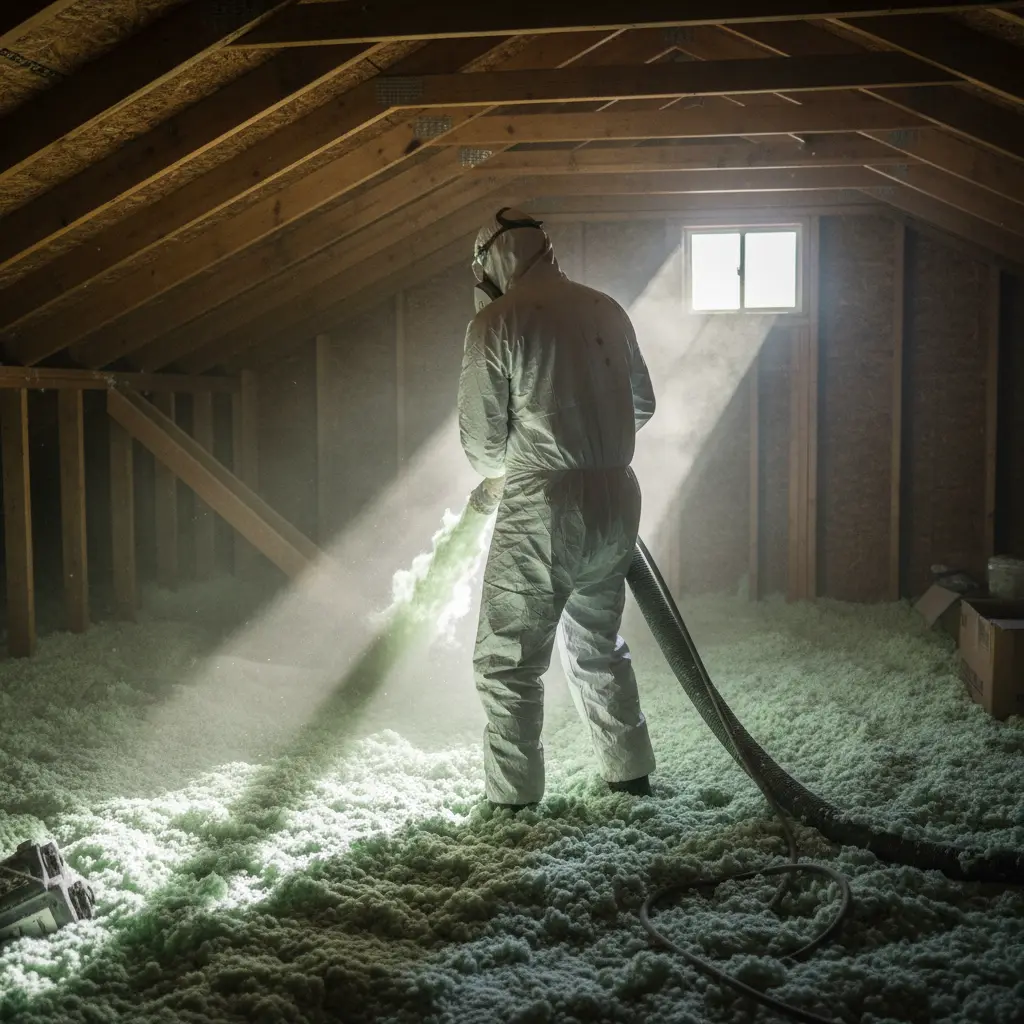
Our team in action — insulation professionals serving Santa Clarita
Blown-In Insulation Methods and Approaches
Open-Blow Attic Application
The most common method used in Santa Clarita’s residential market. Loose-fill material is blown freely across the open attic floor to a prescribed depth. This approach is ideal for the sprawling single-story ranch homes common in Newhall, Castaic, and Granada Hills, where large attic floor areas benefit from rapid, uniform coverage. Typical project depth ranges from 14 to 18 inches of cellulose to achieve R-49 in homes pursuing enhanced energy performance beyond the Title 24 minimum.
Dense-Pack Wall Insulation
Used to insulate enclosed wall cavities without opening walls. Small holes (approximately 2 inches in diameter) are drilled into the wall surface, and insulation is injected at high density to prevent settling. This method is particularly valuable for Canyon Country and Saugus homes built in the 1970s and 1980s with uninsulated exterior walls — a common finding in our Santa Clarita assessments.
Stabilized Blown-In for Sloped Ceilings
For cathedral ceilings and sloped roof lines common in custom homes in Porter Ranch and Stevenson Ranch, stabilized blown-in (a slightly dampened version that adheres in place) prevents material migration. This method maintains R-value integrity in areas where gravity and airflow would otherwise displace dry loose-fill material.
Hybrid Blown-In Over Existing Batts
Many Newhall and Canyon Country homes have original fiberglass batt insulation that, while degraded, is still partially functional. Our hybrid approach adds blown-in cellulose directly over existing batts to bring total R-values up to code without removing serviceable material — reducing both cost and project time by 30% to 40% compared to full removal and replacement.
Ready for Blown-In Insulation? Get Your Free Estimate Today.
Next Level Insulation of Santa Clarita serves Santa Clarita and the surrounding area — we’ll be on-site within 24 hours.
📞 Call (661) 582-0187Blown-In Insulation Cost in Santa Clarita, CA
Understanding the cost of blown-in insulation in Santa Clarita helps homeowners budget accurately and evaluate contractor quotes. Pricing varies based on several key factors specific to the local market.
Typical Price Ranges
- Attic blown-in insulation (open blow): $1.50 to $3.00 per square foot installed, including material and labor. For a typical 1,800 square foot Santa Clarita home, expect a total cost of $2,700 to $5,400.
- Dense-pack wall insulation: $2.50 to $4.50 per square foot due to additional labor for drilling and patching. A 2,000 square foot home with all exterior walls treated may range from $4,000 to $8,000.
- Hybrid top-up over existing insulation: $1.00 to $2.00 per square foot, making it the most cost-effective option for partially insulated homes.
Factors That Affect Pricing in Santa Clarita
- Attic accessibility: Low-pitch rooflines common in 1960s Newhall homes require more labor time than standard walk-up attics.
- Existing insulation removal: Rodent-contaminated insulation removal adds $1.00 to $2.00 per square foot before new material is installed.
- Air sealing requirements: Older homes with extensive bypass gaps require additional sealing labor, typically adding $200 to $600 to the project cost.
- Material choice: Cellulose typically costs 10% to 15% less than fiberglass loose-fill for equivalent R-value coverage.
Available Rebates
Southern California Edison customers in Santa Clarita may qualify for energy efficiency rebates that offset installation costs. Additionally, federal tax credits under the Inflation Reduction Act of 2022 allow homeowners to claim up to 30% of insulation costs (up to $1,200 annually) as a tax credit. Learn more about available insulation rebates
Neighborhoods We Serve in and Around Santa Clarita
Newhall
One of Santa Clarita’s oldest communities, Newhall features housing stock dating to the 1940s and 1950s. Many homes have original or once-upgraded insulation that has settled significantly over 60-plus years. Our teams frequently encounter attics with less than 4 inches of remaining effective insulation depth — well below the R-38 Title 24 requirement. Dense-pack wall insulation is also commonly needed in Newhall’s older wood-frame construction.
Canyon Country
Developed heavily during the 1970s and 1980s, Canyon Country’s tract homes often contain original R-11 to R-19 batt insulation that has never been upgraded. The community’s location deeper in the Santa Clarita Valley means it experiences some of the highest summer temperatures in the region, making adequate attic insulation a priority. Canyon Country insulation services
Stevenson Ranch and Castaic
These newer communities feature larger custom and semi-custom homes built from the 1990s onward. While their insulation is more recent, Stevenson Ranch homes often have complex rooflines with multiple planes and cathedral ceiling sections that require specialized stabilized blown-in techniques. Castaic properties near open space corridors frequently require rodent-proof insulation protocols before blown-in installation. Castaic insulation services
Granada Hills and Northridge
These San Fernando Valley communities, served by our Santa Clarita team, contain significant post-1994 Northridge Earthquake rebuild housing where insulation was sometimes installed hastily. Our assessments in these neighborhoods frequently reveal incomplete attic coverage and unsealed penetrations from rushed post-earthquake reconstruction. Granada Hills insulation services
Blown-In Insulation Maintenance Tips for Santa Clarita Homeowners
- Inspect attic insulation depth annually — preferably before summer. Measure depth at multiple points and compare to your installation certificate. Settling of more than 1 inch per year in cellulose insulation warrants a professional assessment.
- Check for rodent activity each fall — as temperatures drop, roof rats and mice common to the Santa Clarita foothills seek shelter in attics. Tunneling through insulation significantly reduces its effective R-value.
- Keep attic ventilation clear — blown-in insulation should never block soffit vents. Check eave vents twice yearly and clear any insulation that has migrated near vent openings, which is especially common after Santa Ana wind events.
- Seal new penetrations immediately — any new plumbing, electrical, or HVAC work that penetrates the attic floor should be sealed with fire-rated foam before and after insulation is disturbed.
- Monitor for moisture after winter rains — while rare in Santa Clarita, El Niño-pattern winters (such as 2022–2023) can introduce roof leaks that wet cellulose insulation, reducing its R-value and promoting mold growth.
- Schedule a professional re-inspection every 10 years — or after any major weather event, roof replacement, or HVAC upgrade that involved attic access.
- Upgrade after wildfire smoke events — smoke infiltration through attic gaps can contaminate insulation with particulates and odor compounds that do not dissipate over time.
Why Choose Next Level Insulation of Santa Clarita
When you choose Next Level Insulation of Santa Clarita, you are working with a team that has spent over 20 years serving homeowners across the Santa Clarita Valley, San Fernando Valley, and surrounding communities. We understand the specific challenges posed by Santa Clarita’s Climate Zone 9 designation, its aging housing stock, its wildland-urban interface fire risks, and its proximity to major wind event corridors.
Our technicians are trained in California Title 24 compliance documentation, ensuring your project meets current energy code requirements and qualifies for available utility rebates through Southern California Edison. We use commercial-grade blowing equipment to achieve consistent, verified depth — not estimates.
We serve homeowners across Santa Clarita, Newhall, Canyon Country, Castaic, Stevenson Ranch, Granada Hills, Northridge, Simi Valley, Porter Ranch, Chatsworth, Canoga Park, Mission Hills, Sylmar, North Hills, and San Fernando. Whether your home is a 1950s bungalow in Newhall or a 2005 custom build in Stevenson Ranch, we deliver insulation solutions that produce measurable results.
Call us at (661) 582-0187 for a free, no-obligation estimate. Schedule your free assessment today
Frequently Asked Questions About Blown-In Insulation in Santa Clarita
How much does blown-in insulation cost in Santa Clarita, CA?
For a typical Santa Clarita home with an attic between 1,500 and 2,500 square feet, blown-in attic insulation generally costs between $2,700 and $5,400 installed, including material and labor. Dense-pack wall applications cost more due to drilling and patching labor. Hybrid top-up applications over existing insulation are the most affordable option, often ranging from $1,500 to $3,500 for an average home. Final pricing depends on attic accessibility, existing insulation condition, air sealing requirements, and material selection. We provide free, detailed written estimates for all Santa Clarita projects. View detailed insulation cost information
How long does blown-in insulation installation take?
For a standard single-story Santa Clarita home between 1,800 and 2,200 square feet, attic blown-in installation typically takes 4 to 6 hours including air sealing preparation, installation, and final inspection. Larger two-story homes or projects requiring dense-pack wall treatment may take 1 to 2 full days. We work efficiently to minimize disruption to your household.
What R-value do I need for my Santa Clarita home?
Santa Clarita falls within California Climate Zone 9. California Title 24 requires a minimum of R-38 for attic insulation in this zone. However, many energy efficiency consultants and utility programs recommend upgrading to R-49 for maximum performance, particularly given Santa Clarita’s extreme summer temperatures. We assess your existing insulation and recommend the target R-value that balances code compliance with cost-effectiveness for your specific home.
Can blown-in insulation be added over my existing insulation?
Yes — in most cases. If your existing insulation is undamaged, dry, and free of rodent contamination, blown-in insulation can be added directly over it. This is a common and cost-effective approach in Canyon Country and Newhall homes with original but degraded batt insulation. We inspect existing material before recommending whether a hybrid top-up or full removal and replacement is the better approach.
Is blown-in insulation fire-resistant — especially important in Santa Clarita’s wildfire zones?
Yes. Both cellulose and fiberglass blown-in insulation products we use are treated with fire-retardant compounds and meet ASTM E84 flame spread requirements. Cellulose insulation in particular has a Class I fire rating. While insulation in an attic does not directly protect against an exterior wildfire, it significantly reduces heat transfer into the living space and can slow the rate at which a structure loses temperature integrity during a fire event — a meaningful consideration for homes in Santa Clarita’s Very High Fire Hazard Severity Zones.
How do I know if my existing insulation contains asbestos?
Homes built before 1978 in older Santa Clarita neighborhoods like Old Newhall may contain vermiculite insulation or other materials that could contain asbestos. We do not disturb suspected asbestos-containing material without a certified asbestos inspector’s clearance. If your home was built before 1980 and insulation has not been tested, we recommend an asbestos inspection before any attic work proceeds. We can refer you to certified local inspectors serving the Santa Clarita area.
Will blown-in insulation help with noise reduction in my Santa Clarita home?
Blown-in insulation, particularly cellulose, provides meaningful sound attenuation in addition to thermal performance. Dense-pack cellulose installed in wall cavities can reduce sound transmission by an estimated 4 to 8 STC (Sound Transmission Class) points compared to an empty wall cavity. For homes near the 14 Freeway corridor, Soledad Canyon Road, or Magic Mountain Parkway where traffic noise is a factor, this is a secondary benefit worth considering. Learn more about sound insulation options
Do you serve areas outside Santa Clarita proper?
Yes. Our service area includes Canoga Park, Chatsworth, Mission Hills, Sylmar, Granada Hills, North Hills, Castaic, Porter Ranch, Stevenson Ranch, Newhall, Canyon Country, Northridge, Simi Valley, and San Fernando. If you are unsure whether your location is within our service area, call us at (661) 582-0187 and we will confirm availability for your address.
Get a Free Blown-In Insulation Estimate in Santa Clarita Today
Don’t let another triple-digit Santa Clarita summer drain your energy budget and compromise your family’s comfort. Next Level Insulation of Santa Clarita is ready to assess your home, provide a transparent written estimate, and deliver a blown-in insulation solution that meets California Title 24 standards and maximizes your energy savings.
We serve all of Santa Clarita including Newhall, Canyon Country, Castaic, Stevenson Ranch, and surrounding communities throughout the San Fernando Valley. Our team is standing by to schedule your free, no-obligation in-home assessment at your convenience.
Call us today at (661) 582-0187 or submit your information online to request your free estimate. Take your home’s comfort and efficiency to the next level.